
Creature Features (26)

Creature Feature: The Drama Noodle Oscar goes to … the hognose!
If you grew up east of the Rockies, your grandmother may have told tales of deadly “spreading adders,” dangerous serpents that would spread their heads wide when approached and chase down unsuspecting children.
These quasi-mythical creatures rank alongside the Jersey Devil and the Chupacabra for their legendary status, with a glaring exception: the mythos surrounding the “spread-head,” “spreadnatter,” or “blow viper” are based firmly on a real, though harmless animal — the eastern hog-nosed snake.
A live video stream was featured at the top of this article while “Rotty Top” was blooming, July 29-31, 2021.
Another article includes details about that particular plant and the event.
The corpse plant at the University of Tennessee, Knoxville has not bloomed in 20 years
The titan arum (Amorphophalus titanum), native to Sumatra, is remarkable for several reasons.
It is more often referred to by colloquial names, such as corpse flower, rotting corpse plant or carrion plant, because of the strong distinct odor it releases to attract pollinators when it flowers.
No other species of flowering plant has an unbranched inflorescence, or flower-bearing reproductive part, as large as titan arum. Unbranched means that all flowers grow from a single stem; a gigantic one in this case. A record height above corm (underground storage tuber) of 10.5 ft was measured at Bonn Botanical Gardens in June 21, 2013.
A window on ursine motherhood in Cades Cove
As I was descending a wooded hillside in the heart of Cades Cove on a June afternoon, a motionless black bulk caught my eye off to my left.
I turned my attention there, regarded the scene for a few moments, and realized the sprawling blur was a large sleeping bear. A few moments more of inspection revealed three cubs snoozing in the branches overhead.
Bald eagles fly with the Tennessee angels who helped save them from extinction. We must keep them on the wing.
Written by Stephen Lyn Bales American Eagle Foundation founder Al Cecere releases a rehabilitated bald eagle at Ijams Nature Center on Aug. 12, 2016. The foundation named her Summit in honor of UT Lady Vols basketball coach Pat Summit. Photo by Chuck Cooper.
Is the bald eagle’s remarkable comeback fading down the stretch?
(Part one in a series)
It was a damp morning in early spring 2005 when Paul James and I met Linda Claussen at Seven Islands Wildlife Refuge along the French Broad River in east Knox County. Heavy rains had fallen through the night, but the clouds were beginning to break. As we walked down Kelly Lane toward the river the vocalized yearnings of thousands of chorus frogs could be heard singing from the soppy floodplain along the river. Spring was definitely here.
The refuge itself was the brainchild of Linda’s late husband, Pete. In the late 1990s, he formed the Seven Islands Foundation, a privately owned land conservancy, and began setting aside property to be protected and restored to a variety of natural habitats. Most of the acreage had recently been fescue pasture maintained for grazing livestock and hay production.
 Chickadee the bear cub soon after she arrived at Appalachian Bear Rescue in spring 2020. Photo courtesy of Appalachian Bear Rescue
Townsend bear rehab center takes in injured and orphaned black bears for eventual return to the wild.
This story was originally published by Appalachian Voices.
Being a decent neighbor isn’t something that should stop with the humans next door — it also includes backyard animal visitors. Birds, squirrels, deer … and bears!
Appalachian Bear Rescue, a black bear care facility located in Townsend, Tennessee, is dedicated to rehabilitating young bears up to age 2 that need extra care and preparation to reacclimate to their natural environment as healthy, independent members of the wildlife community.
The rescue will celebrate its 25th anniversary this year, and has rehabilitated more than 300 bears from eight different states, including as far as Arkansas.
“While we are based in Tennessee, we would be willing to, and have worked with, wildlife agencies from any state,” says Victoria Reibel, one of the black bear curators at Appalachian Bear Rescue. “We are a bit unique in that aspect.”
The facility aims to re-create a nurturing environment for the bears by offering a nursery, two recovery centers and four half-acre natural outdoor enclosures to explore. The specific area where the bears begin depends upon their age and condition. Newborns start off in the cub nursery and are bottle-fed around the clock, while older bears may be able to go directly out into the spacious outdoor enclosures. These are crafted to closely resemble a forest, with the addition of enrichments such as platforms and hammocks for added interaction. These wild-simulated enclosures are the last step before the bear can be confidently released back into the wild, always near the same area of original rescue.
Great Smokies rangers levy fines against visitor feeding Cades Cove bear peanut butter
Written by Thomas Fraser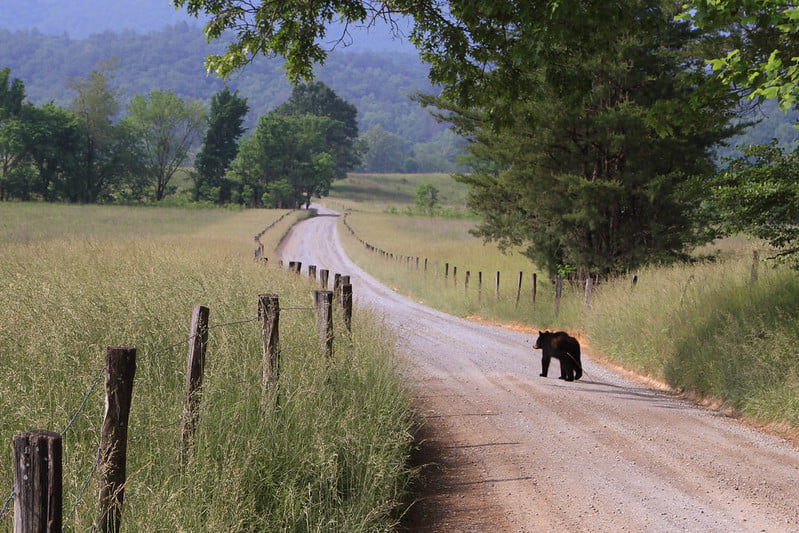 A black bear makes its way through Cades Cove in this National Park Service photograph. This is emblematic of Smoky Mountain bears on the move in the spring; the park service recently took action against a visitor who fed a bear peanut butter in the area. The bear in question had been feeding on walnuts for several weeks prior to the visitors’ introduction of human food, attractions to which can doom black bears because they are more prone to exhibit dangerous behavior toward people and become habituated, and even dependent, on their presence.
Smokies visitor feeding bear peanut butter in Cades Cove was reportedly caught on camera. That aided park rangers’ search for the perp.
A visitor to Cades Cove thought it would be wise to feed peanut butter to a black bear in Great Smoky Mountains National Park, and she got a ticket as a result. The person who received the citation, according to a news release from the park, was identified via video taken by another park visitor.
A National Park Service spokeswoman followed up with Hellbender Press the morning of June 8 in response to some questions. Rangers issued the citation to a 27-year-old woman, one of three adults in the vehicle. If the woman simply pays the fine and doesn’t contest it in court, she will pay a $100 fine, plus a $30 fee
Anyhoo, for Pete’s sake, don’t feed the bears. They’ve got enough problems without us getting involved.
“Managing wild bears in a park that receives more than 12 million visitors is an extreme challenge and we must have the public’s help,” said Great Smoky Mountains National Park Wildlife Biologist Bill Stiver. “It is critical that bears never be fed or approached — for their protection and for human safety.”
The full National Park Service release from Great Smoky Mountains National Park follows:
“Great Smoky Mountains National Park rangers issued a citation to visitors responsible for feeding a bear peanut butter in Cades Cove. Rangers learned about the incident after witnesses provided video documentation. Following an investigation, the visitors confessed and were issued a citation.
“Prior to the incident, the 100-pound male bear had been feeding on walnuts for several weeks along the Cades Cove Loop Road. The bear started to exhibit food-conditioned behavior leading wildlife biologists to suspect the bear had been fed. Biologists captured the bear, tranquilized it, and marked it with an ear tag before releasing it on site in the same general area. Through aversive conditioning techniques such as this, rangers discourage bears from frequenting parking areas, campgrounds, and picnic areas where they may be tempted to approach vehicles in search of food. This includes scaring bears from the roadside using loud sounds or discharging paint balls.
“Park officials remind visitors about precautions they should take while observing bears to keep themselves and bears safe. Until the summer berries ripen, natural foods are scarce. Visitors should observe bears from a distance of at least 50 yards and allow them to forage undisturbed. Bears should never be fed. While camping or picnicking in the park, visitors must properly store food and secure garbage. Coolers should always be properly stored in the trunk of a vehicle when not in use. All food waste should be properly disposed to discourage bears from approaching people.
“Hikers are reminded to take necessary precautions while in bear country including hiking in groups of three or more, carrying bear spray, complying with all backcountry closures, properly following food storage regulations, and remaining at a safe viewing distance from bears at all times. Feeding, touching, disturbing, or willfully approaching wildlife within 50 yards (150 feet), or any distance that disturbs or displaces wildlife, is illegal in the park.
“If approached by a bear, park officials recommend slowly backing away to put distance between yourself and the animal, creating space for it to pass. If the bear continues to approach, you should not run. Hikers should make themselves look large, stand their ground as a group, and throw rocks or sticks at the bear. If attacked by a black bear, rangers strongly recommend fighting back with any object available and remember that the bear may view you as prey. Though rare, attacks on humans do occur, causing injuries or death.
“For more information on what to do if you encounter a bear while hiking, please visit the park website at www.nps.gov/grsm/naturescience/black-bears.htm. To report a bear incident in the park, please call 865-436-1230.
“For more information about how to be BearWise, please visit www.bearwise.org. Local residents are reminded to keep residential garbage secured and to remove any other attractants such as bird feeders and pet foods from their yards. To report a bear incident outside of the park, please call Tennessee Wildlife Resources Agency or North Carolina Wildlife Resources Commission.”
This story has been updated with information supplied by the National Park Service in response to questions about the case from Hellbender Press.

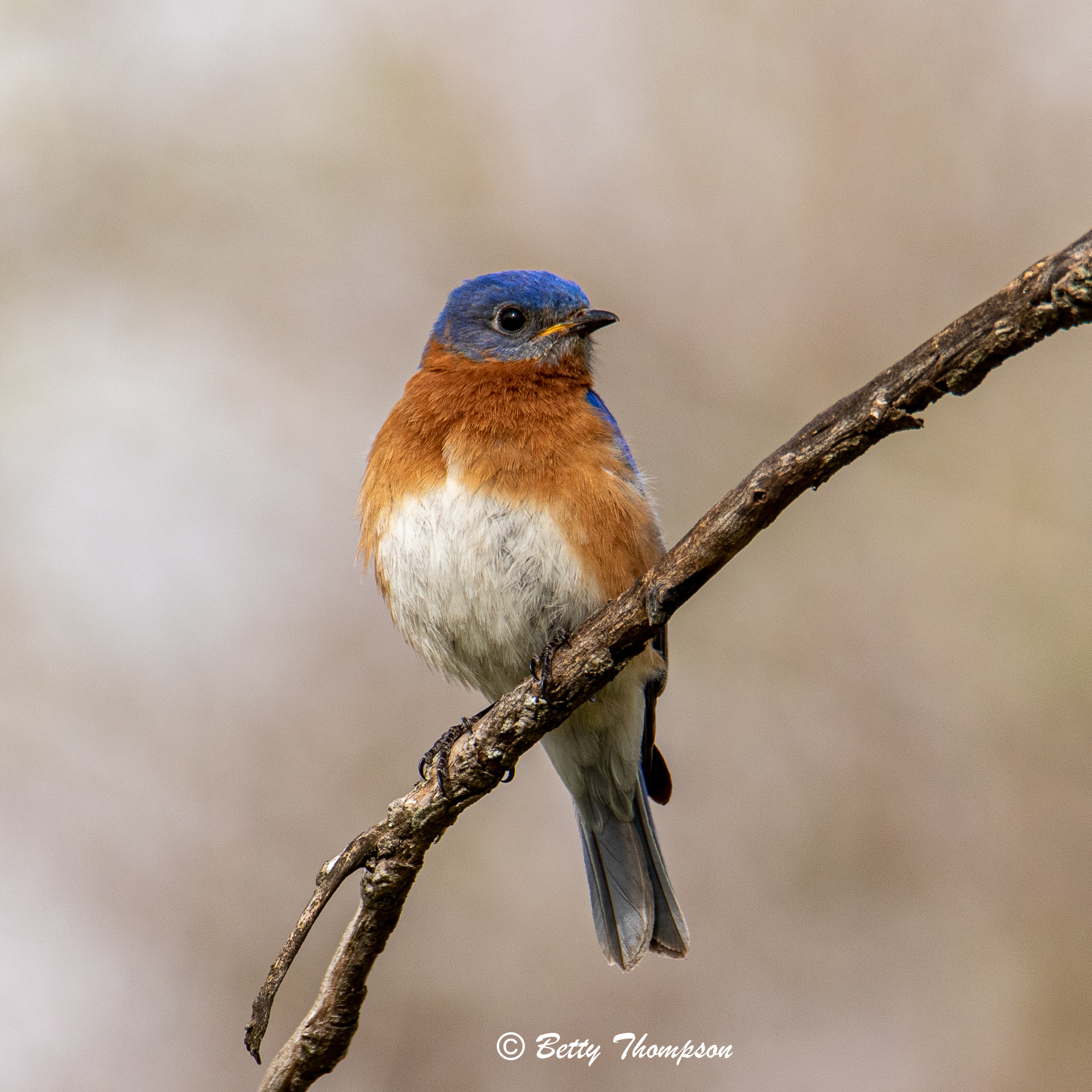
One man’s initial efforts led to the bluebird’s recovery
Eastern bluebirds have long been cherished.
Henry David Thoreau was this country’s first widely regarded and, perhaps, foremost nature writer. He rigorously kept a journal, recording the happenings around his home in Concord, Massachusetts. On April 26, 1838 he scribed a poem that began, “In the midst of the poplar that stands by our door, we planted a bluebird box, and we hoped before summer was o’er, a transient pair to coax.”
Thoreau ended the long entry with the lines, “The bluebird had come from the distant South, to his box in the poplar tree, and he opened wide his slender mouth, on purpose to sing to me.”
It has now been 183 years since the master of Walden waxed poetic about Eastern bluebirds, but his words seem just as appropriate today as they were then because people still love the birds that “carry the sky on their backs” and a song in their hearts.
 Dr. Brian MIller
MTSU researchers document hellbender’s accelerating decline in Middle Tennessee
(Author’s note: I was aware of the hellbender before interviewing Brian Miller, but did not know the giant salamanders were present on the Highland Rim of Tennessee. Subsequent reading and interviews with other researchers, including Dr. Bill Sutton at Tennessee State University, Nashville, confirm Miller’s statements that hellbenders are vanishing from large portions of Tennessee, and Missouri. The healthy populations in portions of the Great Smoky Mountains and Cherokee National Forest may be an exception to a general trend toward extirpation and, ultimately, extinction).
Brian Miller has been researching hellbenders for decades. He serves on the faculty of Middle Tennessee State University where he teaches in the biology department and mentors younger researchers, many of whom publish their research.
He has even developed a digital “Guide to the Reptiles and Amphibians of Middle Tennessee.” The guide began more than 30 years ago as a dichotomous key for students in his vertebrate zoology class and now includes hundreds of photographs and exceeds 400 pages.
Dr. Miller researches the hellbenders of the Highland Rim, the upland that surrounds Nashville and the Great Basin. Populations of hellbenders in streams of this region are perhaps Tennessee’s most endangered.
QUESTION: I noticed that you specialize in herpetofauna. Most of the research listed on your faculty page is focused on amphibians, but with some papers on snakes. Can you comment about your research?
ANSWER: You are correct that amphibians are my primary research interest, particularly salamanders. However, I also have strong interests in reptiles, and my students and I have conducted research on various species of snakes and turtles.
When did you become interested in hellbenders?
Hellbenders have been of interest to me since I first encountered them while enrolled in a course on herpetology at the University of Missouri in 1977. I was fortunate that the professor of that course, Dean Metter, was involved with research on hellbenders and I began to assist with his research in 1978, in collaboration with Robert Wilkinson at Southwest Missouri State University in Springfield, Missouri.
Chris Petersen was working on his master’s degree with Dr. Wilkinson at that time and he matriculated to the University of Missouri a couple of years later to start on his Ph.D, which was also with hellbenders. Chris and I spent time in the field gathering data for his Ph.D. project until I moved to Washington State to work on my Ph.D.
I was hired into the biology department at Middle Tennessee State University in 1989 and began working with hellbenders in this state in 1990. At that time, I was able to locate populations in several rivers in Middle Tennessee, including a large population in the Collins River. I decided to concentrate my efforts on this population and one in the Buffalo River.
Of note, the population I worked with in the Collins River was dominated by large adults, whereas the population in the Buffalo River consisted of many age classes, including young individuals.
The Collins River situation was like what I was familiar with in Missouri and Arkansas populations. Unfortunately, by the early 2000s the population I was working with in the Collins River was gone; however, populations remain in the Buffalo River. My research with hellbenders during the past decade has been concentrated in streams in the Western Highland Rim.
Do you work with both subspecies, the Ozark, and the Eastern hellbender?
I worked with both subspecies while a student at the University of Missouri when assisting with projects in the Metter lab, but since I moved to Tennessee, I have worked only with Tennessee populations.
What do you perceive as the greatest threats to hellbender populations?
I am not certain why most populations of hellbenders are in decline rangewide, but suspect that habitat alteration, including sedimentation, and disease are involved in many if not all areas where declines are occurring. Lack of recruitment of young is a common theme of populations that decline.
The Appalachian Voice: Critter corridors aspire to provide Safe Passage for roaming mountain wildlife
Written by Frances Figart  Bears stand by a roadside guardrail. Bridget Donaldson, Virginia Transportation Research Council
Safe Passage initiative calls for wildlife and human protections along mountain highways
Jean Loveday is driving her husband, Tom, home from a doctor’s appointment in Johnson City, Tennessee. Their Toyota pickup truck is winding along Interstate 26, not far from the North Carolina state line north of Asheville.
Suddenly Loveday sees something black tumbling down the mountain and out into the highway in her peripheral view. “Oh no, Tom, oh no!” she mumbles. Loveday realizes it’s a bear cub hurtling toward them. She attempts to avoid hitting it by steering into the median, but vehicle and animal seem destined to collide.
“It all happened so fast,” she says today. “I don’t know where its mother was, whether the cub was following her or on its own. We stopped. It moved for a few minutes, and then was still. All I could think for days was, ‘I killed a bear cub!’ I hope I never, ever have to go through that again.”
Loveday is overwhelmed with emotion as she relates this sad memory, one shared by many motorists in the Southern Appalachians.
“I don’t care where you are on the political spectrum, no one wants to hit an animal with their vehicle,” says Jeff Hunter, senior program manager for National Parks Conservation Association, an organization devoted to protecting and enhancing the national parks system for future generations.
“Human infrastructure is making it increasingly difficult for wildlife to follow their natural patterns of movement across the landscape,” says Hugh Irwin, a landscape conservation planner with The Wilderness Society who raised concerns back in the 1990s about I-40 being a barrier to wildlife movement. “Historically too little thought and planning has gone into wildlife needs, and our current infrastructure fails to provide for wildlife passage.”
Passionate discussions led to action, and soon more than 80 individuals from nearly 20 federal, state, Tribal, and non-governmental organizations were collaborating to make this section of roadway more permeable for wildlife and safer for people.
Roadkill’s “Pernicious Twin”
The intersection of roads and wildlife is a safety issue that is not unique to North Carolina and Tennessee. According to the Federal Highway Administration, an estimated two million large mammals are killed on roads in the United States each year, resulting in more than 26,000 human injuries and at least 200 human fatalities.
For years, road ecologists around the world have been working to mitigate highways that were originally designed without consideration for wildlife. Europe, Canada, Mexico, and many U.S. states have already created effective wildlife road crossings. Recent articles and videos featuring large wildlife overpasses in Utah and Texas have been shared widely on social media.
Senior Research Ecologist Marcel Huijser (pronounced ‘Houser’) with the Western Transportation Institute at Montana State University in Bozeman has contributed to road ecology studies for more than two decades. He cites three main reasons why people care about this issue: the desire for wildlife conservation, concern for human safety, and economics. “No matter who you are, where you live, or what you do for a living, you’re going to care about at least one of these,” he says.
On November 26, 2019, The Atlantic ran an auspicious road ecology article by Ben Goldfarb titled “How Roadkill Became an Environmental Disaster.” Focusing on the giant anteaters of Brazil, whose range is—you guessed it—bisected by a huge highway, the epic, riveting story introduces readers to Evelyn the anteater and a cast of road-weary researchers. One particular Goldfarb quote became the motto for researchers assessing wildlife movement and mortality in the Pigeon River Gorge: “Collisions may be road ecology’s most obvious concern, but fragmentation is roadkill’s pernicious twin.”
Conservationists point out the gravity of individual animals being killed on roads. But when they no longer try to cross, it can signal an even more dire situation.
“When wildlife finally stops even trying to cross, the highway has become a barrier,” says Hunter. “The ‘barrier effect’ is not to be confused with the concrete Jersey barriers that prevent many individual crossings. When a whole population stops crossing the road, that means their habitat is now fragmented, preventing the healthy genetic exchange that species need to thrive.”
Ron Sutherland works to restore, reconnect and re-establish wildlife corridors that have been fragmented throughout the eastern United States in his role as chief scientist with Wildlands Network, the organization that kicked off discussions about mitigation to I-40 in 2015. He defines habitat connectivity as the degree to which organisms are able to move freely across the landscape.
“Habitat connectivity can be very high, such as in a remote and intact wilderness,” he says, “or it can be very low, such as in a city park surrounded on all sides by busy highways.”
Sutherland points out that people often get wildlife corridors and wildlife road crossings confused.
“A wildlife corridor is the term we use for a defined movement pathway that, if protected or restored, would provide essential habitat connectivity for one or more species,” he says. “They can be easy to see—such as a vegetated trail alongside a roadway—or nearly invisible and defined only by the movements of the animals.”
A wildlife road crossing, on the other hand, is “a structure that is designed to allow wildlife to safely cross over or under a busy road,” he says. “So, of course it follows that one of the best places to put wildlife road crossings is where you have a wildlife corridor that gets cut off by a highway.”
Read the rest of the story at The Appalachian Voice.
Into the Royal Blue: Public and private lands crucial for cerulean warbler preservation
Written by Stephen Lyn Bales
Ephemeral birds of lasting beauty dependent on Tennessee forest
Think azure. A male cerulean warbler is sky blue. And to see one, you have to climb to the tops of certain Appalachian ridges and look toward the wild blue. To see one is to see a bit of heaven in an eight-gram bird.
East Tennessee’s Royal Blue Unit is not named in honor of the cerulean warbler but it's appropriate to think so. The land parcel is part of the North Cumberland Wildlife Management Area and is one of the few places — very few places — the sky-blue passerines still nest in North America. It is estimated that 80 percent of the remaining population nests in the Appalachians.
The cerulean is the fastest declining migratory songbird in North America, said ornithologist David Aborn, an assistant professor of biology, geology and environmental science at UT Chattanooga. The Breeding Bird Survey estimates that cerulean warbler population declined by 70 percent between 1966 and 2008.
“The species is not in danger of imminent extinction, but is rare enough to warrant concern, and its future is not assured,” the U.S. Fish and Wildlife Service reported in 2020.
Currently a management goal of “no net loss” is in place. “Management programs can be instituted at the present time that do not require major changes in land-use practices, but do consider silviculture appropriate to producing habitat for the species,” the report concluded.
The American Bird Conservancy and ProAves Colombia purchased 500 acres of rural land identified as wintering sites for the migratory bird. The Cerulean Warbler Reserve is the first in Latin America set aside for a migrant bird. It’s a start. But the beautiful bird faces many challenges here and abroad.
More...
Brood X cicadas to emerge this spring for last gestures of beauty, reproduction and death
Written by Stephen Lyn Bales
After 17-year wait, millions of cicadas are coming
“Do not go gentle into that good night, Old age should burn and rave at the close of day; Rage, rage against the dying of the light." — Dylan Thomas
Imagine living 99.99 percent of your life underground largely unseen and then emerging above the earth for one last grand gesture of panache and reproduction and death.
This year it’s time for the 17-year cicada Brood X to pop up. The last time they appeared in Knox County was 2004. Periodical cicadas are related to the more frequently seen and heard Dog Day cicadas or harvestflies that appear every July.
Periodical cicadas remain subterranean for years. Here in the Tennessee Valley, we actually have two populations that overlap. Brood X, known as “the big brood” that will be seen and heard this summer, emerges every 17 years. Brood XIX climbs from the ground every 13 years, and is not scheduled to reappear in the valley until 2024.
Annual cicadas look like large green flies. Periodical cicadas are more colorful: bluish with red eyes and gold wings. Both groups are in the insect order Hemiptera and spend their larval stage underground tapping into tree roots for nourishment.
At this moment, this year’s brood is inching its way upward. The cicadas lie in wait below the surface until the right conditions — day length and temperature — signal it’s time to move out. If you happen to be in an area where the cicadas are, you’ll see hundreds, maybe thousands, all over the place. It’s truly one of nature’s most spectacular occurrences.
They usually begin to climb from the ground at dusk in early May and quickly scurry to a nearby tall object that they climb and shed their last larval skin. After their wings dry, the new adults leave behind the husk of their former life and fly away. For the next few weeks, the males buzz to attract the females. After they mate, the females lay eggs in tender branches. All the adults die in a few weeks; when the eggs hatch the tiny larva crawl to the ground to disappear for another 17 years.
Crazy monkey love or amorous owls?
Written by Rob Hunter A barred owl peers from its winter hideaway. Rob Hunter/Hellbender Press
February kicks off the season of love for region's barred owls
The frosty woods may be relatively quiet today, but soon the hilltops and hollers will echo with deep, resonant voices.
Barred owls (Strix varia) are our second-largest resident owl here in the Southeast, second only to the great horned owl (Bubo virginianus). With their fluffier plumage, doe-eyed countenance and round profiles lacking ear tufts, barred owls don’t have quite the fierce appearance of their more formidable neighbors. They’re also generally easier to observe. Often active in the daytime and fond of low perches, barred owls occasionally make themselves visible to lucky woodland wanderers. More often, though, they are heard rather than seen. Their breeding season may extend into summer, but courtship generally fires up in February and peaks in March. This is my favorite time to seek them out on the woodland slopes, usually near water, that they call home.
Barred owls are not easy to find per se, but they definitely make themselves more conspicuous when looking for love. Their best-known call is an eight-beat hoot often verbalized as “Who cooks for you? Who cooks for y’all?” with the final “y’all” drawn out in a dramatically descending, tremulous wail. They sometimes give the wail alone or as crescendo following a series of ascending hoots.
To hear any of these sounds echoing through a twilight woods can fill one with awe, but they give another vocal performance that is generally only heard when an amorous pair of owls meets up. This call, for lack of a better term, is often referred to simply as the “monkey call.”
A caterwauling cacophony of simian sounds explodes from a dense grove of hemlocks. Have chimpanzees escaped from the local zoo? Nope, just a couple of night birds seeking romance. People who hear these calls without knowing the caller are often understandably perturbed. More than once I’ve been awakened suddenly in my tent when such a liaison takes place in a tree over my campsite, and I can say it’s a bit unsettling, even knowing the avian source.
So when you’re walking in the woods over the next few weeks, keep an eye and an ear out for these lovebirds as they’re at their most vocal. And if you hear what sounds like a troop of monkeys hailing the setting sun, just remember that, more likely than not, you’re just hearing the music of owls in love.
Audubon has a 2-minute podcast for you to
‘Hear the Many Different Hoots of the Barred Owl’