The Environmental Journal of Southern Appalachia

Scott Schlarbaum speaks for the trees and the future of Tennessee forests

Written by

IMG 8094Tennessee Tree Improvement Program director Scott Schlarbaum stands among a collection of grafted and cloned native trees at the program’s grafting facility off Alcoa Highway. Thomas Fraser/Hellbender Press

2-minute video on hemlock genetic diversity conservation added to this article on September 2, 2021

UT Tree Improvement Program prepares for its greatest grafting season yet

“What you have here is the future of Tennessee forests,” said Scott Schlarbaum, a professor and director of the University of Tennessee Tree Improvement Program.

You can tell from a chuckle he thinks his statement might sound hyperbolic and a bit dramatic, but it’s really not.

He gestured across an unassuming but important UT facility just off Alcoa Highway tucked within the East Tennessee AgResearch and Education Center that will be the main base for a historic tree-grafting effort that will commence this winter. 

The goal: Create trees with high-quality genetic traits ranging from wildlife and habitat qualities to timber value.

Heavy traffic hissed down the nearby highway as it passed by the modest understock yard, greenhouse, raised beds and small house containing offices used as the main grafting facility for the UT Tree Improvement Program (TIP). At least 50,000 vehicles pass by the site every day but most drivers and passengers are oblivious to the existence of this small but important outpost of forest conservation skirted by a Knox County greenway.

The Tree Improvement Program was first established in 1959. It survives as a notable exception to the cost-cutting of such projects in other states at both university and government levels.

“These days we tend to look only at the short term. UT did not.”

Beginning in January, Schlarbaum, director of the program since 1983, will oversee grafting efforts on some 3,600 trees. Last year, during which TIP efforts were disrupted by the Covid-19 pandemic, about 2,000 trees were grafted.

“We are gearing up for our biggest grafting year ever. That’s a huge deal,” Schlarbaum said.

The collection of seedlings in the understock yard awaiting grafting outside the greenhouse were transplanted from the East Tennessee State Nursery operated by the state forestry division in Delano on the Hiwassee River. The trees will be grafted with scion wood from regional trees with proven genetically superior fruit, timber and other characteristics. To close the circle, as the trees eventually flourish in orchards across the state, the seed will be available for sale to land owners or managers at the state nursery.

The program focuses mainly on hardwoods, representing oak, cherry, butternut, maple, hickory and other species ultimately destined for state and private orchards or other sites in west, middle and east Tennessee. 

That includes some species that will be part of a new orchard on Jack Daniels property near Lynchburg in Middle Tennessee. The University of Tennessee entered into an agreement with Jack Daniels distillery in 1998 to ensure the world-renowned distillery never runs out of the sugar maple and white oak crucial to its charcoal-mellowing process.

Among the understock is progeny from old historical trees, such as the massive white oak near the Native American burial mound on the UT agriculture campus, as well as the so-called Adair oak. That massive white oak, named after pioneering East Tennessean John Adair, grows in a graveyard in Fountain City. 

Some of the trees are being improved and propagated as stopgaps against the potential loss of individual species to global warming and climate change.

Overcup oak native to Middle Tennessee, which is uniquely adapted to wet habitats, is an example. It has poor timber value, but is valuable from an ecological standpoint.

“With climate change, those pockets are going to go away if there’s a drying trend.” TIP is establishing an overcup oak stand at the Jack Daniels orchard.

The bottomland plain at the Jack Daniels property also lends itself to butternut and bald cypress, both of which will likely be further stressed by regional warming trends. The butternut stands could also eventually provide some clues to resistance against a canker that has threatened the species over the last few decades.

Another short-term plan is to further establish a West Tennessee swamp white oak orchard in hopes of restoring the vanishingly rare tree to its former range.

In addition to improving and protecting native tree species for a variety of contemporary uses and reasons, TIP ensures a genetic bank of sorts exists well into the future. It’s a hedge against climate change or other threats such as exotic insects or similar invasive attacks.

Hemlock, for instance, is under an enduring threat from the hemlock woolly adelgid, an invasive insect native to China. Clones of hemlocks representing multiple East Tennessee counties are being raised at the South Knoxville facility for eventual distribution to Tennessee Valley Authority land.

IMG 8114 2These hemlock seedlings cloned by the UT Tree Improvement Program will be moved to TVA land to be preserved as a genetic reservoir should the trees be eradicated by hemlock woolly adelgid. Thomas Fraser/Hellbender Press

The viability of hemlock in the region is questionable, as evidenced by the skeletons of ancient dead hemlocks in formerly old-growth forests such as Albright Grove in Great Smoky Mountains National Park.

Thanks to the efforts of TIP there will be healthy, young hemlocks ready to replace those lost giants over time should the adelgid be vanquished.

Trees that provide ample food for wildlife are also a big goal of TIP’s enhancement efforts. 

Black cherry and wild pecan, which (relative to commercially cultivated pecan varieties) produce smaller nuts that “slide right down a turkey’s throat,” are also set for grafting next year.

The 2022 grafting effort will be labor intensive. It involves seeking out scion wood and the actual grafting, tagging and care of the trees. 

While TIP efforts are funded by a variety of sources, and enjoy the leverage of overall UT resources, Schlarbaum operates lean and mean and has grown accustomed to make do to deliver his goals.

“We run like the Marine Corps: Improvise, adapt and overcome,” he joked.

Seed and grafted trees need to be refrigerated, and when he first arrived at UT, he sought out cast-off refrigerators from the UT housing department for that purpose. Thirty-eight years later, two are still in operation.

The program is costly by a thousand cuts: TIP currently has $40,000 invested in plant containers alone (and shipping costs are a killer). Most of the program’s work — which has a “hard cash” annual budget of about $150,000 — is funded by recurring grants from independent sources, such Brown-Forman (which owns Jack Daniels) and the Shackleford Foundation. Operational and other support is also provided by TVA, the state division of forestry, and the Biology Service Facility at UT.

“We have a tremendous support network,” Schlarbaum said. “It’s not just me.”

Still, he said somewhat wistfully as birds chattered in a willow tree near the greenhouse: “I wish we could double or triple the output of this program,” he said.

He wants the program to cultivate more woody shrubs and bushes such as beauty bush that provide food and habitat for wildlife. They could then be procured, as well as traditional hardwood timber species, by landowners from the state nursery. 

A lot of forest remains, he notes, but much of that is either unproductive secondary forest or has been high-graded, meaning the largest, most mature trees have been removed.

More aggressive human intervention in the management of our remaining healthy woodlands is inevitable, Schlarbaum said, though he admits he’s fighting something of a holding action from his small outpost near the Tennessee River. 

“There’s no doubt our forest land will be decreased,” especially as people chase a tendency to live near water in prime forest. “The forest land base is shrinking because of urban sprawl,” and other development, he said, and notes additional threats to forest health from invasive species, exotic pests, and climate and habitat changes.

“If we want to maintain our wood quality and diversity of forest products, we are going to have to go to (increased) domestication.”

“When you look at history, more people mean more pressure on natural resources,” and the state of Tennessee needs a forest-protection plan and politicians and leaders with a long view to see beyond their terms in office or careers, he said.

He also wonders, just a few years from retirement, what will become of his life’s work when he’s gone, and who will carry it on. 

The traffic continued to roll by earth movers on an ever-widening Alcoa Highway and an airplane choked off the sound of birdsong as Schlarbaum returned to tend to the future of our forests.
 

Rate this item
(3 votes)
Published in News

Related items

  • 5 big threats to the world’s rivers
    in News

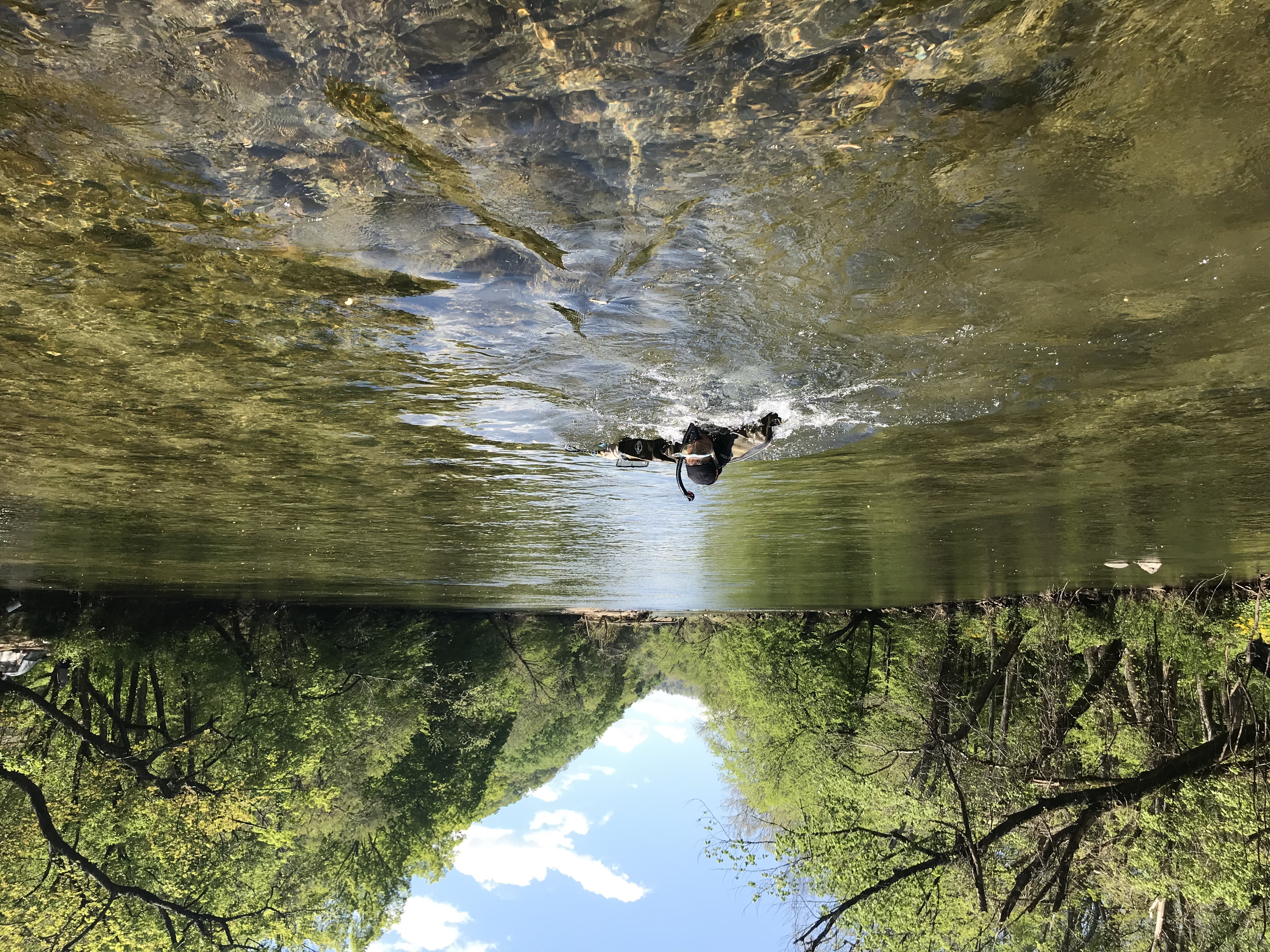
    fresh water Conservation FisheriesA biologist with Conservation Fisheries surveys a stretch of Little River near Walland, Tennessee to determine fish viability and identify rare species for transplantation. Thomas Fraser/Hellbender Press

    Human activities have imperiled our waterways — along with a third of freshwater fish and other aquatic species

    This story was originally published by The Revelator.

    If we needed more motivation to save our ailing rivers, it could come with the findings of a recent study that determined the biodiversity crisis is most acute in freshwater ecosystems, which thread the Southern landscape like crucial veins and arteries.

    Rivers, lakes and inland wetlands cover 1 percent of the Earth but provide homes for 10 percent of all its species, including one-third of all vertebrates. And many of those species are imperiled — some 27 percent of the nearly 30,000 freshwater species so far assessed by the IUCN Red List. This includes nearly one-third of all freshwater fish.

    How did things get so bad? For some species it’s a single action — like building a dam. But for most, it’s a confluence of factors — an accumulation of harm — that builds for years or decades.

  • Citizen scientists are taking stock in Smokies, and the inventory keeps increasing
    in News

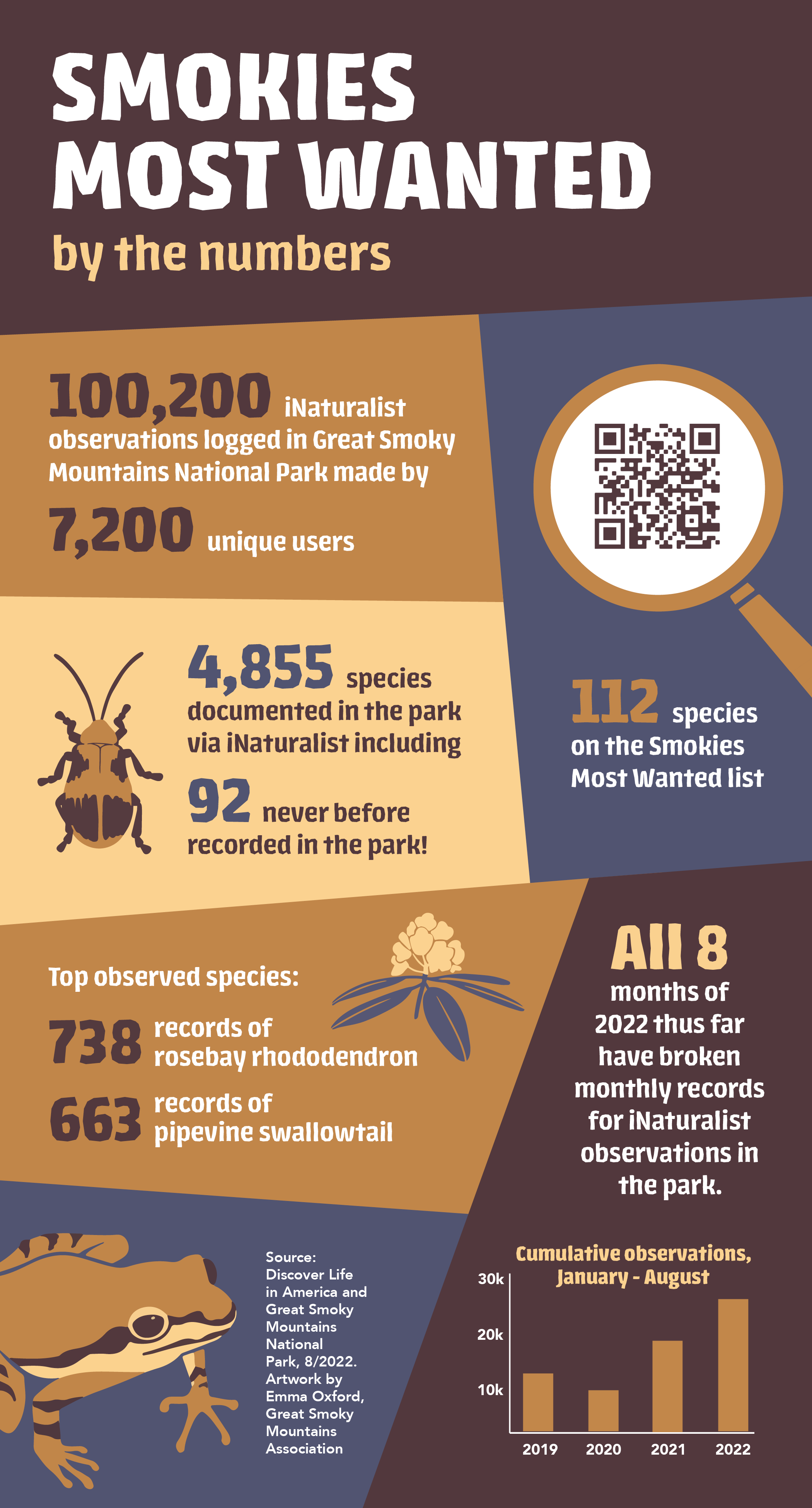
    1 smokies most wanted infographic credit Emma Oxford GSMA

    This story was provided by Great Smoky Mountains National Park.

    Next demonstration on Thursday, Oct. 20

    GATLINBURG — Great Smoky Mountains National Park is celebrating the success of a community science project led by nonprofit partner Discover Life in America (DLiA) called Smokies Most Wanted. The initiative encourages visitors to record life they find in the park through the iNaturalist nature app. DLiA and the park use these data points to map species range, track exotic species, and even discover new kinds of life in the park. 

    “iNaturalist usage in the Smokies has skyrocketed from just four users in 2011, to 3,800 in 2020, to now more than 7,100 users,” said Will Kuhn, DLIA’s director of science and research. 

    In August, the project reached a milestone, surpassing 100,000 records of insects, plants, fungi, and other Smokies life submitted through the app. Among them are 92 new species not previously seen in the park.

  • There’s a whole world in the dirt beneath your feet
    in News
    Dust bowl soilThe Dust Bowl of the 1930s resulted in the displacement of tons of soil in the midst of a drought similar to the one that grips the Southwest today. Library of Congress
     

    Dirt is far from just dirt. It’s a foundation for life.

    This story was originally published by The Revelator.

    Look down. You may not see the soil beneath your feet as teeming with life, but it is.

    Better scientific tools are helping us understand that dirt isn’t just dirt. Life in the soil includes microbes like bacteria and fungi; invertebrates such as earthworms and nematodes; plant roots; and even mammals like gophers and badgers who spend part of their time below ground.

    It’s commonly said that a quarter of all the planet’s biodiversity lives in the soil, but that’s likely a vast understatement. Many species that reside there, particularly microorganisms such as viruses, bacteria, fungi and protists, aren’t yet known to science.

  • National park reopens Cades Cove road traced for centuries

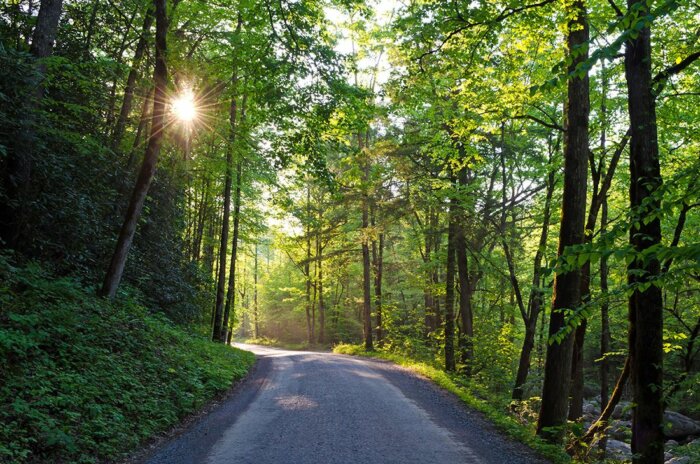
    Parson Branch RoadParson Branch Road in Great Smoky Mountains National Park was reopened May 26 after a six-year closure. National Park Service 

    Parson Branch Road had been closed since 2016 because of washouts and danger from trees killed by the hemlock woolly adelgid

    This article was provided by Great Smoky Mountains National Park Public Information Officer Dana Soehn.

    CADES COVE — Great Smoky Mountains National Park officials celebrated on Thursday (May 26) the reopening of Parson Branch Road with a ribbon-cutting event honoring the crew who performed the needed work and the Friends of the Smokies who provided critical funding to support the efforts. The historic gravel road, originally constructed in 1838, is now reopened to the public after a six-year closure. 

    “We are pleased to reopen Parson Branch Road in time for the 2022 summer season,” said Deputy Superintendent Alan Sumeriski. “Not only does this restore access to one of the most special places in the Smokies, it also allows another opportunity for people of all abilities to spread out and explore less traveled areas of this very busy park.”  

  • Smokies to reopen Parson Branch Road after massive clearance of trees killed by exotic insect

    CADES COVE — Great Smoky Mountains National Park on Thursday plans to officially reopen Parson Branch Road, first cut through the ridges around Cades Cove 180 years ago.

    The narrow, 8-mile one-way mountain road out of Cades Cove to U.S. 129 has been closed since 2016 following washouts that were compounded by a steady diet of collapsing diseased and dead hemlocks. A ceremony is set for Thursday morning at the beginning of the road in Caves Cove.

    The road was closed because of the tree hazards and damage to the road surface. The hemlocks succumbed to the hemlock woolly adelgid, an exotic insect that has wreaked havoc on hemlock stands and their accompanying ecosystems.

  • Another look at the parallel war Russia is waging against the natural environment
    8i8pjciusqt81
     
    New York Times: Ukraine environmental holocaust just the latest in ways war scars the Earth

    Open armed conflict understandably abrogates immediate concerns about the natural environment.

    Despite the tens of thousands of human deaths already caused by Russia’s invasion of Ukraine, the war’s impact on natural systems can’t be understated.

    In some cases, Russian troops have taken up positions in natural parks and protected ecological areas in Ukraine. The Black Sea coast is an important remaining area of biodiversity in Europe. Ukrainian counterattacks, while understandable, have also inflamed environmental consequences.

    There are also immediate risks to human respiratory health from the fires sparked by attacks on fuel depots and chemical facilities.

    War’s negative environmental impacts are by no means a new thing: See the use of Agent Orange by the U.S. in Vietnam and the wasteland of burning oil fields left behind in the Gulf War.

    War is bad for every living thing.

  • Fire, fog, floods: Scientists probe climate-change impacts in Smokies
    in News

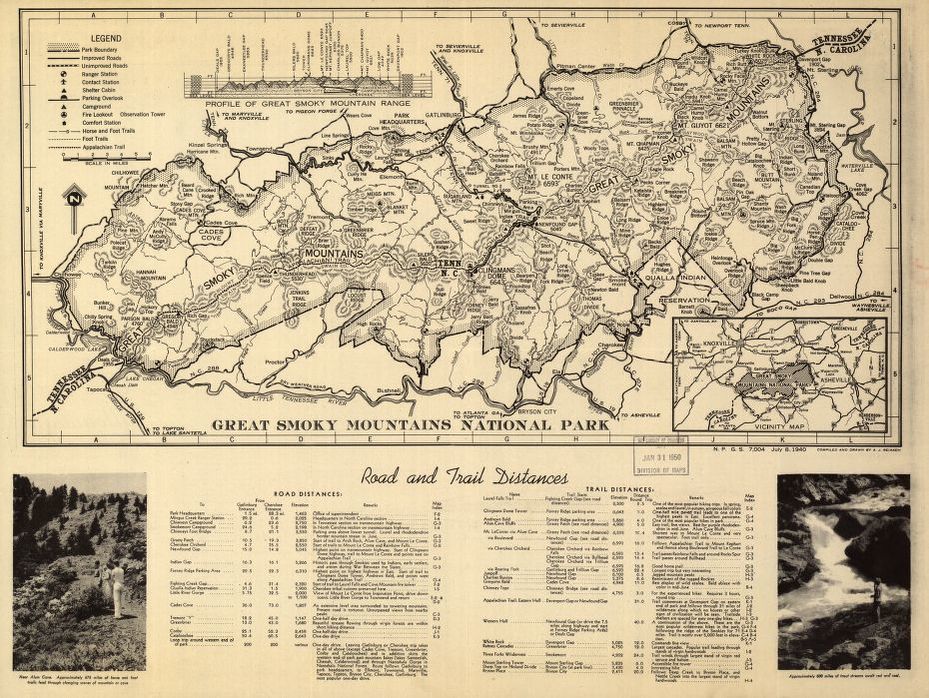
    iiif service gmd gmd390 g3902 g3902g np000243 full pct 12.5 0 defaultMany climate-change related issues have appeared since publication of this vintage map of Great Smoky Mountains National Park. Library of Congress

    Invasive insects are among the vanguard of noticeable climate changes in America’s most-visited national park

    GATLINBURG — Ants scurry beneath the carpet of last year’s leaves in Great Smoky Mountains National Park. The native ants are busy spreading the seeds of violets and bloodroot, preparing a new carpet of spring wildflowers to draw thousands of visitors.

    But the local insects aren’t alone under there. They have become prey to venomous Asian needle ants that also prowl the leaf litter.

    These invaders dine on termites, other ants and insects, while stealing habitat from them. Unlike invasive fire ants, needle ants can live in pristine forests and build large colonies with hundreds of queens. But like fire ants, needle ants have a painful sting that can trigger an allergic reaction. 

    Climate change is expected to make it easier for invasive species like needle ants to upset the delicate balance of this temperate rainforest full of rare plants and animals. That’s just one example.

  • New digital maps outline precious pockets of remaining U.S. biodiversity and the threats they face
    in News

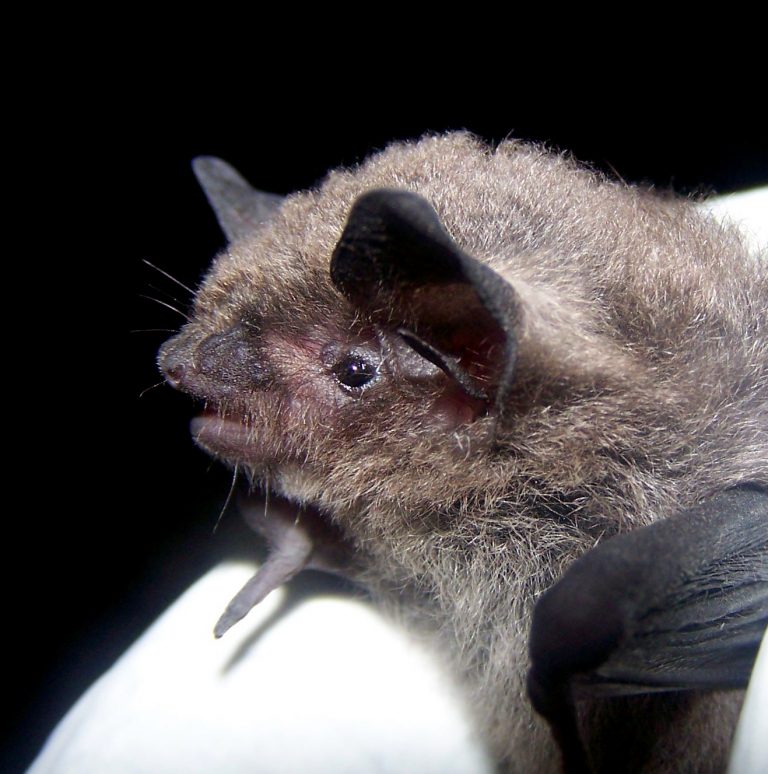
    Indiana batThe endangered Indiana bat is among threatened and endangered species in Great Smoky Mountains National Park.  U.S. Fish and Wildlife Service

    Southern Appalachians show red as a warning on new detailed biodiversity maps 

    This story was originally published by the Sylva Herald.

    SYLVA — Great Smoky Mountains National Park has long been known for its abundance of different species of flora and fauna.

    Credit old mountains in a warm, sunny and wet region with varying types of climate, soil and stone for that large number.

    “The park is almost certainly the most biodiverse national park in North America,” said Paul Super, national park science coordinator. “And certainly the most studied of any national park.”

    A group of environmental organizations recently put together a series of maps illustrating the regions with the biggest threats to their biodiversity, and the area around Jackson County and the national park showed up in the red, showing risk. One such map, based on NatureServe data, is among the most detailed maps of endangered and threatened species ever produced.

  • Parson Branch Road improvements under way in Smokies

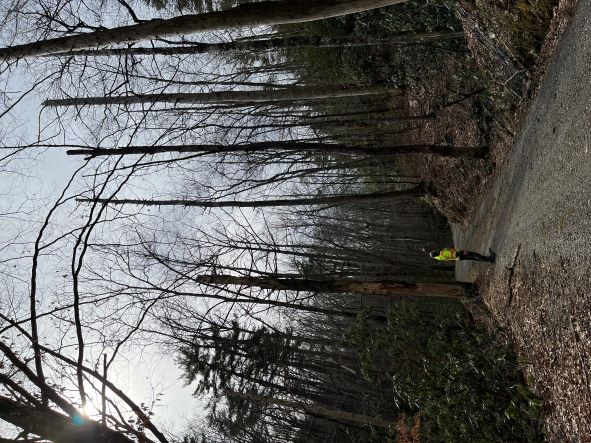
    Parson Branch RoadDead hemlocks are seen along Parson Branch Road near Cades Cove. National Park Service

    CADES COVE — Great Smoky Mountains National Park contractors began removing at least 800 dead hemlock trees along Parson Branch Road, an eight-mile primitive backcountry road that connects Cades Cove with U.S. 129 on the western edge of the park.

    The road has been closed since 2016 because of the tree hazards and damage to the road surface. The hemlocks succumbed to the hemlock woolly adelgid, an exotic insect that has wreaked havoc on hemlock stands and their accompanying ecosystems.

    The road passes several trailheads, and is used by emergency vehicles as needed. The park initially identified some 1,700 trees that posed a hazard to the adjacent roadway, but that number has naturally declined by about half over the past six years.

    Friends of Great Smoky Mountains National Park provided $100,000 for the hazard-mitigation project. That was matched with $50,000 from the federal government.

    Once the dead trees are removed, work will begin to rehabilitate the roadway and ensure its safety. 

    The roadway could reopen this summer, according to a news release from the National Park Service.

  • Zigging and zagging to find the Zigzag
    in News

    Zigzag salamander UT doctoral student Bryce Wade examines a Southern zigzag salamander he found at Ijams Nature Center in South Knoxville. Keenan Thomas/Hellbender Press

    On the happy herping trail: Bryce Wade searches for salamanders

    KNOXVILLE — Bryce Wade scours the nature trail, turning over rocks and logs. On this overcast day at Ijams Nature Center, he searches beneath the leaves on the ground for one creature: salamanders.

    Underneath the rocks, logs and leaves, salamanders populate the cool, moist earth, avoiding the sun whenever they can. Wade is looking for a particular type: a winter species informally called the Southern zigzag salamander (Plethodon ventralis).