
Displaying items by tag: pollination
Please don’t poison the humble carpenter bees
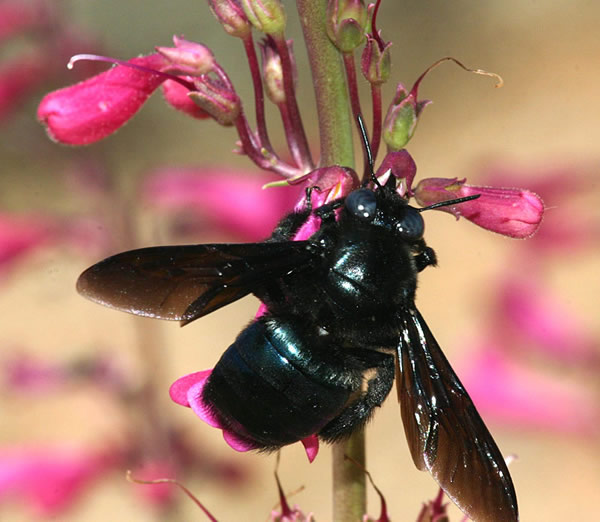 A male carpenter bee takes a break from building its nest to get nourishing nectar from the base of a penstemon. Juian Cowles/U.S. Forest Service
Please don’t wage chemical warfare on these busy bees
KNOXVILLE — Old George Harvey lived two houses upstream from where I grew up on Baskins Creek in Gatlinburg. He had a strange obsession. Using empty jars, Old George would catch bees he found on the flowers and gardens around his house, screw on the lid and line the jars up on a ledge inside his screened-in porch. He’d then watch the bees die.
We kids thought it was odd and cruel. We’d plot slipping into his porch and freeing all the bees like Elliot freed the frogs from the classroom in the movie “E.T. The Extra-Terrestrial.”
Come get up close with a corpse (flower) at UTK
KnoxNews: Welcome to Rocky Top, Rotty Top!
A seldom-seen corpse flower is about to burst forth in bloom following a 20-year sleep — presumably not in a casket and not at the Body Farm — at the Hesler Biology Building at the University of Tennessee in Knoxville.
A previous faculty member got the plant two decades ago, but this is its first blooming cycle, according to the News Sentinel. It has been nursed along by current greenhouse director Jeff Martin — in someone else’s office, of course. The plant only blooms about every 10 years, if not more infrequently.
Members of the public are invited to come partake of the odor and revel in sheer stank in the next several days.
“A 2010 study by Japanese researchers attributed the plant’s smell to a combination of chemicals that smell like cheese, sweat, garlic, decaying meat, rotten eggs and more,” according to the News Sentinel.
But it’s not just about the smell: The plant produces the world’s largest flower and is endangered in the wild. Pollen from this corpse flower (Amorphophallus titanum — you can suss out the literal definition yourself) may be used to pollinate other endangered corpse flowers, which are native to Southeast Asia.
The odor is an evolutionary pollination mechanism to attract flies and other insects that are attracted to the smell of rotting flesh.