The Environmental Journal of Southern Appalachia

Public biological survey searches for the Smokies most-wanted species

Written by

Photo by Valerie PolkA child snaps a photo of a flower beetle on a wild hydrangea in Great Smoky Mountains National Park.  Valerie Polk

Grab your phone and get to some citizen science

Rhonda Wise writes for the public affairs office of Great Smoky Mountains National Park

Discover Life in America (DLiA), the nonprofit science research partner, is inviting the public to participate in the Smokies Most Wanted program. This initiative allows visitors to help preserve park species by recording sightings of animals, plants, and other organisms from their smartphones using the iNaturalist app. 

Using the nature app iNaturalist, Smokies Most Wanted encourages visitors to document any organism they encounter while exploring the Smokies. DLiA uses the data collected to record new park species, detect invasive species, learn about under-studied or rare species, and to map species across the park. 

“There are lots of fairly common plants and animals around the Smokies that we just don’t have many datapoints for,” said Becky Nichols, park entomologist. “Smokies Most Wanted is a great way for the public to contribute to science in the park, and to help us learn about and protect life in the Smokies.” 

Smokies Most Wanted is an extension of the All Taxa Biodiversity Inventory, DLiA’s ongoing project to catalog all life in the Smokies. The ATBI, also utilizing iNaturalist, has recorded 4,100 species by more than 5,700 users, who have submitted over 71,000 iNaturalist observations in the park. 
Rate this item
(1 Vote)
Published in News

Related items

  • 5 big threats to the world’s rivers
    in News

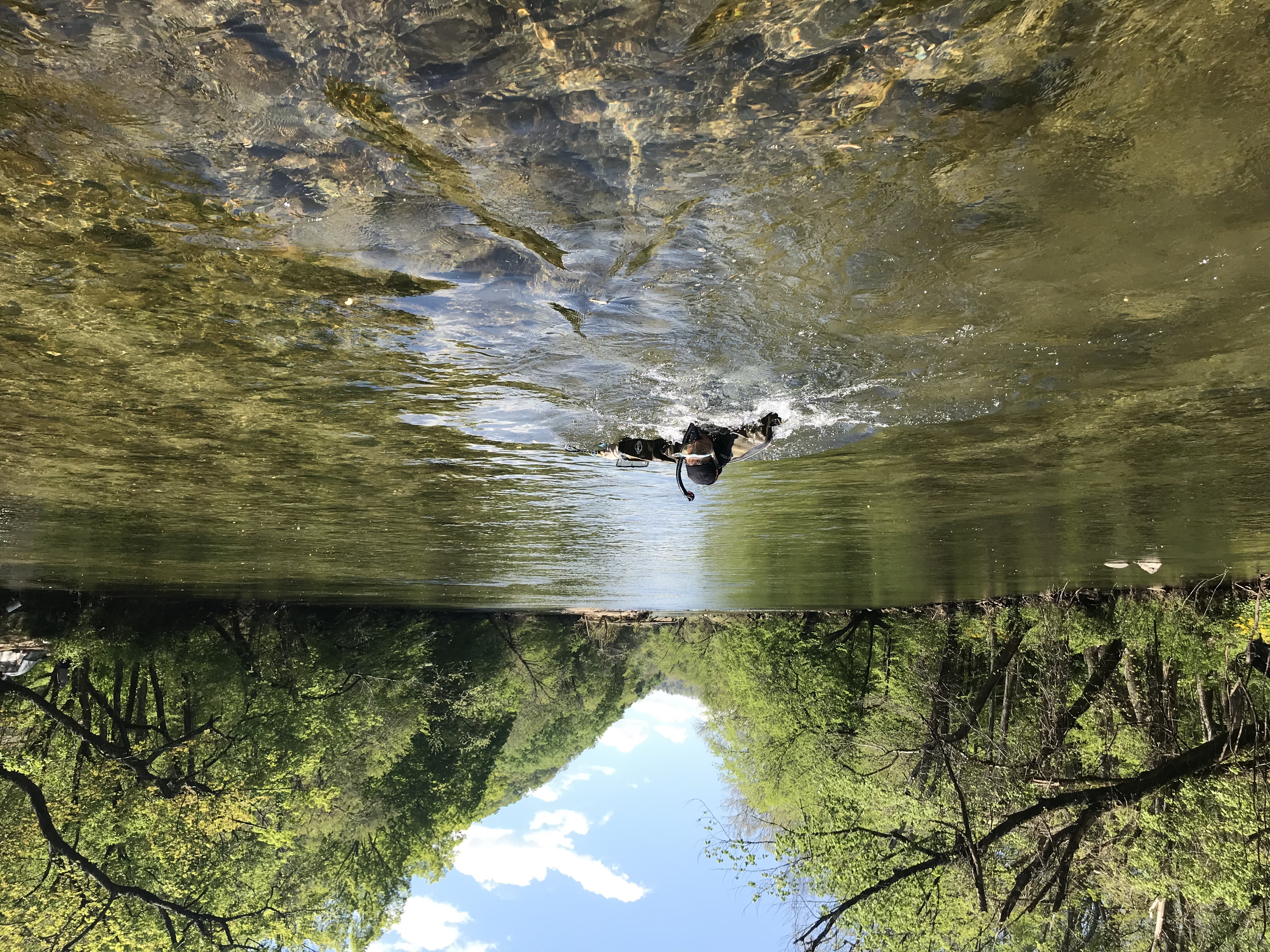
    fresh water Conservation FisheriesA biologist with Conservation Fisheries surveys a stretch of Little River near Walland, Tennessee to determine fish viability and identify rare species for transplantation. Thomas Fraser/Hellbender Press

    Human activities have imperiled our waterways — along with a third of freshwater fish and other aquatic species

    This story was originally published by The Revelator.

    If we needed more motivation to save our ailing rivers, it could come with the findings of a recent study that determined the biodiversity crisis is most acute in freshwater ecosystems, which thread the Southern landscape like crucial veins and arteries.

    Rivers, lakes and inland wetlands cover 1 percent of the Earth but provide homes for 10 percent of all its species, including one-third of all vertebrates. And many of those species are imperiled — some 27 percent of the nearly 30,000 freshwater species so far assessed by the IUCN Red List. This includes nearly one-third of all freshwater fish.

    How did things get so bad? For some species it’s a single action — like building a dam. But for most, it’s a confluence of factors — an accumulation of harm — that builds for years or decades.

  • Citizen scientists are taking stock in Smokies, and the inventory keeps increasing
    in News

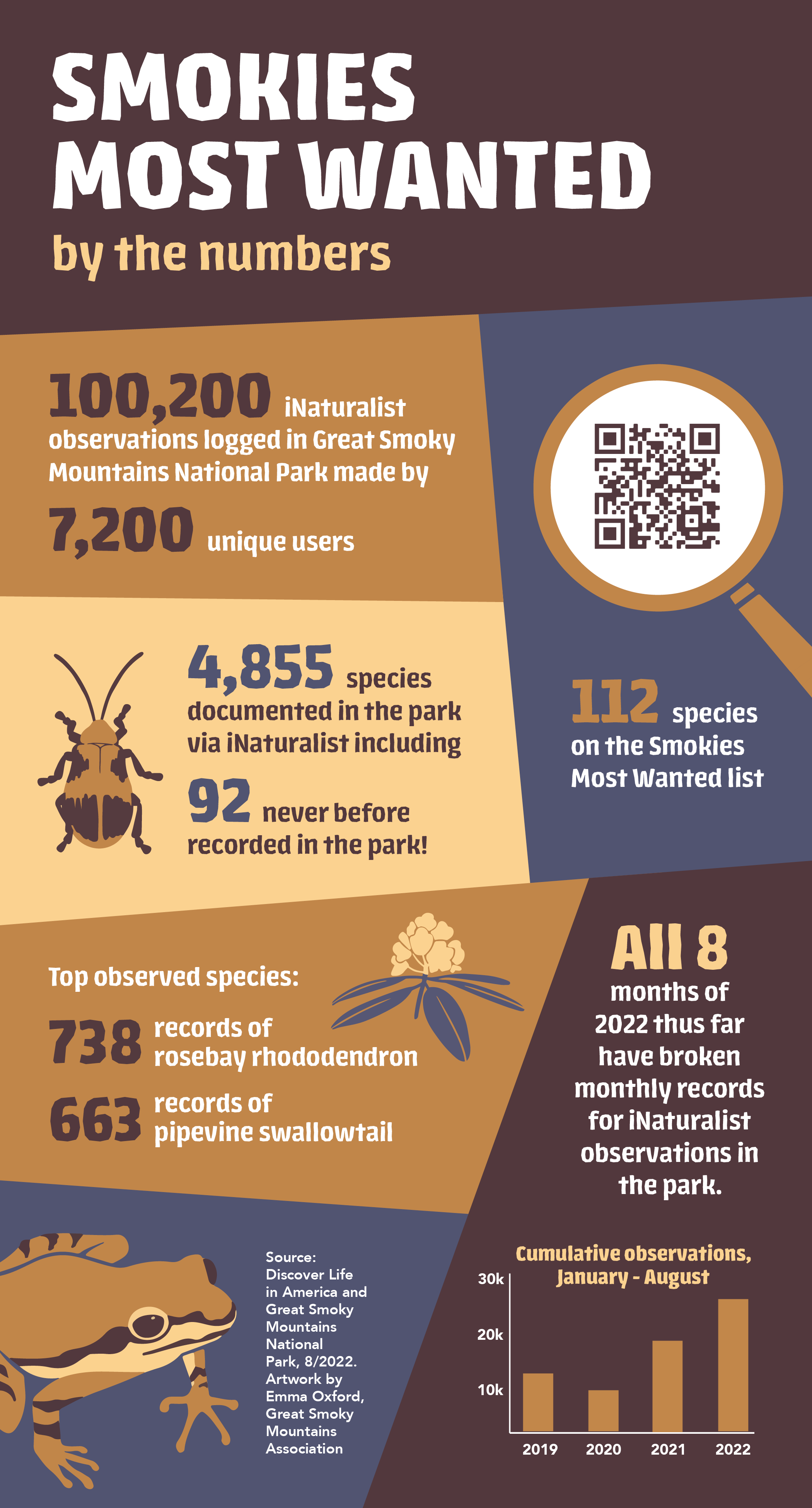
    1 smokies most wanted infographic credit Emma Oxford GSMA

    This story was provided by Great Smoky Mountains National Park.

    Next demonstration on Thursday, Oct. 20

    GATLINBURG — Great Smoky Mountains National Park is celebrating the success of a community science project led by nonprofit partner Discover Life in America (DLiA) called Smokies Most Wanted. The initiative encourages visitors to record life they find in the park through the iNaturalist nature app. DLiA and the park use these data points to map species range, track exotic species, and even discover new kinds of life in the park. 

    “iNaturalist usage in the Smokies has skyrocketed from just four users in 2011, to 3,800 in 2020, to now more than 7,100 users,” said Will Kuhn, DLIA’s director of science and research. 

    In August, the project reached a milestone, surpassing 100,000 records of insects, plants, fungi, and other Smokies life submitted through the app. Among them are 92 new species not previously seen in the park.

  • Public comment: Environmental group leaders say TVA makes input difficult
    in News

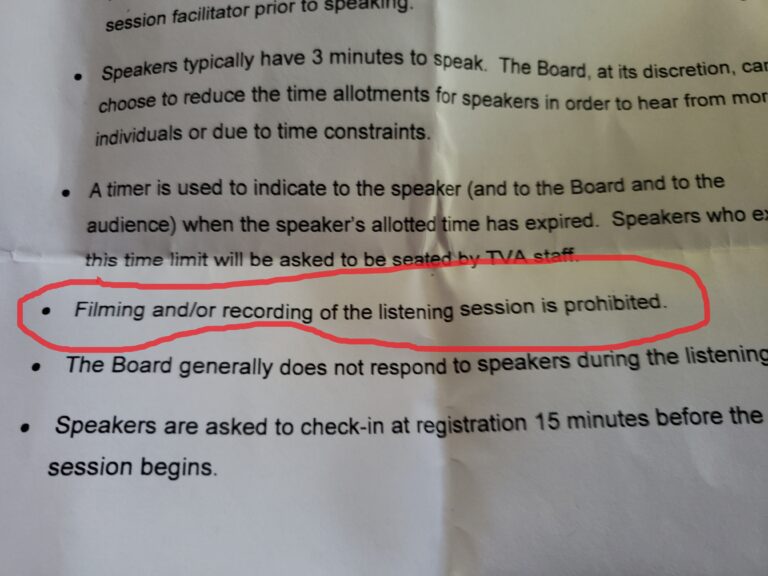
    Handout from TVA Listening Session Aug. 30 2022Scott Banbury with the Tennessee Chapter of the Sierra Club said a handout provided at TVA’s Aug. 30 listening session stated recordings of the meeting were not allowed; a TVA spokesperson said recordings are, in fact, allowed. Flyer provided by Scott Banbury

    Is TVA trying to gag its critics?

    This story was originally published by Tennessee Lookout.

    KNOXVILLE — While the Tennessee Valley Authority, a utility company that provides power to millions in Tennessee and other states, allows for public input into decisions, the process isn’t simple or transparent, say some regular attendees.

    Take, for instance, a recent public listening session: representatives of the Tennessee Chapter of the Sierra Club say they were told they could not record the session despite a spokesman for TVA saying the opposite.

    According to TVA spokesperson Scott Brooks, attendees are always allowed to record public meetings, provided they don’t cause a disturbance, but minutes before the session, members of the Tennessee chapter of the Sierra Club were prohibited from doing so.

  • There’s a whole world in the dirt beneath your feet
    in News
    Dust bowl soilThe Dust Bowl of the 1930s resulted in the displacement of tons of soil in the midst of a drought similar to the one that grips the Southwest today. Library of Congress
     

    Dirt is far from just dirt. It’s a foundation for life.

    This story was originally published by The Revelator.

    Look down. You may not see the soil beneath your feet as teeming with life, but it is.

    Better scientific tools are helping us understand that dirt isn’t just dirt. Life in the soil includes microbes like bacteria and fungi; invertebrates such as earthworms and nematodes; plant roots; and even mammals like gophers and badgers who spend part of their time below ground.

    It’s commonly said that a quarter of all the planet’s biodiversity lives in the soil, but that’s likely a vast understatement. Many species that reside there, particularly microorganisms such as viruses, bacteria, fungi and protists, aren’t yet known to science.

  • Opponents of Oak Ridge waste dump, citing comms breakdown, urge extension of public comment period
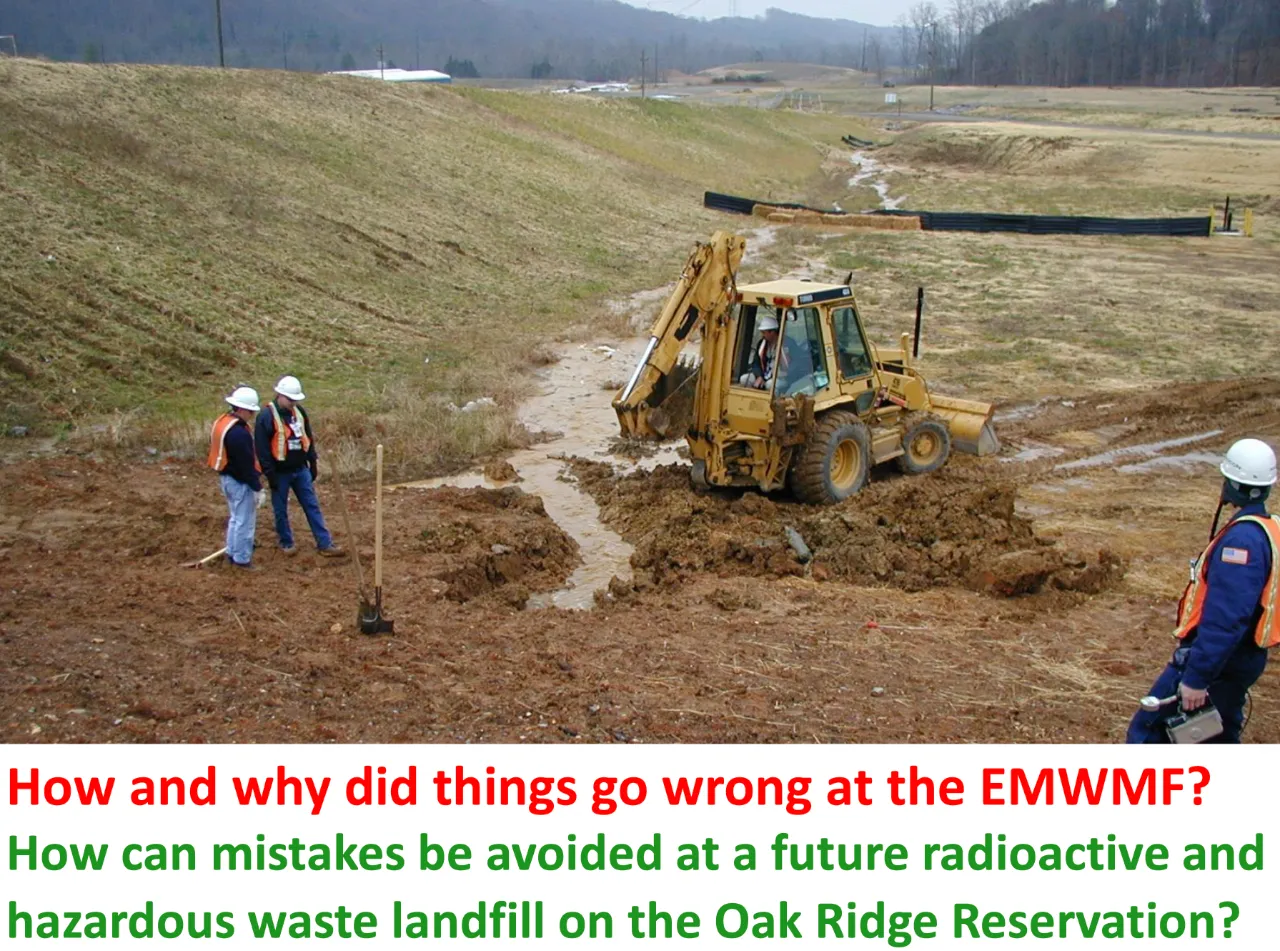
    How and why did things go wrong at the EMWMFImage from a 2018 memorandum authored by experts including former Department of Energy employees in Oak Ridge. EMWMF is the present landfill that has a history of failures and is reaching capacity. Ecologists say, after a decade DOE still is not adequately addressing waste acceptance criteria and feasible alternatives.


    Public can comment in person Tuesday night in Oak Ridge on proposed DOE waste dump

    OAK RIDGE — The Southern Environmental Law Center blistered the Department of Energy in a letter ahead of a May 17 hearing on construction of a toxic-waste landfill that opponents said poses contamination threats to portions of the Clinch River watershed and downstream TVA reservoirs.

    The hearing is set for 6-8 p.m. Tuesday, May 17 at the Pollard Technology Conference Center, 210 Badger Ave. This email address is being protected from spambots. You need JavaScript enabled to view it. will be accepted through June 7.

    The Department of Energy wants to bury contaminated debris from demolition of Manhattan Project-era complexes and associated legacy toxins from the Oak Ridge Reservation. The drawn-out debate about how best to safely store the materials now focuses on the transparency of the decision process and the health of the Bear Creek watershed and downstream pollution threats to the Clinch River. 

  • Updated: Your — once in 20 years — opportunity to influence the livability of Knox County
    in News

    AdvanceKnoxGibbsYou can still share your own ideas to improve and protect our community   Advance Knox

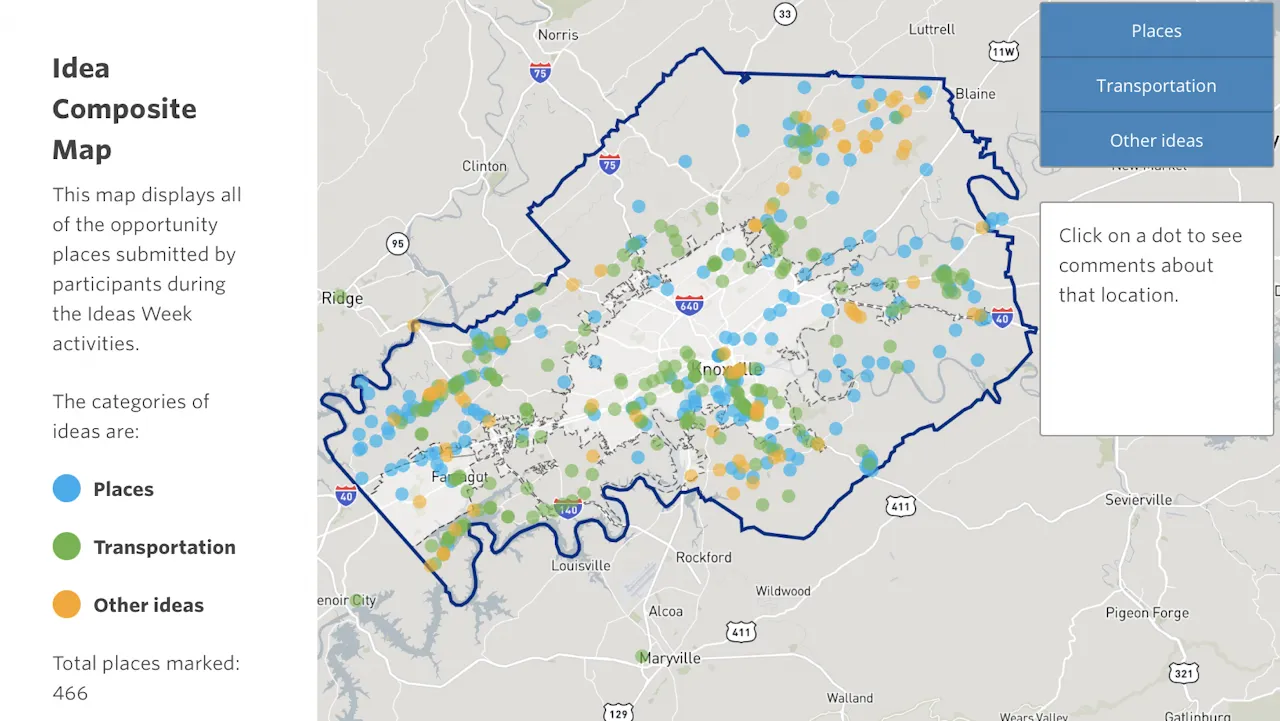
    Updated again on May 4: Hundreds of ideas, complaints and comments, many of them with map locations, have been posted on the Advance Knox website.

    As announced in Hellbender Press earlier, Advance Knox held a series of public input events across Knox County during its Ideas Week at the end of March.

    If you missed those in-person gatherings and could not attend the virtual session, we hope you recorded your preferences and opinions online at the Advance Knox website.

    You can now see what others had to say about your neighborhood and your favorite places.

    And, even if you already participated, you may have had new ideas or important thoughts not recorded yet. Please let us know,

    — what you treasure in Knox County

    — what you miss

    — what you think is most important to consider as the county keeps growing.  

    The interactive facility to submit ideas will remain open online through May 10as suggested at the last Advisory Committee meeting.

  • Another look at the parallel war Russia is waging against the natural environment
    8i8pjciusqt81
     
    New York Times: Ukraine environmental holocaust just the latest in ways war scars the Earth

    Open armed conflict understandably abrogates immediate concerns about the natural environment.

    Despite the tens of thousands of human deaths already caused by Russia’s invasion of Ukraine, the war’s impact on natural systems can’t be understated.

    In some cases, Russian troops have taken up positions in natural parks and protected ecological areas in Ukraine. The Black Sea coast is an important remaining area of biodiversity in Europe. Ukrainian counterattacks, while understandable, have also inflamed environmental consequences.

    There are also immediate risks to human respiratory health from the fires sparked by attacks on fuel depots and chemical facilities.

    War’s negative environmental impacts are by no means a new thing: See the use of Agent Orange by the U.S. in Vietnam and the wasteland of burning oil fields left behind in the Gulf War.

    War is bad for every living thing.

  • Fire, fog, floods: Scientists probe climate-change impacts in Smokies
    in News

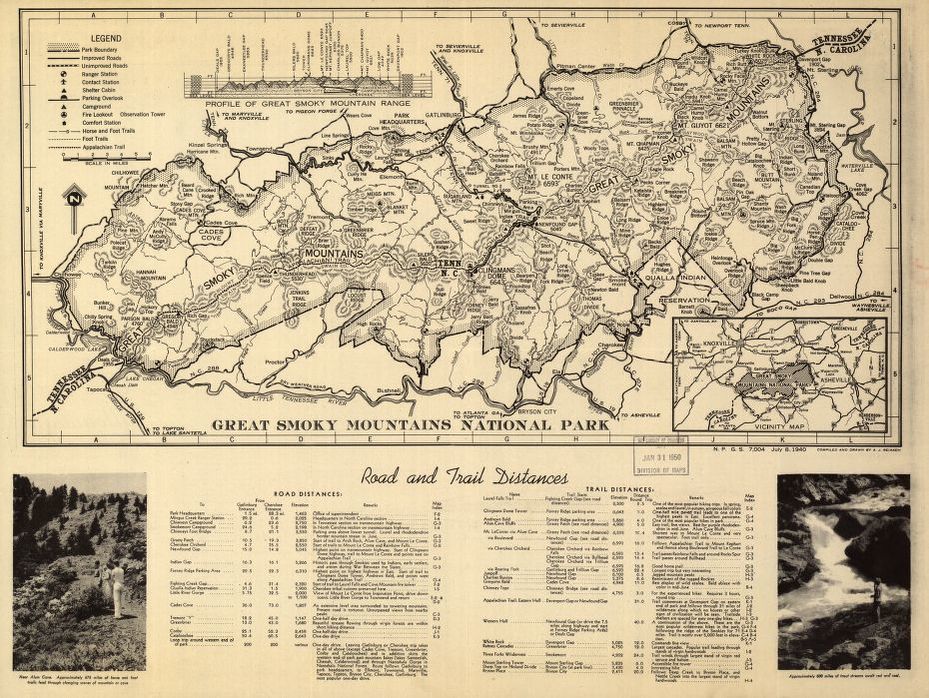
    iiif service gmd gmd390 g3902 g3902g np000243 full pct 12.5 0 defaultMany climate-change related issues have appeared since publication of this vintage map of Great Smoky Mountains National Park. Library of Congress

    Invasive insects are among the vanguard of noticeable climate changes in America’s most-visited national park

    GATLINBURG — Ants scurry beneath the carpet of last year’s leaves in Great Smoky Mountains National Park. The native ants are busy spreading the seeds of violets and bloodroot, preparing a new carpet of spring wildflowers to draw thousands of visitors.

    But the local insects aren’t alone under there. They have become prey to venomous Asian needle ants that also prowl the leaf litter.

    These invaders dine on termites, other ants and insects, while stealing habitat from them. Unlike invasive fire ants, needle ants can live in pristine forests and build large colonies with hundreds of queens. But like fire ants, needle ants have a painful sting that can trigger an allergic reaction. 

    Climate change is expected to make it easier for invasive species like needle ants to upset the delicate balance of this temperate rainforest full of rare plants and animals. That’s just one example.

  • New digital maps outline precious pockets of remaining U.S. biodiversity and the threats they face
    in News

    Indiana batThe endangered Indiana bat is among threatened and endangered species in Great Smoky Mountains National Park.  U.S. Fish and Wildlife Service

    Southern Appalachians show red as a warning on new detailed biodiversity maps 

    This story was originally published by the Sylva Herald.

    SYLVA — Great Smoky Mountains National Park has long been known for its abundance of different species of flora and fauna.

    Credit old mountains in a warm, sunny and wet region with varying types of climate, soil and stone for that large number.

    “The park is almost certainly the most biodiverse national park in North America,” said Paul Super, national park science coordinator. “And certainly the most studied of any national park.”

    A group of environmental organizations recently put together a series of maps illustrating the regions with the biggest threats to their biodiversity, and the area around Jackson County and the national park showed up in the red, showing risk. One such map, based on NatureServe data, is among the most detailed maps of endangered and threatened species ever produced.

  • Advance Knox — Ideas Week: Knox County invites public participation to guide land use and transportation decisions for years to come
    in News

    Knox County offers opportunities for public participation in the overhaul of planning guidelinesKnox County offers opportunities for public participation in the overhaul of planning guidelines  Knoxville-Knox County Planning

    Framework for growth in Knox County

    Advance Knox is a comprehensive planning process initiated by Knox County Mayor Glenn Jacobs “to guide growth, land use, transportation, economic prosperity, and quality of life.”

    The process is intended to result in a new Knox County general plan and subsequently shape revisions of the sector plans. Together, that set of major plans establishes criteria for further plans by Knoxville-Knox County Planning, such as local area and annual plans, as well as timing and implementation specifics for the Knox County portions of the Regional Transportation Planning Organization’s Long Range Regional Mobility Plan.

    At each 90-minute Ideas Week event, you’ll learn about the process through idea generation and map-based activities. It’s a chance to share what’s important to you.

    — Sunday, March 27 – 1:30 p.m. at Gibbs Middle School

    — Monday, March 28 – 5:30 p.m. at Hardin Valley Middle School or Carter High School

    — Tuesday, March 29 – 5:30 p.m. at West High School or Northshore Elementary School

    — Wednesday, March 30 – 5:30 p.m. at Powell High School or South Doyle Middle School

    Knoxville-Knox County General Plan 2033, adopted in 2003, established the framework for the current sector plans and was amended with the Knoxville-Knox County Park, Recreation and Greenways Plan in 2010.