
The Environmental Journal of Southern Appalachia

(Part 2) Flight to safety: Life finds a way like a great blue heron

Written by

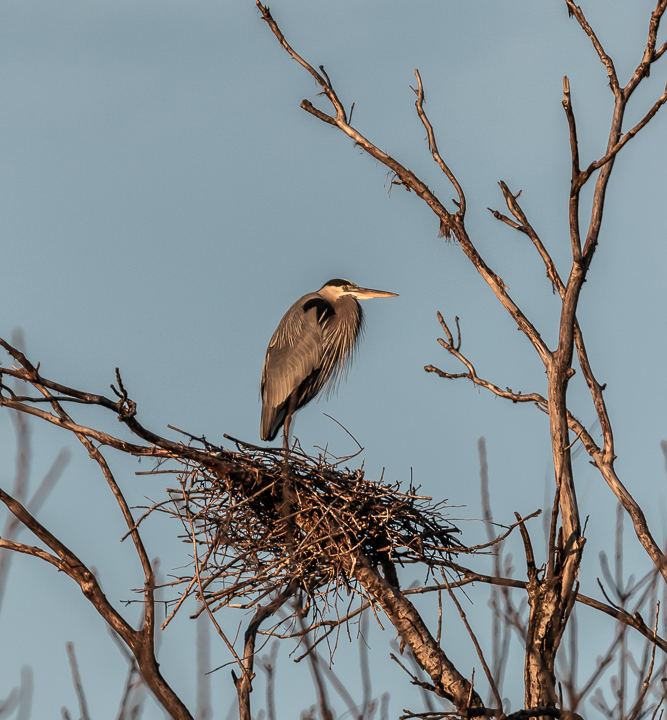
Thompson GB Heron 2A great blue heron is seen above a nest in the Tennessee River Valley. Herons moved northward to the valley from tiny remaining Florida rookeries after the birds were annihilated in the early 20th century for hat decorations. Betty Thompson

After their kind almost vanished, great blue herons took a minute to take to the Tennessee Valley. Now they are here in a big way. 

"Life breaks free, it expands to new territories, and crashes through barriers painfully, maybe even dangerously, but, uh, well, there it is," said Jeff Goldblum's Malcolm in 'Jurassic Park.' "Life finds a way."

In the early 20th century, after it became illegal to hunt for feathers, as referenced in this previous Hellbender Press story, herons began to recover.

But it took a while. The curious thing with great blue herons, which perhaps attests to the tenacity of nature itself, is that for years they really had little presence in the Tennessee Valley, even after the principal dams and reservoirs were completed. There were plenty of shallow waters for fish eaters.

From the 1940s to the early 1970s, the heron population in the valley was extremely small. They were only seen randomly.  Then in the mid-1970s their numbers surged as they moved up the valley and formed new colonies, slowly and steadily like the bird itself. Clearly the leggy, wading heron had come to terms with urbanization along the rivers. Just how some species are able to adapt to life with humans when others cannot is a mystery. It suggests that each species has its own sensitivity level.

The first colony turned up in the Tennessee Valley in Meigs County at Armstrong Bend adjacent to Chickamauga Lake, according to Charles Nicholson. T. D. Pitts reported the find in 1977.

Two years later a colony was discovered at Cotton Port, also in Meigs County, followed by rookeries at Savannah Bay in 1982; Watts Bar in 1983; and Patten Island in 1984.

Between 1977 and 1988, 15 colonies appeared along the rivers in the Tennessee Valley; clearly the birds were making their way upstream. During this time the population at these new colonies jumped from 45 to 1,056.

They reached Knox County and Looney Island in 1990.

On April 12 of that year, Steve and Rebecca Satterfield were looking for the herons that had been reported along the river off Cherokee Boulevard in Sequoyah Hills, a neighborhood just west of the University of Tennessee. They scanned Looney Island with binoculars and discovered the active nest with two fairly large nestlings being fed by their lookalike parents. The late J.B. Owen, columnist for the Knoxville News Sentinel, reported the discovery and it caused quite a stir because the island was so easy for everyone to see.

Growing up in the shadow of Mount LeConte, I had never seen one of these lordly birds until life brought me to Knoxville in the early 1980s. I still recall my initial amazement on seeing one pass. “Geez,” I’d whisper under my breath.

The woodland birds I had grown up with tended to be small and fidgety, more like winged sprites, like Tinkerbell, that were here and gone before your mind had a chance to become comfortable with their presence. But not great blue herons; their deliberateness pulls them from the vaporous existence of high-strung warblers into the world of the solid and concrete.

A great blue is decidedly substantial. Watching one as it stands in knee-high water, frozen, patiently waiting for its prey, you get a true sense of the steely resolve that a master fisherman needs. You’d swear the bird to be a statue: elongated and perfect, chiseled in blue-gray marble by some modern Michelangelo. But great blue herons are real and their presence in the valley is growing.

On warm days in February, great blues begin to show up at the rookery to stake their claims. Initially, the male arrives and with feet firmly planted he will stand erect, head high. I recall one year on Looney Island, very early in the season with most sites unclaimed, a single heron stood in an uppermost nest.

In the case of the great blues, this declaration of turf marks the beginning of courtship. As with many other species, the courtship of a pair of great blue herons is elaborate and protracted. It lasts several weeks.

Even if it’s a mated pair that have produced many successful clutches, the pair bond has to be reestablished and reaffirmed.

The male and female have been living apart prior to the onset of courtship, leading solitary lives. Once they’re back together at the rookery the display behavior begins.

For the great blue herons in the valley, egg-laying probably peaks in mid-March. After that, the female and the male take turns incubating the eggs, a process that lasts about 28 days. The average clutch size is three or four. After hatching, both parents feed the young that fly for the first time in just under two months, or mid-June.

After the fledglings disperse, their parents go their separate ways until the following year.

And those once-coveted nuptial plumes are slowly shed during summer to drift away down the river unnoticed on hats no more.
Rate this item
(1 Vote)
Published in News

Related items

  • Monarch butterflies, an ephemeral but regular glimpse of beauty, are fluttering toward extinction
    in News

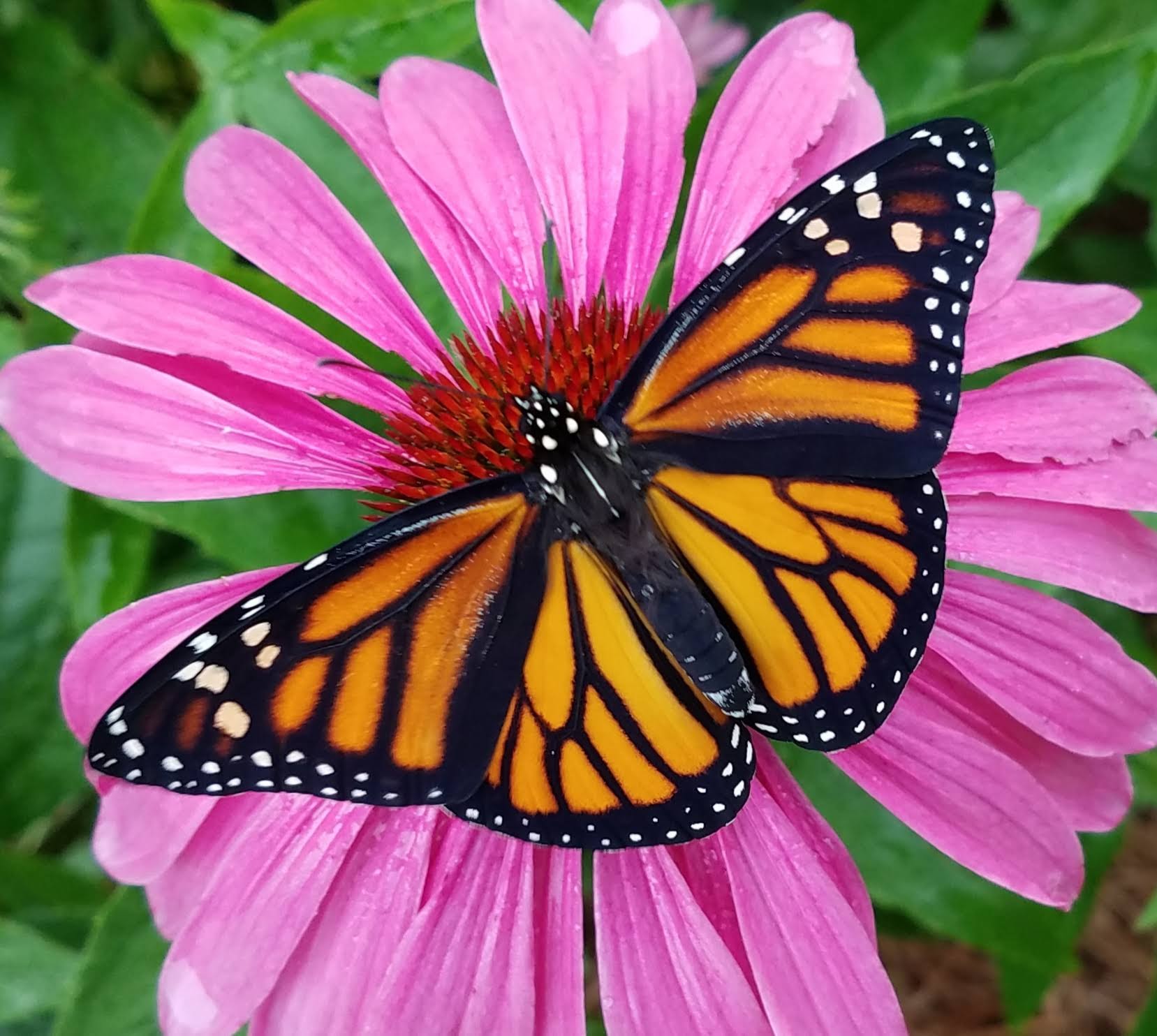
     Bales Monarch on coneflowerA monarch butterfly, recently declared endangered despite decades of conservation, is seen atop a coneflower. Stephen Lyn Bales

    Dramatic monarch declines mean the bell tolls for we

    KNOXVILLE — Monarch butterflies are ephemeral by nature. The orange and black dalliances that flitter through our lives, our yards, and our countryside like motes of dust are here one minute and gone the next. We pause for a few seconds to watch the “flutter-bys” and then move on.

    For about all of the Lepidopteran family, where they come from, where they go, their raison d'être, we don’t ask. They are winged wisps that pass through our busy lives. But that is not true with this orange and black butterfly, named to honor King William III of England, the Prince of Orange. But two people did ask.

    Norah and Fred Urquhart lived in Southern Canada and in the late 1930s they noticed that the monarch butterflies seemed to all be fluttering south this time of the year. Could they possibly be migrating and if so, where did they go? The notion that a butterfly might migrate south for the winter seemed hard to fathom. Yes, broad-winged hawks migrate. But a flimsy butterfly?

  • Hellbender Press nets two top awards from Society of Professional Journalists

    KNOXVILLE — Hellbender Press took home two awards from the 2021 Golden Press Card contest sponsored by the East Tennessee Society of Professional Journalists.

    Hellbender Press was recognized with two first-place awards for East Tennessee digital journalism: The Hal DeSelm Papers and Requiem for the Lord God Bird

    The Hal DeSelm story chronicled his decades-long effort to document terrestrial biomes in all but one Tennessee county, and subsequent work by the University of Tennessee to craft his datasets into an accessible database.

    The other award was for reporting on the extinction of the ivory-billed woodpecker relying heavily on the work of Ijams Nature Center naturalist Stephen Lyn Bales.

    Judging was conducted by the SPJ chapter in Cincinnati.

    “We are incredibly grateful to our editorial board, readers and others who helped with this great win,” said Hellbender Press editor Thomas Fraser. “Our stories are only as good as the sources.”

  • (Part 1) Flight to safety: Herons barely survived a bloody fashion trend
    in News

    Thompson GB Heron 1Great blue herons and other heron species were reduced to a handful of rookeries after numbers plummeted because of high demand for their plumage.  Courtesy Betty Thompson

    Herons were almost a victim of their own beauty

    plume. noun. a long, soft feather, or arrangement of feathers used by a bird for display 

    During our Gilded Age of opulence and corruption, members of polite society wore alligator shoes, top hats made from beaver pelts, ivory buttons, whalebone corsets and dead foxes draped around their shoulders. After all, status had its price and the surrounding wild lands were bountiful.

    In the late 1800s and early 1900s, most fashion-conscious women would not be seen in public without a hat adorned with feathers. In 1915, at the height of this fashion craze, an ounce of plumes sold for $32, the same going rate as an ounce of gold. The most highly coveted feathers were “aigrettes,” which are the long, silky white nuptial plumes of egrets and great blue herons. Plume hunters could make a sizable sum of money for a day’s work with a gun. 

  • (News alert: Katy did it!) Seventeen-year cicadas were just an opening act. Now the woods are rolling with the rhythm of our annual insects.
    in News

    Bales Common true katydidA true katydid is shown here. It’s one of the main insects that provides a permanent soundtrack to your summer life in the Knoxville area.  Stephen Lyn Bales/Hellbender Press

    What’s that buzz? We thought Brood X was over.

    In case you haven’t noticed: It’s hot!

    The “dog days of summer,” are so called because the season coincides with the period of time when the brightest star Sirius, aka the Dog Star, rises and sets with the Sun: early July through August into September.

    The ancients believed that when Sirius and the Sun were in the sky together, the days were hotter. I think they got it right.

    August has never been that thrilling to me, more of a month to endure. The birds have finished raising their families and are going through their late-season molt. Some of the migratory birds have already started to move south. But that doesn’t mean that our backyards are totally silent because late summer is cacophonous with insects.

    During the day, the trees are filled with large, green cicadas that generally spend three years underground in their larval stage, but they are not all in sync like Brood X was, so each summer we have plenty that mature to collect en masse in our neighborhoods.

    To attract females, the male cicadas do the chainsaw buzzing, but the songs are not made with vocal chords but rather special organs on the sides of their abdomens called “tymbals.” In effect, their sides vibrate loudly.

    Locally in the Knoxville region we have five species of these annual cicadas. Early in the morning and into the afternoon, swamp cicadas (Neotibicen tibicen) are calling. They are also known as morning cicadas because they usually crank up by 10 a.m. with a long uninterrupted rattle that builds in intensity.

  • Fly, flit, buzz, flutter or soar over to Ijams Nature Center this weekend for its Hummingbird Festival and Celebration of Wings

    Children by Pond 300dpi

    Bats, birds and all winged creatures are the guests of honor at Ijams Nature Center in Knoxville this weekend.

    The center plans a celebration of science and our flighty friends from 7 a.m. to 2 p.m. on Saturday.

    The educational event is open to all ages and will feature bird-banding demonstrations/projects; food trucks; guided walks; expert speakers; arts and crafts; and a chance to meet a number of raptors and animals native to East Tennessee. Citizen science demonstrations will show how anyone can contribute to the study and conservation of our natural world. 

    You can get tickets online for the Hummingbird Festival and Celebration of Wings.

    The 2021 Ijams Hummingbird Festival: Celebration of Wings is sponsored by Ergon Terminaling Inc.The Trust Company of TennesseeWBIR-TV Channel 10HomeTrust BankStanley's Greenhouse, and Tennessee Wildlife Federation.