
News (340)
At least $35 million headed to Smokies for southern Foothills Parkway overhauls and maintenance facilities improvements
Written by Thomas Fraser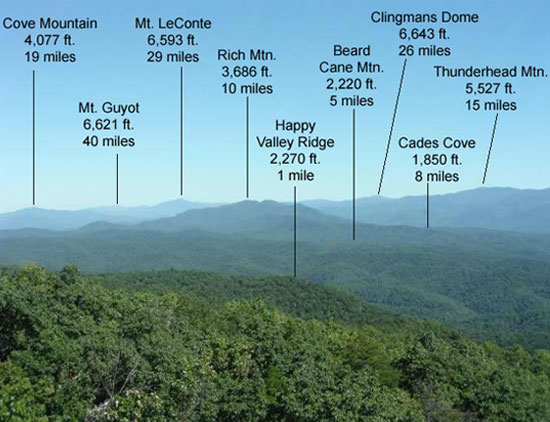 The crest of the Smokies and its peaks are shown from Look Rock on the Foothills Parkway. National Park Service
Southern stretch of Foothills Parkway to get $33 million overhaul
The National Park Service will repave and improve the entire southern stretch of Foothills Parkway and design a replacement of the outdated maintenance facilities at Sugarlands thanks to funding from the Great American Outdoors Act.
Both projects will cost a combined $40 million and be paid for via a foundation established as part of the overall legislation passed by Congress in 2020.
The Department of the Interior will spend a total of $1.6 billion from the Legacy Restoration Fund this year alone as part of a long-range goal to improve infrastructure and catch up on maintenance needs in national parks and other federally managed lands, according to a release. National public lands across the country, including Great Smoky Mountains National Park, have long faced maintenance deficits totaling billions of dollars.
The Foothills Parkway and Sugarlands work is one of 165 deferred maintenance projects that will be funded this year. Infrastructure improvements are also planned for sections of the Blue Ridge Parkway and Shenandoah National Park.
The $33.6 million in planned improvements to the parkway between Walland and Tallassee (from mile marker 55 to 72) will include enhanced safety features and milling and replacement of the pavement.
“The road rehabilitation will include pullouts and parking areas, replacing steel backed timber guardrail, and repair, reconstruction and repointing of stone masonry bridge parapet walls and the walls along Look Rock Overlook,” according to interior department documents.
“Other work will include removing and resetting stone curb, replacing/repairing of the drainage structures, stabilizing roadside ditches, overlaying or reconstructing paved waterways, stabilizing and reseeding the shoulder, installing pavement markings, replacing regulatory and NPS signs, and constructing ramps with curb cuts to provide access to interpretive panels and to meet federal accessibility guidelines.”
“The work proposed in this project would reduce the hazards and improve safety for park visitors and employees,” according to the data sheet.
The Legacy Restoration Fund will also cover the $3.5 million cost of a design/build plan to improve and update the expansive and deteriorating maintenance yard at Sugarlands.
“The buildings, driveways, and parking areas associated with the maintenance yard have not been renovated or rehabilitated in decades,” according to a data sheet.
“There are safety hazards, inadequate space or capacity for park maintenance and operations personnel, and facilities that are entirely insufficient for essential park operations and maintenance. The condition of many buildings is so poor that replacement and disposal is likely the only practical option. This project will complete predesign project programming and budgeting and develop a Design Build RFP for the rehabilitation or replacement of facilities and associated utilities, parking, and grounds.”
Great Smoky Mountains National Park officials did not immediately respond to an email requesting additional information on possible future projects and to what extent national infrastructure plans proposed by the Biden administration might benefit the park, which is the most-visited in the nation.
Here’s a link to the full Department of the Interior National Parks and Public Land Legacy Restoration Fund Fund release. Here are the Foothills Parkway and Sugarlands maintenance yard project data sheets.
Babies born today may be unable to procreate without medical technology
The Guardian: Interview of Shanna Swan. 'Most couples may have to use assisted reproduction by 2045'
In her new book,“Count Down: How Our Modern World Is Threatening Sperm Counts, Altering Male and Female Reproductive Development, and Imperiling the Future of the Human Race,” Shanna H Swan, professor of environmental medicine and public health at Mount Sinai School of Medicine in New York City, provides more evidence how the wide use of plastics and other materials containing hormone-mimicking chemicals interfere with fertility and fecundity.
She advises how one may at least reduce exposure to these substances, to some degree, by making informed purchase decisions, such as avoiding processed food.
Knowledge particularly important for pregnant women!
See also, the ‘Plasticenta’ report referenced in the plastic pollution action alert.
Frauenhofer tandem photovoltaic solar cell achieves record efficiency
 The rainbow colors show the diffraction of sunlight by a mirror with a nanostructured grating, which was applied to the back of the silicon subcell. The sun’s spectrum is thus captured even better in the silicon bottom cell. © Fraunhofer ISE / Photo: Michael Schachtner
Fraunhofer Institute for Solar Energy Systems: Tandem Photovoltaics Enables New Heights in Solar Cell Efficiencies – 35.9 % for III-V//Silicon Solar Cell
The photovoltaic (PV) solar panels most commonly used for commercial applications today have an efficiency in the range of 16 to 22 percent. On the lower side of this range, one finds less-expensive panels, mostly made with poly-crystalline solar cells, while monocrystalline cells dominate the upper side.
The highest-efficiency panel presently on the market is SunPower’s A-Series residential panel, with a claimed 22.8 percent efficiency in converting photons to electrons under standard conditions. That's up just slightly by 0.73 percent from five years ago. Although many other manufacturers have caught up to offer panels rated at more than 21 percent, development progress of silicon-based monocrystalline PV toward the theoretical limit of around 30 percent has slowed to a crawl.
Over the same period, newer technologies for multijunction PV cells with thin subcell layers of gallium-arsenide and similar semiconductors, grown on top of silicon or perovskite crystalline materials, has been progressing rapidly and may be capable of exceeding 50 percent efficiency in the future. Lab results still require years of research and manufacturing development before panels come to market. Initially their high price will limit them to market niches where low-weight and small-surface per Watt will justify the cost, such as for aerospace applications or covering electric vehicle surfaces. The following links provide a good overview of such technologies and discuss their longer-term outlook.
DOE Energy Efficiency & Renewable Energy: Multijunction III-V Photovoltaics Research
Frauenhofer ISE: Tandem Photovoltaics – The Road to Higher Conversion Efficiencies
For a justice-centered transition away from fossil fuels
Apr 8 5–6 p.m.
Revolutionary Power: An Activist’s Guide to the Energy Transition
Shalanda Baker, Deputy Director for Energy Justice & Secretary’s Advisor on Equity, U.S. Department of Energy
Howard H Baker Jr. Center for Public Policy, Distinguished Energy and Environment Lecture Series
Zoom Meeting - Free and open to the public
Dr. Baker will discuss her new book, which offers practical tools to achieve a justice-based transition away from fossil fuels. She argues that transforming our energy system is the next civil rights domain. Those marginalized by our current system, low-income communities, and communities of color, must be the architects to transform the energy sector’s unequal power dynamics.
Join the meeting with this link
What are your ideas and opinions about interpretation at the Manhattan Project National Historical Park?
Apr 22 5:30 p.m. EDT
Manhattan Project National Historical Park Stakeholder Engagement Community Meeting
National Park Service
Manhattan Project National Historical Park (MNHP) is initiating a stakeholder process that will be used to help inform the park’s interpretive planning.
Zoom Meeting - Free and open to the public - RSVP
Interpretive themes convey park significance. Primary interpretive themes are the key ideas through which the park’s nationally significant resource values are conveyed to the public. They connect park resources to the larger ideas, meaning, and values of which they are a part. They are the building blocks—the core content—on which the interpretive program is based.
Find more details about the process, background information on the MNHP and register for the first meeting here.
The interpretive plan will provide guidance in developing future services, activities, events and exhibits in Oak Ridge, at the other MNHP locations, and through media outreach.
The recording of the April 13 national introductory webinar for this stakeholder process has just been released:
Community Solar: How East Tennessee can harness the power of the sun
Apr 20 8 p.m. EDT
Online discussion with Bryan Jacob, Solar Program Director, Southern Alliance for Clean Energy & Jason Carney, Founder and CEO of Energy Electives
East Tennessee EarthRise and Southern Alliance for Clean Energy
Tracking Decarbonization in the Southeast: 2021 Report
Apr 21 1–2 p.m. EDT
Heather Pohan & Maggie Shober, Southern Alliance for Clean Energy
Webinar - Free and open to the public - more details and RSVP
“Tracking Decarbonization in the Southeast: Generation and CO2 Emissions,” a report developed by the Southern Alliance for Clean Energy, examines the role electric utilities have played in decarbonizing the power supply over the last decade. The report examines power sector carbon dioxide emissions throughout the Southeast, home to some of the biggest utility systems in the nation.
Knoxville solar home project groundbreaking
Apr 22 1 p.m. EDT
Socially Equal Energy Efficient Development (SEEED)
In-person event with virtual participation option
SEEED is building a completely solar-powered, energy efficient home, including battery backup, and will sell it at an affordable price to a low-income family. The groundbreaking will take place in the Lonsdale neighborhood, and will also be live streamed through Facebook. If you attend in-person, please wear a mask and practice social distancing in line with guidance from the CDC.
Electric Vehicle Virtual Ride & Drive with race car driver Leilani Münter
Apr 24 1-2 p.m. EDT
Natural Resources Defense Council and Southern Alliance for Clean Energy
Zoom Webinar - Free and open to the public - RSVP
Leilani will take us through the paces in her electric car and explain why she’s an advocate for electric transportation powered by clean energy. Following the virtual ride, Leilani will answer live questions posed by viewers. Make sure to register to hold your reservation.
Getting closer to catastrophic tipping points
CBS News: Eye on Earth
This outstanding video summary by meteorologist and climate specialist Jeff Berardelli explains why scientists fear further deforestation of the Amazon or collapse of Antarctic ice shelves would wreak ultimate havoc in coastal areas around the world.
More...
“How has the river helped you during this time of isolation?”
Apr 29 submission deadline
Voices of the River Contest
Show Us What the River Means to You!
RiverLink
Details, Contest Guidelines and Submission Form
2020 Winners video

Put a lid on it: Rangers, cops targeting unsecured garbage loads to reduce roadside litter
Great Smoky Mountains National Park rangers and the Gatlinburg Police Department made 37 traffic stops targeting insufficiently contained garbage during an enforcement campaign on the Spur on March 28 and March 29.
Unsecured trash and debris blowing from vehicles is a major source of litter along the Spur, which is used by 10 million vehicles per year and is the most heavily traveled — and heavily littered — roadway in the national park.
Rangers and police officers issued 25 verbal warnings and 13 citations during the anti-litter patrols, according to a press release from the national park.
Officials said garbage hauled from rental properties and homes often blows out of trucks and other vehicles and is a major source of litter along the busy road, which runs five miles between Pigeon Forge and Gatlinburg.
“With increasing visitation trends and more use of park roads for business and recreation, we need everyone to do their part to keep our roads litter free,” Great Smoky Mountains National Park Superintendent Cassius Cash said in a park press release announcing the targeted patrols. “To protect our scenic values and wildlife, it is vital that we prevent trash from ever being discarded in a national park.”
Law enforcement ensured the motorists hauling trash "were complying with Tennessee State Code 39-14-507, which states that any motor vehicle that transports litter, or any material likely to be blown off, is required to have the material either in an enclosed space or fully covered by a tarp," according to the park service.
The amount of litter that has accompanied increased visitation is not just a national park concern.
“The city of Gatlinburg is very concerned about the litter issues in the area and is willing to work with the national park and coordinate efforts, such as this targeted enforcement event,” said Gatlinburg City Manager Cindy Cameron Ogle in the combined release. “Together we can all make a difference to help keep our area beautiful for everyone to enjoy.”
Rangers and Gatlinburg police plan more such litter enforcement patrols throughout the year.
Health officials: Knoxville air quality on sustained upswing
WBIR: Knoxville air quality data indicates sustained improvements
The Knox County Health Department reports that fine particles declined by half between 2007 and 2018. Ozone levels also remained below national standards during that period. The combined pollution reductions — achieved through tighter emissions standards on power plants and vehicles — have resulted in the cleanest air in Knox County since 1999, according to the Health Department.
Here’s a link to the full 2019 Knox County Community Health Assessment.
Big South Fork of Cumberland River rises to highest level in 80 years
Independent Herald: Big South Fork sets record flow and depth rates