
News (340)
A lot of aquatic life is now swimming, crawling, balling and growing in a weird pharmaceutical stew
The Revelator: Residual drugs largely unfiltered by existing wastewater plants
Aquatic species around the world are exposed to at least 600 types of residual drugs, ranging from anti-inflammatories to antidepressants, and it’s not fully understood how these chemicals will ultimately affect marine ecosystems.
Some research indicates that a species of crayfish is emboldened by antidepressant compounds in the presence of predators, lessening its flight response. Scientists have also noted the presence of pharmaceuticals among invertebrates, as well as seaweed.
More work is needed to further document the effects of the chemicals on the behavior and reproduction of aquatic life, but people can temper the introduction of pharmaceuticals in the first place by never flushing medications down the toilet or any other drain, and checking in on the filter technologies in place at their local wastewater treatment plant. Some advanced carbon filters can successfully remove pharmaceuticals from wastewater before it’s released into the environment.
 This grounded bald eagle at a wildlife refuge in Missouri eventually succumbed to lead poisoning. Lead from bullets and shot are the latest threat to bald eagles, the recovery of which is an American conservation success story. Betty Thompson
Once again bald eagles are in trouble: This time the threats are a deadly recipe of lead and neurotoxins.
The recovery of America’s bald eagles is one of the greatest environmental success stories of the past 50 years. From an estimated overall population of about 800 at the depth of their decline, they have rebounded to about 100,000 today living near water in Alaska, Canada and all of the lower 48 states.
Hellbender Press has covered the success story that brought our national symbol, the bald eagle, back from the brink of extinction.
The cause of that long-ago calamity was ferreted out with the help of an early citizen-scientist, a retired Canadian banker living in Florida named Charles Broley, who became interested in eagles and obtained a permit to band eaglets. Between 1939 and 1946 he banded a total of 814 of them in the nest before they fledged.
As the years passed Broley observed a population decline and initially thought habitat loss was to blame. But in an Audubon article he penned in 1958, Broley concluded, “I am firmly convinced that about 80 percent of the Florida bald eagles are sterile.”
But why? Broley was the first to speculate that the use of organochlorine pesticides, most notably dichlorodiphenyltrichloroethane, or DDT for short, was somehow the cause; but he had no proof and didn’t know how the chemical compound actually affected adult eagles.
Broley’s suspicions and others were brought to national attention by Rachel Carson in her landmark 1962 book, “Silent Spring.” DDT was outlawed in 1972 and the eagle population slowly began to recover.
And today? Bald eagles still face problems — both old and new.
The old one is lead poisoning.
From Appalachian Voices: Learn about the terminal sacrifices made for our carbon lifestyle
Coal miners who contracted black lung disease are at risk of losing their healthcare options as mining companies wind down operations.
Join Appalachian Voices for an online overview of the disease, testimony from the afflicted and potential cures for this blemish on public health.
From Appalachian Voices:
“Rates of black lung are at their highest level in decades, and a wave of bankruptcies have enabled some coal companies to quit paying for healthcare and disability benefits for miners with the disease.
“This means that more and more miners must rely on the federal Black Lung Disability Trust Fund to provide these critical resources. But the small tax coal companies pay to finance the trust fund is in jeopardy. Industry lobbyists and some in Congress want to give coal companies a tax break at the expense of miners, even though the trust fund is already billions of dollars in the red.
“This webinar, at 6 p.m. Aug. 11, will feature a panel of coal miners and other advocates discussing the impacts of black lung disease, the policies that are needed to address this public health crisis, and what you can do to support the miner-led grassroots movement for black lung benefits and healthcare.”
News Sentinel: Anderson County ball fields built atop TVA coal ash
News Sentinel: Toxic ash fill at Claxton ball field uncapped and unsealed
Tennessee Valley Authority used a mix of coal ash and dirt for fill during construction of a playing field that was later leased to Anderson County and the local Optimist Club for public use, reported Jamie Satterfield of the Knoxville News Sentinel.
She had earlier reported an adjacent playground was contaminated by coal ash byproducts, including heavy metals and multiple other toxins. The contaminants likely originated from coal-ash piles at the nearby Bull Run Fossil Plant.
Anderson County and the Claxton Optimist Club operate the playground and sports fields, which are still owned by TVA.
The playground was built about 20 years ago, during which time coal ash disposal was lightly regulated. The disposal of coal ash from facilities such as Bull Run coal plant, which will be closed by 2023, has proven a major environmental problem and challenge for utilities across the country.
United Nations climate report: We are in dire straits and it’s getting too late
Washington Post: Carbon dioxide levels at highest point in 2 million years
A United Nations climate report authored by 34 people mining 14,000 scientific studies concludes that substantial climate change and its effects are now largely unavoidable but nations, municipalities and individuals can still take steps to minimize the consequences as much as possible.
Here are some key points from the Intergovernmental Panel on Climate Change report:
— Human-caused global climate change is an irrefutable fact. Now the debate is what we do about it.
— Few if any signatories to the 2015 Paris Climate Accord met their pledged reduction targets.
— At current emissions rates, the Earth will have heated to or beyond 2.7 degrees (F) above pre-industrial levels by the 2030s.
— Hurricanes, cyclones, droughts, heat waves and other weather anomalies will worsen.
The report comes as many present disasters linked to global warming unfold around the world. The second-largest wildfire in California history burned in the drought-stricken state; Greece dealt with historic wildfires; and Germany and the European Lowcountry reeled from an unprecedented rainstorm that destroyed entire towns and killed more than 200 people. Another heat wave is supposed to arrive in the Pacific Northwest this week.
Summers are getting hotter. Your lifetime is proof.
NYT: Database allows you to track the local increase in 90-degree days every summer since your birthday
If you were born in Knoxville in 1970, it got hot in the summer, sure. But you and your parents could expect temperatures to exceed 90 degrees only about 37 days a year, generally at the height of summer, according to an interactive database from Climate Impact Lab.
But if you were born in 1985, there were an average 44 days per year when the temperature rose above 90 degrees. Now there are about 63 such days each year in Knoxville. I think you can see the pattern here.
To use the climate-change database, simply key in your birthdate (it goes back to 1960) and locality and you will see how summer temperatures (as measured by the number of daily high temperatures at or above 90 degrees) have steadily tracked upward over the course of your lifetime.
(If you have any doubt as to how this affects you, check your utility bill).
100 citizens attend ‘People’s Hearing’ on TVA and demand more accountability, transparency
Written by Rick HerronAttendees raise concerns about coal ash; call for more clean energy, transparency and public engagement from TVA
Nearly 100 people from Tennessee and other states served by the Tennessee Valley Authority joined a virtual People’s TVA Hearing. The hearing on Aug. 4 was organized by the Tennessee Valley Energy Democracy Movement (TVEDM). It included a public comment session and multiple breakout sessions for attendees to discuss specific issues facing TVA and the Tennessee Valley.
TVA has not held any public listening sessions in a year and a half because of the Covid-19 pandemic, and attendees called on TVA to resume such sessions as soon as possible when the pandemic ebbs.
“TVA talks a good game about being public power but they are simply not walking the walk,” said Barbara Mott of Knoxville. “Hiding from the people is not the answer.”
Knoxville-area transportation planner maps region’s most dangerous roadways
Compass: TPO mapping will hasten safety fixes
A map compiled by the Knoxville Regional Transportation Planning Organization denotes the most dangerous intersections, streets and roads in the Knoxville region.
Transportation planner Ellen Zavisca crunched crash and related injury data to highlight the most dangerous roadway stretches in the region over 3.5 years, according to Compass.
The database will be updated with real-time data, and will allow a quantified approach to prioritizing safety improvements in the planning region.
“One of the things that stands out is the major arterial roads tend to see more of these (serious accidents) even than the interstates,” Zavisca said, referring to commercial corridors like Chapman Highway, Clinton Highway and Kingston Pike," Compass reported.
“Because those are the roads that have this, unfortunately, really unsafe combination of high speeds, high volumes, and just a lot of access points,” Compass reported.
“(The) ... map shows the location of 2,326 traffic crashes in the Knoxville region that resulted in a fatality or serious injury between January 2016 and June 2019,” according to the TPO website.
“There were 321 crashes involving a fatality, and 2,005 serious-injury crashes.
“Every 13 hours in our region, someone experiences a fatal or life-altering traffic crash,” according to TPO.
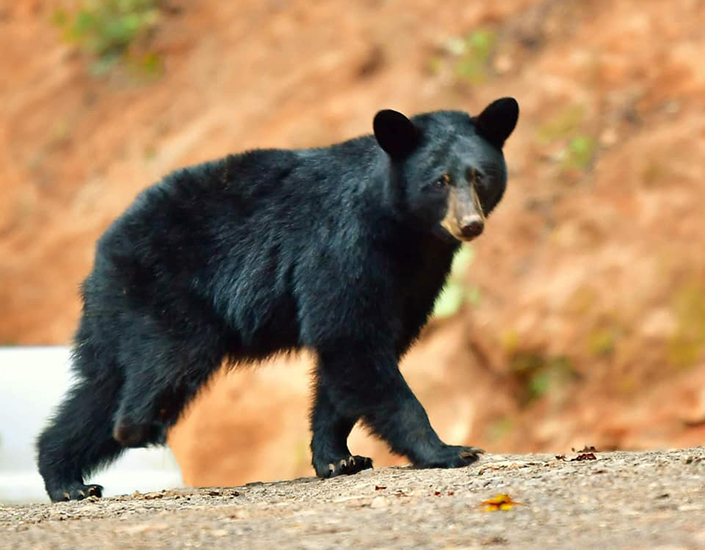 Courtesy of Help Asheville Bears
By any other name: From poaching to cars and traps, black bears face diverse human threats in Southern Appalachians
Activists and state agencies agree bear poaching is an age-old problem in the mountains of Tennessee and North Carolina, but they diverge when it comes to some key aspects of the crime and its prevention.
The non-profit Help Asheville Bears is raising awareness of threats to bears on both sides of the state lines and getting coverage on local media outlets like this piece on Knoxville-based WBIR. Its message has also appeared on a billboard in Sevierville. The Arden, N.C.-based group offers a tip line, rewards and also supports what could be described as a self-styled anti-poaching militia.
“Bear poaching is a big deal. It happens anywhere where there are bears,” said Jody Williams, the founder of Help Asheville Bears, which is responding to what its members see as an increasing threat to the very symbol of wild Southern Appalachia. HAB is especially concerned about trapping that Williams said has left limbless bears limping throughout the mountains.
The group is demanding Amazon quit selling leg-snare traps with a petition on Change.org that has gotten more than 220,000 signatures.
A video at the top of the page shows images and footage of bears with missing limbs as sad flute music plays.
“We currently follow 12 cases of bears missing limbs in a 25 mile radius of the Asheville area and 15 missing limbs within 90 miles of Asheville,” according to the Help Asheville Bears website.
“Help Asheville Bears intends to help prevent illegal bear trapping in the South Asheville and Arden areas, where there has been much photographic evidence of illegal trapping, especially bears missing limbs.”
- bear poaching
- smoky mountains bear poaching
- limbless bear
- legless bear
- save asheville bears
- twra bear
- bear trap
- trap sold on amazon
- poacher strike force
- help asheville bear
- leg trap
- leg trap amazon petition
- danger to bear
- don't feed bear
- bearwise
- tennesse wildlife resources agency
- north carolina wildlife resources commission
- black bear
Tour de France champion will build bikes in Knoxville
WATE: Greg LeMond will manufacture and sell bicycles in Knoxville
Three-time Tour de France winner Greg LeMond christened a new bike shop in Knoxville this week accompanied by Lt. Gov. Randy McNally and Knoxville Mayor Indya Kincannon.
LeMond has been researching and integrating carbon fibers into his bikes for a few years, but the Knoxville shop will sell electric bikes along with other bicycle styles.
“LeMond moved to Knoxville in 2016 and has a goal to build and sell bikes in the city and by the end of 2022, he plans to be making all of his bikes in East Tennessee,” WATE reported.
“The store is selling a range of bikes including road bikes, mountain bikes and electronic bikes. LeMond also stated that Tennessee has some of the best bike riding in the country.”
The store is on Deermont Lane in Knoxville.
More...
Report: Children exposed to coal-ash pollutants in Knoxville-area playground
News Sentinel: Playground near TVA’s Bull Run Fossil Plant contaminated by coal ash
Testing by independent Duke University researchers indicates a playground in the Claxton community contains dangerous levels of coal-ash byproducts.
The playground is near the Tennessee Valley Authority’s Bull Run steam plant, which has historically used vast amounts of coal to produce electricity and stored the resultant coal ash in huge landfills near the facility on Melton Hill reservoir near Oak Ridge. The plant will be decommissioned within two years, but questions remain about how TVA will handle the tons of remnant coal ash produced over the lifetime of the plant.
Duke University researchers sampled soil from the site, and results showed high levels of heavy metals and other toxins typically present in coal ash.
TVA maintains its testing has not detected harmful levels of contaminants in the area, but the News Sentinel’s Jamie Satterfield, who was been relentless in her investigations of TVA coal-ash policies and the disastrous Kingston coal slurry spill of 2008, noted that “There are no human health guidelines, however, for substances like coal ash that combine many toxins or radioactive metals.”
Welcome to the wilderness: Knoxville celebrates its range of outdoor amenities with park dedication
Inside of Knoxville: City dedicates Urban Wilderness Gateway Park
Mountain bikes ripped through ribbons July 23 as city officials, designers and outdoor aficionados marked the opening of an impressive entrance to the city's 500-acre Urban Wilderness. The "ribbon-cutting" had been delayed for months because of the Covid-19 pandemic.
The park is at the terminus of the James White Parkway, which once was planned to slice through what eventually became a regional recreational and environmental asset five minutes (by car) from downtown.
"Phase 1 investment built the park’s infrastructure: neighborhood connections, roads and greenways, lighting and utility installation. The most visible part of Phase 1 is the Baker Creek Bike Park, which was dedicated in August 2020," according to a news release from the city.
"Phase 2, beginning in Fall//Winter 2021, will see construction of the adventure playground at Baker Creek Preserve, restroom facilities, shade structures and picnic areas, as well as new play features and gathering spaces."
Alan Sims has coverage of the event on his excellent Knoxville-centric blog.
DOE moves ahead with plans for radioactive waste dump on Oak Ridge Reservation despite concerns about its ultimate holding power
Oak Ridger: Landfill moves ahead, for now, for DOE demolition debris in Oak Ridge
Hellbender Press contributor Ben Pounds has a great piece in the Oak Ridger about a long dispute over a plan to bury low-level nuclear onsite in a greenfield on Department of Energy property in Oak Ridge. Over the years, many such contaminated materials were typically transported to off-site storage points, namely the western U.S.
Detractors of the plan worry local landfill membranes and safeguards could ultimately fail or be compromised, leading to a surge of low-level radioactive materials and associated contaminants, into the surrounding area and its water tables. Most of the debris slated for storage comes from the demolished legacy buildings of the Oak Ridge Reservation, originally built as part of the Manhattan Project atomic weapons program during World War II.
“DOE released a Draft Record of Decision Monday, July 12, which goes over some of the aspects of this proposed landfill and environmental issues related to it, as part of the process to get approval from Tennessee Department of Environment and Conservation,” Pounds reported in the Oak Ridger.
“Kim Schofinski, TDEC deputy communications director, stated her agency is currently reviewing the document and its revisions, which could take around 120 days.”
Come get up close with a corpse (flower) at UTK
KnoxNews: Welcome to Rocky Top, Rotty Top!
A seldom-seen corpse flower is about to burst forth in bloom following a 20-year sleep — presumably not in a casket and not at the Body Farm — at the Hesler Biology Building at the University of Tennessee in Knoxville.
A previous faculty member got the plant two decades ago, but this is its first blooming cycle, according to the News Sentinel. It has been nursed along by current greenhouse director Jeff Martin — in someone else’s office, of course. The plant only blooms about every 10 years, if not more infrequently.
Members of the public are invited to come partake of the odor and revel in sheer stank in the next several days.
“A 2010 study by Japanese researchers attributed the plant’s smell to a combination of chemicals that smell like cheese, sweat, garlic, decaying meat, rotten eggs and more,” according to the News Sentinel.
But it’s not just about the smell: The plant produces the world’s largest flower and is endangered in the wild. Pollen from this corpse flower (Amorphophallus titanum — you can suss out the literal definition yourself) may be used to pollinate other endangered corpse flowers, which are native to Southeast Asia.
The odor is an evolutionary pollination mechanism to attract flies and other insects that are attracted to the smell of rotting flesh.