
News (340)
EPA to announce stricter regulations on HFC emissions
NYT: EPA plans stricter regulation of HFC emissions
Hydrofluorocarbons were used on an industrial scale to replace ozone layer-destroying chlorofluorocarbons used in refrigeration, cooling and other applications, but they turned out to be a powerful driver of climate change. Scientists estimate HFCs are 1,000 times more potent than carbon dioxide in terms of their cimate-change role.
Oak Ridge National Laboratory scientists continue research into zero-emission refrigerant technologies.
According to Times reporting: “In proposing a new regulation, Michael S. Regan, the E.P.A. administrator, said the agency aimed to reduce the production and importation of hydrofluorocarbons, which are used in refrigeration and air-conditioning, in the United States by 85 percent over the next 15 years.”
It’s Epic: 7,500-acre Roan Mountain wild land donation largest in North Carolina history
CItizen Times: Roan Mountain donation will protect vast stretches of forest in Roan Highlands
Epic Games CEO Tim Sweeney donated 7,500 acres to the Southern Appalachian Highlands Conservancy, an area described by an Asheville Citizen-Times reporter as “A high-elevation hideaway for birds, bears and salamanders, a massive piece of Western North Carolina’s famous mountains left unmarred, and a refuge for rare species in the face of climate change...
“The property includes the largest American Chestnut restoration project in the country, extensive boulder fields, rich coves, old growth forests, six waterfalls, and a system of rare heath balds,” according to Citizen-Times reporter Karen Chavez.
The land area is at least equivalent to the size of some highland state parks.
Knoxville Mayor Indya Kincannon’s budget calls for $30m in environmental-improvement measures
Written by Thomas Fraser
Mayor wants green for green; some otherwise supportive city residents already aren’t pleased with some initiatives.
Mayor Indya Kincannon’s proposed Knoxville 2020-2021 budget commits some $30 million to reduce city climate impacts, expand its use of renewable energy, invest in urban forest preservation and outdoor recreation assets and improve bus and bicycle travel in communities across the city. The budget also provides money for revitalization of the Burlington District, a historic pedestrian center of Black commerce in East Knoxville.
The city’s net budget is $384 million, which includes a $253 million operating fund.
The budget is just a recommendation to City Council at this point.
Nuclear energy update
Sep 13 Noon EST
Current Issues in the Nuclear Field
Richard H “Chip” Lagdon Jr.
Technical Society of Knoxville (TSK)
Zoom Webinar — Free and open to the public — advance registration required
Richard Lagdon is Professor of Practice in Nuclear Engineering at the University of Tennessee. He also is Engineering Manager, Systems Integration and Chief Engineer, Nuclear Operations & Safety with Bechtel National Inc. Reston, VA.
He will review the status of current projects for Natrium and VTR fast reactors, the challenges of advanced reactor licensing and how the development of the Nuclear Licensing Course NE486/586 at UT reckons with these challenges.
He has forty years of progressive nuclear experience managing projects, developing technical policy, interfacing with stakeholders and developing long range plans. He is an accomplished nuclear professional, practiced in engineering, emergency operations, plant startups and conduct of operations while supporting operational goals.
From working as Shift Test Engineer for the reactors of the nuclear Navy to developing life cycle maintenance plans for aircraft carriers, Captain Lagdon’s broad range of assignments over 30 years in the Navy Reserves, earned him the Leo Bilger award for outstanding leadership. The civilian side of his career included a decade as Chief of Nuclear Safety in the U.S. Department of Energy, where he lead nuclear construction reviews for projects totaling more than $15 billion.
While some hope that nuclear energy will end the climate crisis others point out that it will be too expensive and take too long to scale up while climate disasters grow exponentially. What most can agree upon is that the reliable output of existing nuclear plants remains indispensable for the foreseeable future and that maintaining their safety is paramount.
The webinar organized by the Technical Society of Knoxville, which provides Professional Development Hour confirmation to attending professional engineers, is hosted by the Foundation for Global Sustainability (FGS).
FGS facilitates educational events to inform the public and foster better understanding of complex environmental, social and economic issues that impact the resilience of communities and the natural life support systems of planet Earth. Views and opinions expressed by event organizers and participants do not necessarily reflect the views of FGS. FGS neither endorses any product or service mentioned nor warrants for accuracy, completeness or usability of the information.
Technical Society of Knoxville Centennial Celebration
Jun 14 6:30 p.m. EST
The Turning Point: Things were never the same after 1921, when technology was changing the city in several surprising ways
Jack Neely, Executive Director of the Knoxville History Project
Technical Society of Knoxville (TSK)
Charity Banquet at Crowne Plaza for the Charles Edward Ferris Engineering Endowments at University of Tennessee, Knoxville - the public is invited - RSVP by June 8
Ferris was the first Dean of UTK’s College of Engineering.
More details on the event, sponsorships, and reservations
The Technical Society of Knoxville was founded in 1921. It has met over 4,000 times to discuss the application of technology from early Knoxville’s coal smoke and traffic problems to present Knoxville’s transportation air pollution and the impact of electric car technologies.
ORNL scientists fan out to local schools and bring their research home during National Environmental Education Week
Written by Karen Dunlap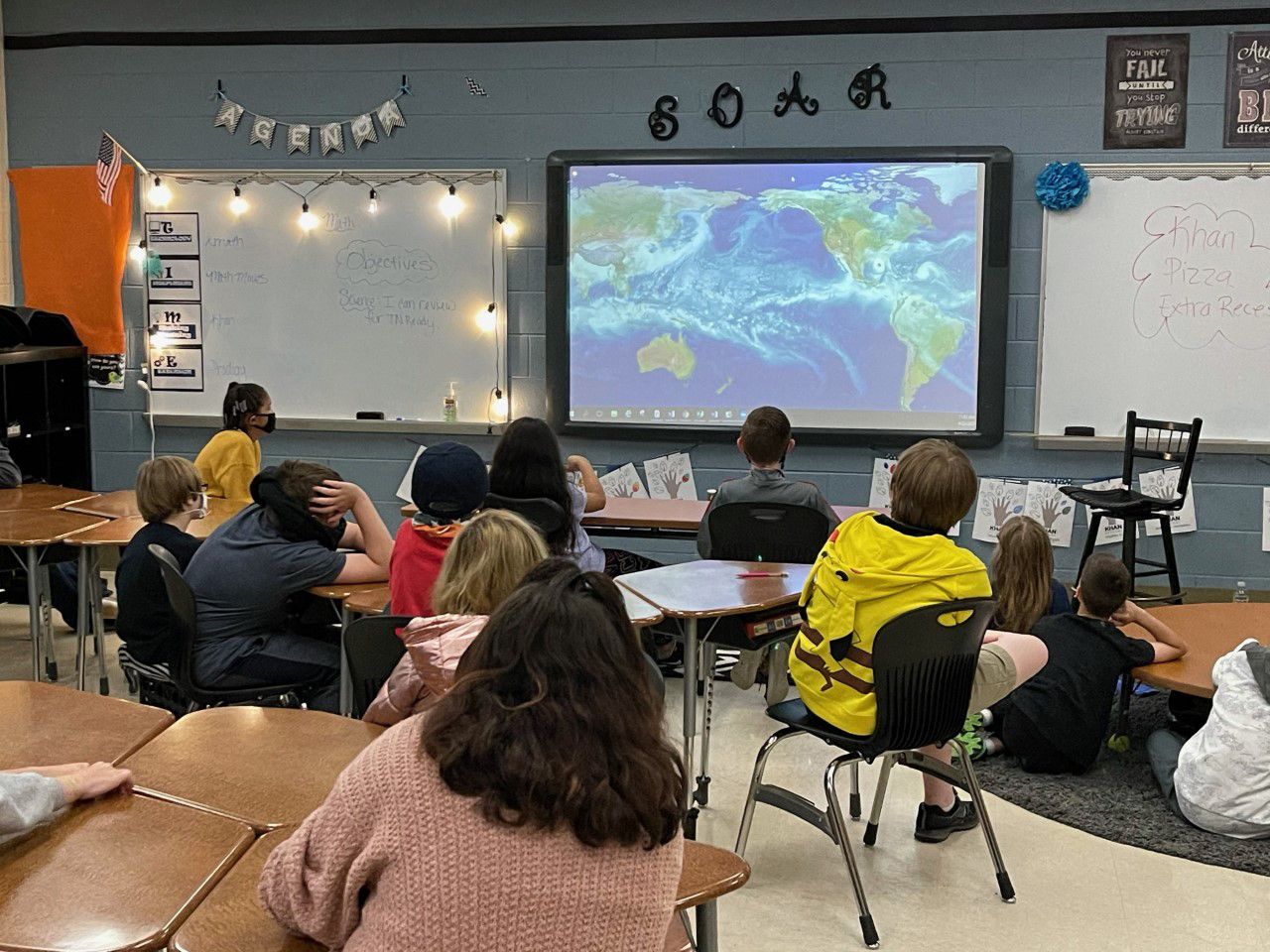 Students listen to a presentation from an Oak Ridge National Laboratory researcher during National Environmental Education Week. Courtesy Oak Ridge National Laboratory
Scientists link research to students’ lives and communities
(Editor’s note: Karen Dunlap is a public information officer at Oak Ridge National Laboratory).
Esther Parish is one of eight Oak Ridge National Laboratory scientists talking to students in nine schools across East Tennessee as part of National Environmental Education Week.
On Monday, she spoke to Cathy Kimball’s fifth-grade class at Lenoir City Middle School.
The discussion covered renewable energy resources, science career paths and how climate change may affect East Tennessee.
Other ORNL scientists, including Debjani Singh, Liz Agee, Shelaine Curd, Spencer Washburn, Colleen Iversen, Keith Kline and Matthew Langholtz are participating in classroom events through April 30.
The national event is organized by the National Environmental Education Foundation (NEEF), which celebrates environmental education.
“I think it is important to reach out to young people about environmental science because the choices that our society makes regarding renewable energy resource development and climate-change mitigation will have long-term effects on their environment, health and future quality of life,” Parish said. She is a member of ORNL’s Environmental Science Division and specializes in geography and landscape ecology.
 This photo provided by Ijams Nature Center is an example of the plethora of weird things removed from the Tennessee River and its tributaries during the annual River Rescue held March 27.
Mattresses, rocking horse and plastic shed among the stranger items retrieved from area waterways
Volunteers removed 31,000 pounds from the Tennessee River and its watersheds on March 27 during the 32nd annual Ijams River Rescue despite a storm system that dropped several inches of heavy rain on the area.
The rain dissuaded some of the 717 volunteers signed up for the river rescue, but nearly 500 people still joined together to collect trash from 32 sites. Their nasty haul included 919 bags of garbage and 82 tires, according to a release from Ijams Nature Center.
The heavy rain actually worked out somewhat in organizers’ favor, as debris and flotsam were flushed from tributaries into the main stem of the river.
“Heavy rain always means more trash because the rising waters wash everything downstream and into the Tennessee River,” Ijams Volunteer Coordinator Madelyn Collins said in the news release. “We are so appreciative to everyone who braved the storms and did the work while they could. It was amazing how much volunteers accomplished in such a short time.”
One lucky participant found a $50 bill; other unusual items removed from the river included a toilet, a recliner, mattresses, a rocking horse, plastic shed and a baby stroller.
“The takeaway from this year’s event—and every other cleanup this community does—is that we need to be more careful about how we dispose of trash and recyclables. If you don’t put it where it belongs, it ends up in our water.”
Tennessee Valley Authority; city of Knoxville Stormwater Engineering; Bio Plumbing, LLC; First Horizon Foundation; Tennessee Wildlife Resources Agency; WestRock CP, LLC; Genera, Inc.; Knoxville TVA Employees Credit Union; Waste Connections of Tennessee Inc.; CAC AmeriCorps; and the Water Quality Forum sponsored, supported or participated in the annual cleanup.
Show your mother some love this Earth Day
There are lots of ways to show your affection for our planet on Thursday, which marks the 51st annual observance of Earth Day.
You can stay at home and plant a tree; donate to your favorite environmental charity; join a virtual event; or clean up your block.
Or, unlike last year, you can join other like-minded individuals at socially-distanced observances and trash cleanups, and even drink some beer and get in a good jog with a purpose.
Here's a sampling of Earth Day celebrations in East Tennessee, some of which will occur Thursday and some of which will stretch into the weekend. If you'd like to include an event, please email This email address is being protected from spambots. You need JavaScript enabled to view it..
-
Hellbender Press editor and publisher Thomas Fraser will join several featured speakers during the Narrow Ridge Earth Literacy Center Earth Day 2021 Celebration. The virtual event runs from 6-8 p.m. Thursday and will include poetry, music and networking opportunities. You can register here. You can also view the Narrow Ridge Earth Day celebration on its Facebook page.
-
Infinite Light Center will host an Earth Day ceremony at First Creek Park in Old North Knoxville at 11 a.m. Thursday, followed by lunch and music. Attendees are asked to bring a musical instrument, folding chair, and an individual lunch. Participants can also bring personal items to include in a mandala made with natural objects found in the park.
-
Knoxville skaters and others are invited to come out and clean up the area around the Tyson Park skatepark at 6 p.m. Thursday. A skate session will follow.
-
Keep Knoxville Beautiful will host a fun run along Sutherland Avenue to clean up litter along the roadway beginning at 6 p.m. Thursday. Enjoy a brew from Albright Grove Brewing Company after the event.
-
Seven Islands State Birding Park will offer a science program for home-school students from 1-3 p.m. Thursday. The program will include basic ecology lessons and crafts. Register here.
-
The annual Running for the Bears 5k begins at at 10 p.m. Friday at Nantahala Outdoor Center in Gatlinburg. Proceeds from the race benefit Friends of the Smokies and black bear preservation efforts.
- Greensteps and WaterWays in Chattanooga will host a Citico Creek cleanup from 1 to 4 p.m. Thursday.
- Green Steps and North Chickamauga Creek Conservancy organized a cleanup of North Chickamauga Creek from 12 to 3 p.m. Saturday. There are a range of other Earth Day events in the Chattanooga area.
TDOT opens virtual-only Pellissippi Parkway extension comment period for two weeks
Written by Thomas Fraser
$20 million per mile: TDOT opens virtual-only comment on highly controversial roadway
The Tennessee Department of Transportation has opened a virtual-only public comment period for the controversial Pellissippi Parkway extension, which would slice through the remaining rural areas of Blount County and move urban expansion and increased traffic flow ever closer to the Great Smoky Mountains, one of the most biologically diverse areas on Earth.
The public comment period began April 15 and will last until April 25. The project has generated controversy and lawsuits for at least two decades, but TDOT decided the comment period should be held virtually for only two weeks because of the Covid-19 pandemic.
The project encompasses about four miles and will cost nearly $100 million. Opponents of the parkway say the extension is a waste of money and will destroy rural landscapes and wildlife habitat and pollute aquatic resources.
Here's a link to a story about the Pellissippi Parkway extension published in February by Hellbender Press.
According to The Daily Times, which reported the public hearings on April 19:
“'The COVID-19 pandemic has forced the department to look for alternate ways to engage and interact with the public,' TDOT spokesman Mark Nagi said in a video introducing the presentation, framed as a somewhat awkward-to-navigate virtual reality room.”
“It includes a history of the project, a right of way acquisition process overview, a project design summary and a comments and questions section. A digitally generated flyover video of the planned extension shows intricate details of how the road may look once completed.”
According to the TDOT website:
“The Tennessee Department of Transportation (TDOT) will host a Virtual Design public meeting from April 15, 2021, to April 29, 2021, to gather public input on the proposed project in Blount County on SR-162 Ext. (Pellissippi Parkway), from SR-33 to SR-73 (US-321).”
“The virtual meeting was opened to the public at 8:00 am EST on April 15, 2021 and will close at 10:00 pm EST on April 29, 2021. The website link is:
https://gather.cdmsmith.com/v/v8jkyAVO149.”
The proposed highway would require the acquisition of private property and extend through the Wildwood and Sam Houston areas to an abrupt terminus with East Lamar Alexander Parkway to the west of Walland, which is host to an increasing number of high-dollar hospitality attractions such as Blackberry Farm.
Right-of-way acquisitions could start by the end of the year, according to The Daily Times.
To the east of the proposed parkway's end is Townsend, which bills itself as the “Peaceful Side of the Smokies.”
Hard Knox Wire: Renowned white supremacist killed by accidental headshot in South Knox
Written by JJ Stambaugh
Well-known Knoxville white supremacist and ‘cultured thug’ dies of apparent accidental gunshot wound to head
Originally published by Hard Knox Wire
A Knoxville man who earned widespread notoriety as a leader in the violent white nationalist movement died last week after he was shot in the head in South Knox County.
Spaulding was among eight white supremacists who were arrested in the summer of 2020 during a Black Lives Matter protest in Rogersville.
Follow the latest Knoxville crime and justice news from Hard Knox Wire.
More...
Saving America’s “Amazon” in Alabama
Written by Tara Lohan
Alabama is home to remarkably diverse ecosystems:
They face dire threats.
This story was originally published by The Revelator.
When longtime environmental journalist Ben Raines started writing a book about the biodiversity in Alabama, the state had 354 fish species known to science. When he finished writing 10 years later, that number had jumped to 450 thanks to a bounty of new discoveries. Crawfish species leaped from 84 to 97 during the same time.
It’s indicative of a larger trend: Alabama is one of the most biodiverse states in the country, but few people know it. And even scientists are still discovering the rich diversity of life that exists there, particularly in the Mobile River basin.
All this newly discovered biodiversity is also gravely at risk from centuries of exploitation, which is what prompted Raines to write his new book, “Saving America’s Amazon.”
The Revelator talked with Raines about why this region is so biodiverse, why it’s been overlooked, and what efforts are being made to protect it.
Question: What makes Alabama, and particularly the Mobile River system, so biodiverse?
Answer: The past kind of defines the present in Alabama.
During the ice ages, when much of the nation was frozen under these giant glaciers, Alabama wasn’t. The glaciers petered out by the time they hit Tennessee. It was much colder but things here didn’t die.
Everything that had evolved in Alabama over successive ice ages is still here. We have a salamander, the Red Hills salamander, that branched off from all other salamander trees 50 million years ago. So this is an ancient salamander, but it’s still here because it never died out.
The other thing you have here, in addition to not freezing, is that it’s really warm. Where I am in Mobile, we’re on the same latitude as Cairo. So the same sun that bakes the Sahara Desert is baking here.
But we also have the rainiest climate in the United States along Alabama’s coast. It actually rains about 70 inches a year here. By comparison, Seattle gets about 55 inches. It makes for a sort of greenhouse effect where we have this intense sun and then plenty of water. Alabama has more miles of rivers and streams than any other state.
Things just grow here.
The pitcher plant bogs of Alabama, for example, are literally among the most diverse places on the planet. In the 1960s a scientist went out and counted every species of flowering plant in an Alabama pitcher plant bog. He came up with 63. That was the highest total found on Earth in a square meter for a decade or more.
For a long time the Great Smoky Mountains National Park was thought to be the center of oak tree diversity in the world because they have about 15 species of oaks in the confines of the park. Well, two years ago scientists working in this area called the Red Hills along the Alabama River found 20 species of oak trees on a single hillside. It’s just staggering.
Why is Alabama’s rich biodiversity not well known or studied?
The state was never known for being a biodiverse place until the early 2000s, when NatureServe came out with this big survey of all the states. It surprised everyone because it showed Alabama leading in aquatic diversity in all the categories — more species of fish, turtles, salamanders, mussels, snails.
This blew everybody away because Alabama in everybody’s mind is the civil rights protests of the 1960s, the KKK, steel mills and cotton fields. But that’s not what’s in Alabama, that’s what we’ve done to Alabama since we’ve been here.
I think part of it also has to do with being a long way from Harvard and Yale and Stanford and the great research institutions that were sending biologists all over the world. Alabama just wasn’t really studied or explored.
Again and again, the story in Alabama is that nobody has ever looked.
That’s one of E.O. Wilson’s big messages about Alabama. He is our most famous living scientist, I would say, or certainly biologist. He grew up here, and now in his twilight years his big mission has become trying to save Alabama. And he describes it as less explored than Borneo and says we have no idea what miracle cures and things we may find in the Mobile River system, which is what I call “America’s Amazon.”
Vandals deface 1,200-year-old Cherokee and Creek rock carvings in North Georgia
NYT: Ancient Native American rock carvings vandalized in Chattahoochee National Forest
From the “this is why we can’t have nice things” file: Vandals violated ancient and sacred Cherokee and Creek art with scratches and paint in the Track Rock Gap area of Chattahoochee and Oconee national forests.
“It’s one of the most significant rock art sites in the Southeastern United States and the only such site located on public land in Georgia,” according to a National Forest Service Facebook post, the NYT reported. That post was later removed by the forest service, which cited the ongoing criminal investigation.
The rock carvings date to 800 A.D. The vandalism occurred at some point in 2020 or early this year.
There are at least 100 Native American petroglyphs in the north Georgia national forests. Some of the more prominent sites are fenced but allow people to view the ancient art.
Also from the Times report:
The Cherokee Tribal Heritage Preservation Office said in a statement that the Eastern Band of Cherokee people were “sad and frustrated” to learn of the vandalism.
“They are special sites for the Eastern Band of Cherokee Indians and for all people as part of the Heritage of this region,” the statement said. “Whether through ignorance or malice — the result is irreparable damage to a unique site that connects us directly to the people of the past.”
Ecological Society of America honors Oak Ridge National Laboratory scientists for sustainability research
Written by Thomas FraserORNL researchers receive 2021 Sustainability Science Award for mapping human influence on U.S. river and stream changes
Researchers from Oak Ridge National Laboratory mapped and quantified hydrological changes throughout the country due to urban development, energy production and other human factors and won a prestigious award for their efforts.
The team’s analysis was published in the Proceedings of the National Academy of Sciences and received the 2021 Sustainability Science Award from the Ecological Society of America.
“The Sustainability Science Award recognizes the authors of a scholarly work that make a substantial contribution to the emerging science of ecosystem and regional sustainability through the integration of ecological and social sciences. The researchers will be recognized during the society’s annual meeting in August,” according to an ORNL release announcing the award.
The research coupled U.S. Geological Survey stream-flow records with geospatial modeling to quantify human impact on national water resources and concluded the 7 percent of affected aquatic systems hold 60 percent of North American freshwater fish, mussels and other species.
“This work exemplifies how ORNL’s interdisciplinary research in environmental and geospatial science helps equip decision makers with the tools needed to move our nation toward a more sustainable future,” Stan Wullschleger, associate laboratory director for ORNL’s Biological and Environmental Systems Science Directorate, said in the release.
Lead author Ryan McManamay, an aquatic ecologist and faculty member at Baylor University, was with ORNL’s Environmental Sciences Division at the time of publication. Co-authors include ORNL’s Sujithkumar Surendran Nair, Christopher DeRolph, the late April Morton, Robert Stewart, Matthew Troia and Budhendra Bhaduri; Northern Arizona University’s Benjamin Ruddell; and the University of Tennessee’s Liem Tran and Hyun Kim.
“It was a privilege to work with this team that spanned across multiple disciplines and institutions,” said Bhaduri, an ORNL Corporate Research Fellow and director of ORNL’s Geospatial Science and Human Security Division. “Given the impacts of climate change, there has never been a more pressing opportunity to address environmental sustainability. It’s a tremendous honor to make this scientific contribution and to be recognized for it.”
- oak ridge national laboratory
- sustainability
- ecological society of america
- sustainability research
- ornl
- hydrology change
- human impact
- aquatic environment
- sustainability science award
- streamflow
- ecology
- mapping
- urban development
- sociology
- us geological survey
- geospatial modeling
- geospatial science
- research
- interdisciplinary
Developer slams brakes on proposed Oak Ridge motorsports park
Knox News: Developer pulls Oak Ridge motorsports park proposal after pushback
In a victory for local environmentalists, the developer who proposed and pushed for a motorsports park on the western end of Oak Ridge has abandoned the project in hopes of finding a more “attractive” community.
The park would’ve been located in the Horizon Center industrial park and required the development of natural areas preserved via a city agreement with the Department of Energy.
Individuals and groups such as the Oak Ridge-based Tennessee Citizens for Wilderness Planning said the proposal was inherently inappropriate for the site, citing the loss of diverse, mature hardwood forest, and noise pollution.