SACE analyzed how much consumers spend on gas and diesel and how much of that transportation fuel spending remains in a given Southeast state and how much leaves. The analysis then looked at what happens if all on-road gas and diesel-powered cars, trucks, and buses are replaced with vehicles that drive entirely on electricity.
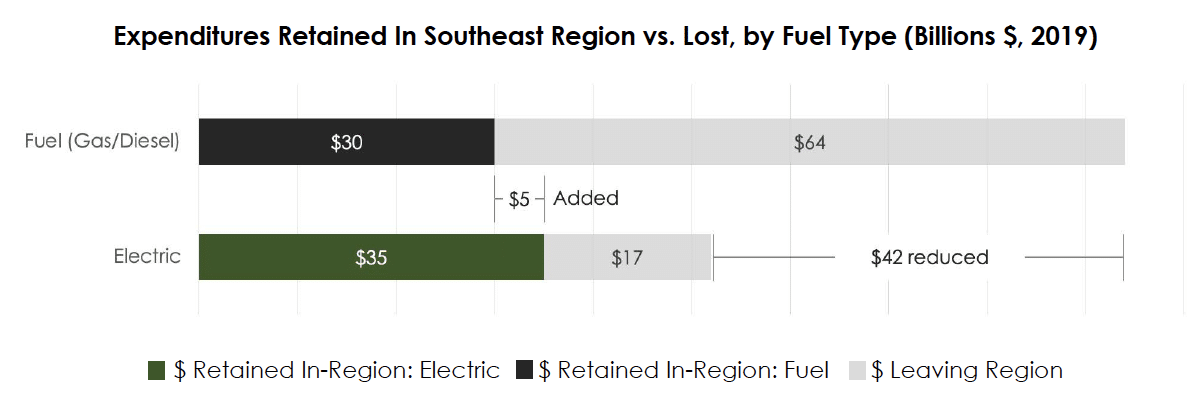
Southeast consumers spend approximately $94 billion on gas and diesel fuels annually. And because the region has nearly no oil production or refining operations, only about one-third of that amount — approximately $30 billion — is retained in our region’s economy, and the rest leaves to pay for the imported fuels. That adds up to $64 billion leaking out of our region’s economy every year.
“Retained Transportation Fuel Spending in the Southeast” report, Expenditures Retained In Southeast Region vs. Lost, by Fuel Type, page 3
ELECTRIFYING TRANSPORTATION COULD PATCH THE LEAK
As light, medium, and heavy-duty vehicle electrification accelerates, more efficient vehicles and cheaper in-state-generated electricity allow consumers to spend less to drive the same number of miles. If all of the region’s vehicle miles traveled were electric today, Southeast consumers would spend approximately $52 billion on electricity, reducing consumer transportation fuel spending by $42 billionannually.
EXTRA SPENDING KEPT IN THE SOUTHEAST BY ELECTRIFYING TRANSPORTATION
Additionally, more than two-thirds of those $52 billion dollars we would spend on electricity for transportation — approximately $35 billion — would stay in the region, vs. the $30 billion we retain under the current system that relies heavily on gas and diesel. This means that we could keep an additional $5 billionannually recirculating through and supporting local economies if we switched to a fully electric transportation system.
By saving consumers $42 billion in fuel spending and keeping an extra $5 billion in-region, electrifying transportation in the Southeast would result in $47 billion in transportation fuel spending retained annually.
Why it matters: Economic impacts should be considered in policy and regulatory actions
Our goal in conducting this analysis is to broaden policymakers,’ utility regulators,’ and industry stakeholders’ views of transportation electrification costs and benefits, stimulate discussion and spur additional research.
It is increasingly understood that electrifying America’s car, truck, and bus fleets will require federal, state government, utility, and private investment. And a lot of it. That is evidenced by the billions of dollars earmarked in the federal infrastructure bill; the $93 million of EV-related Volkswagen Settlement funds spent to date by Southeast states; the over $189 million invested and proposed by Southeast utilities; and the more than $30 billion of auto industry investment in passenger EVs alone.
The Southeast clearly has a lot to gain by distancing itself from imported gas and diesel and embracing locally-generated electricity to power transportation. Such an embrace will result in even greater payback over time as the region, which basks in sunshine, ramps up utility-scale and distributed solar generation, allowing even more dollars to be retained and invested in local economies and local jobs. As those retained dollars recirculate through local economies, they will create a multiplying economic impact.
And then there are the jobs. Collectively, Alabama, Georgia, Florida, North and South Carolina, and Tennessee make up 18 percent of the nation’s population.
These states have secured 18 percent (7,785) of EV jobs, and an outsized 37 percent ($11.2 billion) of national EV investment.
And it’s important to remember that beyond direct EV jobs are all the supply chain jobs, including mineral mining, battery production, charging infrastructure manufacturing and installation, and industry research and development, which are all present in the region and prepared to grow.
State policymakers and utility regulators need to understand what is at stake. We need a strong EV market to retain billions of dollars in transportation fuel spending and support continued regional EV industry job growth. To foster a strong EV market, we need favorable policies and regulatory reforms.
Utilities and regulators are beginning to propose and approve more ambitious electric transportation investments, but the Southeast currently represents just over 4 percent of utility EV investment nationwide. Utilities have the capacity to spur EV charger deployment, support school, and transit bus electrification, and educate consumers at scale. And doing so is in the utilities and ratepayers’ best interests: EVs will create new electricity demand, which in turn will increase utility revenue, and at the same time put downward pressure on utility rates. Utilities are also positioned to ensure EV investments are equitable and reach traditionally marginalized and underserved communities.
The Southeast transportation electrification equation is becoming clearer: favorable policies + regulatory reforms = $47 billion in annual retained transportation fuel dollars and thousands of jobs. Policymakers, regulators, and industry stakeholders need to continue unpacking the costs and benefits. Clearly, there are significant financial investments needed to electrify the movement of people, goods, and services. But the economic returns to be gained are significant and favorable.
Electrify the South is a Southern Alliance for Clean Energy program that leverages research, advocacy, and outreach to promote renewable energy and accelerate the equitable transition to electric transportation throughout the Southeast. Visit ElectrifytheSouth.org to learn more and connect with us.
MEMPHIS —Area residents were invited to a film screening of “Keep the Lights On” and a panel discussion at the Memphis Rox climbing gym with community members, local advocates and policy experts. The event, which ran from 10 a.m. to 4 p.m. Saturday, Aug. 20, coincided with Global Climbing Day, and professional rock climbers Nina Williams, Manoah Ainuu (who recently summited Everest), Olympic Silver Medalist Nathaniel Coleman, and Fred Campbell hosted and participated in community and climbing-oriented events prior to the film screening and conversation.
The film follows Memphis Rox staff member and leader Jarmond Johnson, recounting his experiences with intermittent energy access growing up in South Memphis, his growth into a gang activist and mentorship role at Rox, and, ultimately, working with professional rock climber and environmental activist Alex Honnold (best known for the academy award-winning film, Free Solo) to bring solar energy to the gym. Following the screening, Jarmond and a panel of experts discussed takeaways from the film, and how equitable access to solar energy could help all Memphians keep their lights on.
KNOXVILLE—Clean-energy advocates are urging the Tennessee Valley Authority to use funds provided through the Inflation Reduction Act to deliver environmentally friendly energy to Tennessee customers.
The massive bill Congress passed Friday includes $370 billion for clean energy investments and listed TVA as an entity that is eligible to take advantage of clean energy credits and loans to significantly reduce the cost of energy-efficient infrastructure.
On Aug. 12, the Clean Up TVA Coalition, including the Sierra Club, the Southern Alliance for Clean Energy and Appalachian Voices, urged TVA to take advantage of the legislation and make funds available to its affiliated local power companies, which can then offer energy-efficient options for customers.
A rainbow pierces gray skies during the 2021 United Nations Climate Change Conference in Glasgow. United Nations
Climate activists stress positives of Senate climate bill despite its shortcomings
Amy Rawe is communications director for Knoxville-based Southern Alliance for Clean Energy.
KNOXVILLE — The U.S. Senate passed the Inflation Reduction Act (IRA), an estimated $430 billion bill, of which approximately $370 billion will be allocated to investments in clean energy and to address climate change.
It’s the single largest climate investment in U.S. history, and if it passes the House, will put the country on a path to be able to achieve roughly 40 percent emissions reduction from 2005 levels by 2030, reestablishing our influence in meeting the Paris Agreement goal of limiting global warming to 1.5 degrees Celsius.
Report: Many utilities are not reducing carbon emissions despite public assurances to the contrary
KNOXVILLE — Global greenhouse gas emissions must peak by 2025 and experience rapid and deep reductions to avoid a potentially catastrophic future, according to a new analysis by air-quality and climate advocates. Emissions must reach net zero by the early 2050s to limit warming to 1.5 degrees (C) in order to avoid the worst impacts of the climate crisis.
Many utilities and municipalities have acknowledged this dynamic, but the Southern Alliance for Clean Energy s fourth annual “Tracking Decarbonization in the Southeast" report highlights that current utility resource plans are not in line with this overarching target. Obstacles to getting utilities on track that are discussed in our report include: increasing reliance on fossil gas, underutilizing energy efficiency, and placing limitations on popular technologies such as rooftop solar. There’s still a lot of work to do before any Southeast utility is on track to decarbonize.
Southern Alliance for Clean Energy's fourth annual “Tracking Decarbonization in the Southeast: Generation and Carbon Emissions” report will be released Wednesday, June 22
Amy Rawe is communications director for Knoxville-based Southern Alliance for Clean Energy.
KNOXVILLE — The report examines power-sector generation and emissions throughout the Southeast, which is home to some of the biggest utility systems in the nation, including Duke Energy, Southern Company, NextEra Energy, and the Tennessee Valley Authority.
Many of these Southeastern utilities have been in the national spotlight for their professed commitment to decarbonization, but there are often inconsistencies between stated goals and resource plans.
Illustration courtesy of Southern Alliance for Clean Energy
Annual SACE, Atlas Public Policy data indicates rapidly escalating and enduring demand for electric vehicles in Southern U.S.
Stan Cross leads Knoxville-based Southern Alliance for Clean Energy's electric transportation policy and utility reform efforts across the Southeast.
When will the electrification of America’s cars, trucks, and buses really take off?
Imminently, if not already. Look to the Southeast, which is experiencing impressive EV market growth despite a lack of state-level EV-supportive policies, incentives and regulations.
This is a critical time for the expanding EV market. The pandemic has exposed global supply chain weaknesses related to auto manufacturing and battery production that can only be solved by increasing domestic production of critical materials and components.
The Russian invasion of Ukraine is once again exposing the entanglement of America’s commitment to global democracy and dependency on oil for transportation, and highlighting the national security benefits of rapidly transitioning to electric mobility powered by domestic electricity.
Editors note: SACE executive director Stephen Smith is on the board of Foundation for Global Sustainability. Hellbender Press operates under the FGS nonprofit umbrella.
It continues to highlight that despite being a proven low-cost clean energy resource with enormous potential to reduce carbon emissions and customers’ energy burden, Southeastern utilities continue to underinvest in energy efficiency.
As a result, households in many Southeastern states have some of the highest electricity usage and monthly energy bills in the nation. Some states and utilities are making progress, and it’s not too late for local policymakers to take advantage of untapped efficiency savings to help reach crucial decarbonization goals.
The Tennessee Valley Authority's fossil plant at Kingston. TVA
Southern Alliance for Clean Energy: TVA is not coming clean in Congressional inquiries
KNOXVILLE — On Jan. 13, the U.S. House of Representatives Committee on Energy and Commerce sent a letter to the Tennessee Valley Authority (TVA) requesting information regarding business practices that appear inconsistent with TVA’s statutory requirement to provide low-cost power to residents of the Tennessee Valley.
TVA’s response to the committee’s 16 questions dodges some of the committee members’ key concerns and provides misleading information on several issues, including:
A public demonstration in September 2021 in Market Square in Knoxville demanding TVA resume public meetings with reasonable pandemic safeguards.Courtesy Southern Alliance for Clean Energy
After pandemic starts and stutters, TVA finally allows personal public input at meetings
KNOXVILLE
For the first time in nearly two years, the publicly owned Tennessee Valley Authority will host a public listening session on the day prior to its next board of directors meeting.
Since shifting to virtual board meetings in 2020, TVA diverged from other utilities across the country by not holding a single virtual public listening session. In addition, written comments submitted by ratepayers prior to board meetings have not been shared with the media or the public.
This is a submission from the Southern Alliance for Clean Energy.
After public advocacy from Knoxville community members, the KUB board passed a resolution that will deliver $5 million for emergency bill assistance to benefit those most in need, and an additional $1 million for weatherization to improve the comfort of people’s homes while lowering their bills by increasing energy efficiency. These funds are part of a pandemic relief credit from TVA.
KUB staff proposed a resolution in October that would have allocated $1.3 million of the total $7.3 million TVA pandemic recovery credit toward payment of debt owed by KUB customers, and the remaining $6 million would be distributed as a monthly bill credit for all residential and small business KUB customers. This would have resulted in an average savings of $17 over 12 months, or about $1.40 per month for all KUB customers, regardless of their level of need for pandemic relief.
Knoxville Water and Energy for All (KWEA), a coalition which SACE is a part of, circulated a petition asking that KUB instead forgive all debt owed by KUB customers, and then use the remaining funds to assist households who were struggling to pay their KUB bills. KWEA delivered nearly 200 petition signatures, and the KUB board asked that the resolution be amended.
As a result of our coalition’s advocacy, the KUB board allocated not only the originally proposed $1.3 million for debt relief, but also the remaining $6 million for customers in need.
While KUB did not pledge to forgive all debt, this is certainly a major win for the community.
The KUB Board’s decision to reallocate funds demonstrates the power of our community speaking up to advocate for ourselves and our neighbors.