
Voices (19)
APIEL, the 13th Appalachian Public Interest and Environmental Law conference is set for Saturday, October 1
Written by Wolf Naegeli ELO is a student-run organization at the University of Tennessee College of Law. It is not directly affiliated with the University of Tennesse or any particular non-profit organization. It is dedicated to providing students and attorneys with learning opportunities and leadership experiences.
Networking environmental leaders across Appalachia and the State of Tennessee
Knoxville — APIEL is a relative newcomer to the small circle of inclusive U.S. public interest environmental law conferences. Because it is organized by law school student volunteers, APIEL is affordable to attend for students as well as citizens from all walks of life.
APIEL is much loved and considered essential by regional nonprofit leaders and activists. It is also highly acclaimed by seasoned environmental lawyers. With just 12 conferences under its belt, APIEL has risen to rank among leading peer conferences with a much longer track record, such as the Public Interest Environmental Law Conference (PIELC) at the University of Oregon School of Law (39 events), the Red Clay Conference at the University of Georgia School of Law (34) and the Public Interest Environmental Conference (PIEC) at the University of Florida’s Levin College of Law (28).
- public interest
- environmental law
- university of tennessee college of law
- environmental issue
- tva
- pipeline controversy
- natural gas
- climate change
- dean rivkin
- john m rosenberg
- public interest lawyering in appalachia
- continuing legal education tennessee
- appalachian public interest and environmental law conference
Updated with image — From Knoxville paper boy to owner of the NYT: Panel and plaque to highlight local roots of Adolph Ochs
Written by Thomas Fraser
KNOXVILLE — Adolph Ochs’s path to running The New York Times started in downtown Knoxville, and local organizations and educators will recognize the historical significance with a panel discussion and dedication of a historic plaque.
The East Tennessee chapter of the Society of Professional Journalists (ETSPJ); University of Tennessee School of Journalism and Electronic Media (UTJEM); Knoxville History Project; and Front Page Foundation (FPF) have teamed up for two events that are free and open to the public.
Public comment: Environmental group leaders say TVA makes input difficult
Written by Dulce Torres Guzman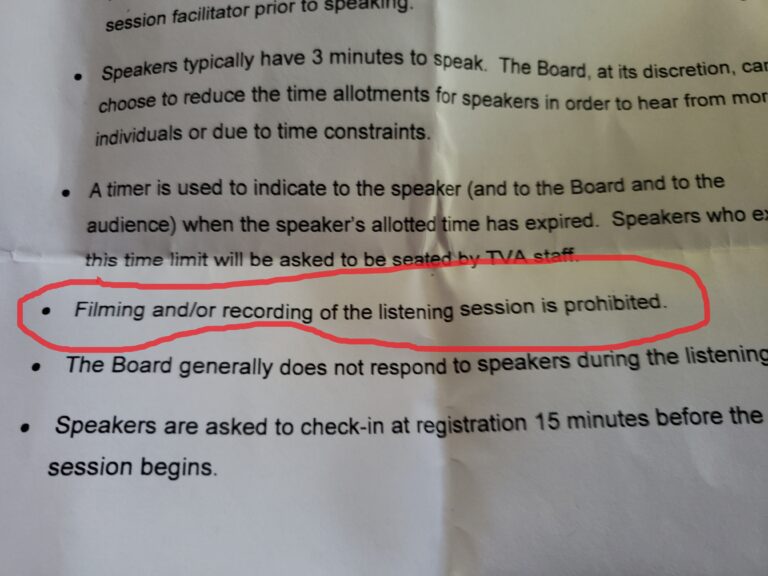 Scott Banbury with the Tennessee Chapter of the Sierra Club said a handout provided at TVA’s Aug. 30 listening session stated recordings of the meeting were not allowed; a TVA spokesperson said recordings are, in fact, allowed. Flyer provided by Scott Banbury
Is TVA trying to gag its critics?
This story was originally published by Tennessee Lookout.
KNOXVILLE — While the Tennessee Valley Authority, a utility company that provides power to millions in Tennessee and other states, allows for public input into decisions, the process isn’t simple or transparent, say some regular attendees.
Take, for instance, a recent public listening session: representatives of the Tennessee Chapter of the Sierra Club say they were told they could not record the session despite a spokesman for TVA saying the opposite.
According to TVA spokesperson Scott Brooks, attendees are always allowed to record public meetings, provided they don’t cause a disturbance, but minutes before the session, members of the Tennessee chapter of the Sierra Club were prohibited from doing so.
Coral, waste, water and weeds: Environmental vignettes from a UT journalism class
Written by Kaylee Walper, Mallory DeVore, Grace Ellison, Kathryn Kavanagh An empty Circle Park is seen in April. The park is adjacent to the UT School of Journalism and Electronic Media. Steven Bridges/University of Tennessee
Everybody has a story about the natural environment. Look around, and into yourself.
University of Tennessee journalism professor Mark Littmann asks students in his environmental writing class every semester to write short sketches about environmental issues they may observe during any given day. Such an assignment requires an almost poetical approach. Here's a sampling from spring semester.
A reef of bones
Huge schools of rainbow-colored fish weave through the brightly colored corals as Sir David Attenborough describes a day in the life of a fish on the television screen. A little girl is mesmerized; this is no Disney fantasy but real life. The nature shows on Animal Planet capture her imagination and soon mornings and afternoons are spent watching big cats and meerkats navigate the wild spaces they call home. She finds an instant favorite in the book “The Rainbow Fish” and celebrates turning four with a sparkly rainbow fish cake, hand decorated with sprees for rainbow scales. She insists someday she will swim among the fish in their magical undersea world.
 Cherokee tribal council member, historian and ethnographer Will West Long holds a traditional Cherokee mask, which he often recreated. He was an active chronicler of Cherokee custom, heritage and tradition and died in 1947 on the Qualla Reservation in Swain County, North Carolina. WikiCommons
As plans gel for massive new developments, has the Eastern Band lost its ancient way?
SEVIERVILLE — The Tennessee Department of Transportation is eyeing a second interchange for exit 407 at Highway 66 along Interstate I-40 in Sevier County.
Exit 407, already one of the most congested interchanges in Southern Appalachia, accesses the main highway to Great Smoky Mountains National Park, the most visited national park in the nation. The park reported a record 14 million visitors in 2021.
The exit also serves crowds flocking to Pigeon Forge and Gatlinburg.
But the new interchange would primarily serve a 200-acre development to be called Exit 407: The Gateway to Adventure.
Scheduled to open spring 2023, and fully operational in 2024, it’s expected to attract 6.7 million people annually. The first phase includes a theme park and a 74,000-square-foot convenience store with 120 gas pumps, making it the world’s largest such store.
- exit 407
- eastern band of cherokee indians
- cherokee
- buc'ees
- world's largest convenience store
- cherokee, nc
- qualla boundary
- theme park at exit 407
- cherokee 'the right way'
- great smoky mountains national park
- great smokies visitation
- sevier county
- swain county
- cherokee casino
- when will buc'ees open in sevier county
- buc'ees beef jerky
- trail of tears
- pigeon forge
- gatlinburg, tn
- traffic in smokies
- traffic in sevier county
- will west long
- cherokee tradition
- cherokee heritage
- what was cherokee's connection to the environment
- rick vaughan
- hellbender press cherokee
- i40 exit for smoky mountain
- did cherokee hunt mastodon?
Report Card for U.S. Department of Energy, Oak Ridge Operations: Failing grades in stakeholder engagement and environmental decision making
Written by Virginia Dale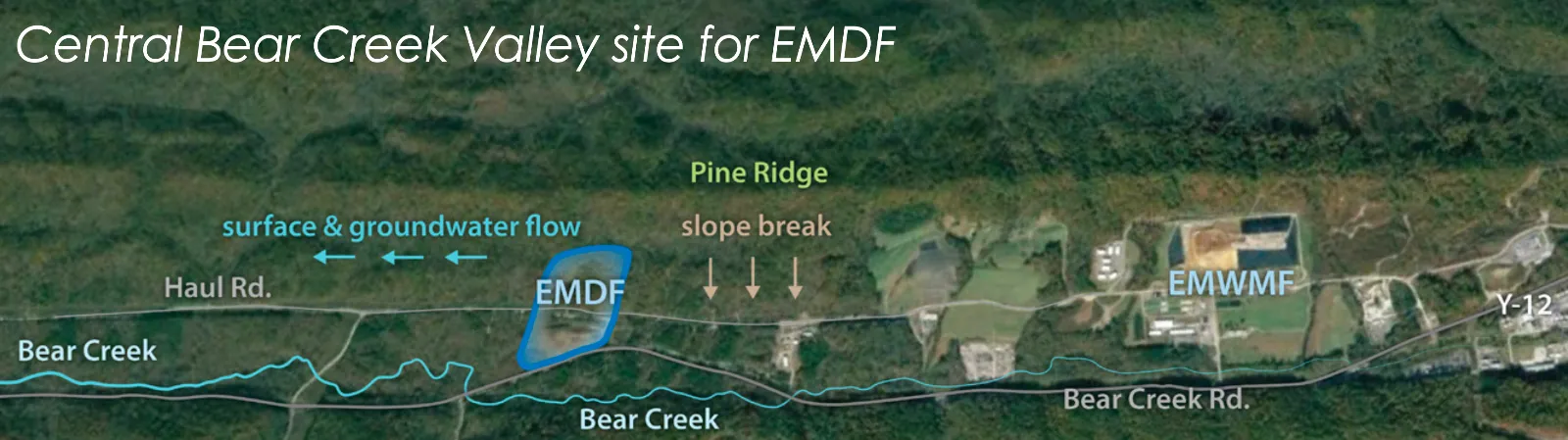
Editor’s note: As reported in Hellbender Press, the Department of Energy’s Oak Ridge Office of Environmental Management (OREM) was reprimanded by the Southern Environmental Law Center for neglecting its duty to follow guidelines and proper procedures mandated by the National Environmental Policy Act (NEPA). Of immediate concern was OREM’s pretext and information — or specifically lack of pertinent information — released ahead of the public meeting on May 17, 2022 about its project for a new “Environmental Management Disposal Facility” (EMDF).
With regard to NEPA compliance, Oak Ridge Operations has been the black sheep in DOE’s stable because it never prepared the required site-wide environmental impact statement (EIS) for the Oak Ridge Reservation (ORR). At said public meeting, Virginia Dale, Corporate Fellow Emeritus of Oak Ridge National Laboratory, commented on another tangent of shortcomings — not spelled out by Federal law — but matters of common sense, competent decision making and good community spirit.
- environmental management disposal facility
- emdf
- oak ridge office of environmental management
- orem
- national environmental policy act
- nepa
- bear creek valley
- oak ridge reservation
- us department of energy
- doe
- virginia dale
- oak ridge
- national science foundation
- nsf
- stakeholder
- stakeholder engagement
- environmental decision making
- waste acceptance criteria
- wac
- bear creek
- ground water characterization
- end use working group
- tennessee water quality control act
- comprehensive environmental response, compensation and liability act
- cercla
Foundation for Global Sustainability appeals to Knox County Commission to preserve the Dry Hollow heritage area in South Knox County
Written by FGSDear Commissioner {last-name}:
We implore you to vote against the request to strip the Agricultural zoning from the core area of the historic Twin Springs Farm in Dry Hollow.
(11-B-21-SP & 11-F-21-RZ Request of Thunder Mountain Properties, LLC for rezoning from A (Agricultural) ... Property located at 8802 Sevierville Pike and 0 Dry Hollow Road.)
This property is an integral part of a forgotten Knox County heritage area that has unique historical, cultural, economic and ecological values.
 The Tennessee Valley Authority's fossil plant at Kingston. TVA
Southern Alliance for Clean Energy: TVA is not coming clean in Congressional inquiries
Something is rotten in Russia
Written by Thomas Fraser
Menacing military buildup on Ukraine borders and Orwellian denials could snuff peaceful scientific cooperation
OAK RIDGE — I went to Russia in 2000 on one of the most extraordinary trips of my life. It was a long time ago, and a generation has passed, but I was left with many enduring and positive impressions of the country and its people.

From plastic pollution to extreme weather and the extinction crisis, the year ahead promises tough fights, enormous challenges and critical opportunities
This story was originally published by The Revelator.
A new year brings with it new opportunities — and more of the same environmental threats from the previous 12 months.
More...
Toward a new age of enlightenment
Written by Wolf Naegeli This photograph of ephemeral chalk street art by David Zinn is symbolic for life reemerging after a catastrophe (of being paved over) or for people coming out from lockdown.
will launch a pilot project to engage citizen volunteers
in grassroots initiatives for community resilience, sustainability and global solidarity.
At this time a year ago, we were hopeful 2021 would bring an end to the pandemic.
The final week of 2020 saw the counts of new cases decline markedly in the United States and worldwide. Except for scientists and medical professionals, few understood yet the risks posed by variants of the virus that causes COVID-19. It wasn’t until May 2021 that the World Health Organization (WHO) started naming major variants for Greek letters.
Not every change brought about by the pandemic had purely negative consequences
Learning from what is going wrong may help us avoid deleterious outcomes of other global crises.
As Hellbender Press reported in April, the Tennessee Valley Authority plans to phase out its use of coal. And as we mentioned in an action alert, TVA is conducting a scoping process pertaining to the preparation of an Environmental Impact Statement (EIS) for retirement and replacement of the Kingston Fossil Plant. TVA is preparing similar EIS for its other remaining coal-fired power plants as well.
Although TVA lists "construction and operation of solar and storage facilities" in these scoping documents as an alternative for replacement of coal as the power source, it has made no secret of its belief that construction of gas-powered combustion turbines (CT) and natural gas pipelines to feed them will be the best solution to replace the outdated generation capacity.
Unlike other power utilities, TVA has been making it more difficult, financially unattractive or impossible for distributed renewable energy, storage and even efficiency projects to get realized, according to proponents of renewables and some of TVA’s local power distribution partners. TVA also reneged on its agreement with other utilities to make large amounts of wind power available to the Southeastern United States through the Plains & Eastern Clean Line high-voltage direct-current power line project.
- tennessee valley authority
- tva
- foundation for global sustainability
- fgs
- climate change
- climate crisis
- electric utility
- power plant replacement
- fossil fuel
- coalfired power plant
- gasfired power plant
- gas pipeline
- kingston fossil plant retirement
- distributed electricity generation and storage
- distributed energy resource
- solar energy
- power storage
- stranded asset
- germany
- renewable energy
- decarbonization
- plains & eastern clean line
Southern Alliance for Clean Energy has a blueprint to help multiple utilities swear off fossil fuels
Written by Maggie Shober
Southern Alliance for Clean Energy offers detailed climate action items for fossil-based utilities
A new SACE report shows not only that is it possible for the four largest utilities in the Southeast to achieve 100 percent clean electricity, but there are several pathways to get there. A variety of different energy technologies and programs can be deployed to reach this goal.
The key takeaway is that we need to start now.
A clean electricity standard is a policy that requires utilities to use clean energy resources to generate a minimum portion of all energy by a certain date. Since the first renewable standard was passed in Iowa in 1983 states and utilities across the U.S. have a lot of experience with this kind of policy.
As part of federal climate action, the Biden administration and several members of Congress have proposed different versions of a Clean Electricity Standard (CES) that achieves 100 percent clean electricity by 2035. SACE has called for the Tennessee Valley Authority (TVA) to lead the way by getting to 100 percent clean electricity by 2030.
To help us understand what 100 percent clean electricity would look like here in the Southeast, SACE staff developed pathways to meet a CES policy for our region’s four largest utility companies: TVA, Southern Company, NextEra (which owns Florida Power & Light and Gulf Power), and Duke Energy.
On Wednesday, June 16, and Thursday, June 17, SACE’s policy staff will host webinars focusing on pathways to 100 percent clean electricity for each of the utilities examined in the report: Duke Energy, NextEra, TVA, and Southern Company, including:
-What a federal Clean Electricity Standard is and how it could be key to kickstarting aggressive decarbonization;
-Multiple pathways with a different power generation mix for each utility to reach net-zero carbon emissions;
-How distributed resources like rooftop solar and energy efficiency are key to decarbonizing; and
-Descriptions of the method used to develop and test each pathway to clean electricity.
Register for one or more of the following webinars Wednesday, June 16, and Thursday, June 17:
- Duke Energy: Wednesday, June 16, 11 AM - 12 PM ET
- NextEra: Wednesday, June 16, 3 PM - 4 PM ET
- Tennessee Valley Authority: Thursday, June 17, 11 AM - 12 PM ET
- Southern Company: Thursday, June 17, 3 PM - 4 PM ET
Download the report: “Achieving 100% Clean Electricity in the Southeast: Enacting a Federal Clean Electricity Standard.”
The primary pathway is focused on distributed energy resources (DERs). We found that with significant and sustained investments in DERs, like energy efficiency and rooftop solar, these utilities can achieve a customer-oriented pathway to clean electricity. In fact, these two resources, energy efficiency and rooftop solar, could meet approximately one-third of all electricity needs for these utilities by 2035. In addition to these distributed resources, these successful pathways will also include wind power, large-scale solar, and energy storage.
We found that when utilities have the ability to share resources to meet peak needs and reserve margins, fewer resources are needed overall. In most parts of the country, utilities already have the ability to do this through competitive electricity markets, but not in the Southeast. Having one such market that spans across the Southeast would help the region as a whole achieve 100 percent clean electricity.
Our analysis only looked at existing technologies. While it is good to know that today’s technologies can play a critical role in the pathway to 100 percent clean electricity, and so we must ramp up these technologies immediately, it is also true that investments in technology innovation are important to make it easier to get there. We still need to invest in research and development that can lead to improvements of existing clean electricity technologies and commercialization of new clean electricity technologies. This should not be a question of either deployment or research, both are needed.
- sace
- tva fossil fuel
- southeastern utility fossil fuel
- southern alliance for clean energy
- climate action
- we need to start now
- clean electricity standard
- electric utility
- southern company
- florida power & light
- gulf power
- duke energy
- net zero carbon emission
- distributed energy resource
- wind power
- largescale solar
- rooftop solar
- tennessee valley authority
- nextera
Make your voice heard for environmental justice
The White House Environmental Justice Advisory Council is seeking public input on a series of recommendations to the Biden Administration to address environmental justice issues across the United States. Air and water pollution caused by coal mining, toxic coal ash spills, and natural gas pipelines are a few examples of such problems in our region. These issues often impact low-income people and people of color the most, and there is a strong need for communities impacted by fossil fuels to build vibrant, diversified economies.
This is a chance for you to communicate your concerns about how these environmental issues impact disadvantaged communities while important policy decisions are under development!
The council will meet on May 13 to discuss:
-
Environmental justice policy recommendations to Congress and the Biden Administration;
-
A new Climate and Economic Justice Screening Tool, which will help identify disadvantaged communities and target federal funding;
-
Updates to a Clinton-era Executive Order (EO 12898) which directed federal agencies to address environmental justice issues in Black and Brown communities and among low-income populations.
Public comments will be accepted in writing until May 27. To submit a written comment, email This email address is being protected from spambots. You need JavaScript enabled to view it. .
Register to attend the meeting or submit your comment today!
Public comments will help to inform the future work of the White House Environmental Justice Advisory Council, and they will be incorporated into the record for federal agencies’ consideration.