

15 Life on Land (18)
Protect, restore and promote sustainable use of terrestrial ecosystems, sustainably manage forests, combat desertification, and halt and reverse land degradation and halt biodiversity loss
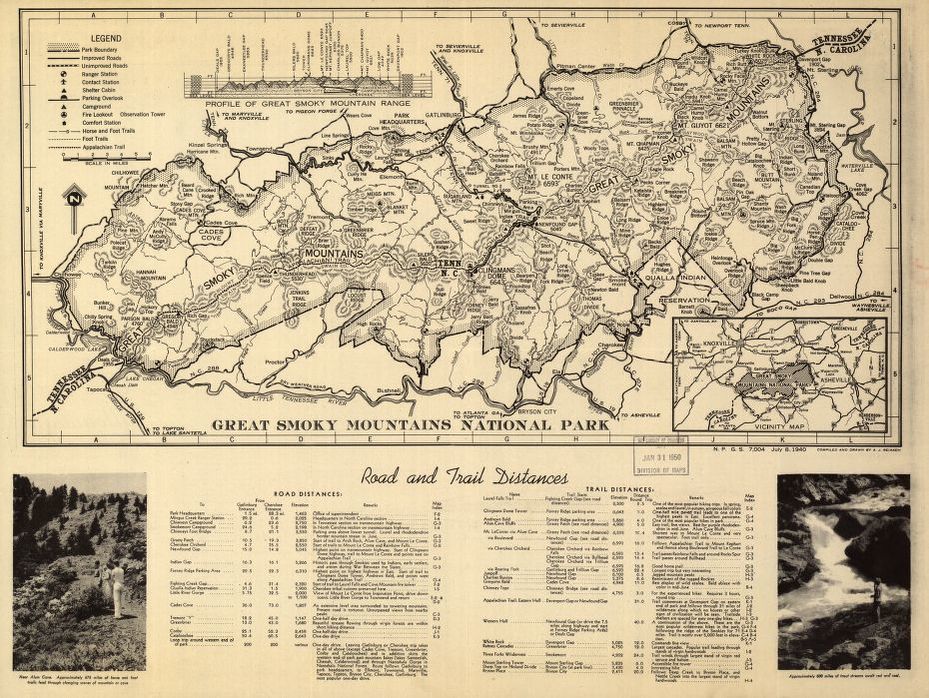 Many climate-change related issues have appeared since publication of this vintage map of Great Smoky Mountains National Park. Library of Congress
Invasive insects are among the vanguard of noticeable climate changes in America’s most-visited national park
GATLINBURG — Ants scurry beneath the carpet of last year’s leaves in Great Smoky Mountains National Park. The native ants are busy spreading the seeds of violets and bloodroot, preparing a new carpet of spring wildflowers to draw thousands of visitors.
But the local insects aren’t alone under there. They have become prey to venomous Asian needle ants that also prowl the leaf litter.
These invaders dine on termites, other ants and insects, while stealing habitat from them. Unlike invasive fire ants, needle ants can live in pristine forests and build large colonies with hundreds of queens. But like fire ants, needle ants have a painful sting that can trigger an allergic reaction.
Climate change is expected to make it easier for invasive species like needle ants to upset the delicate balance of this temperate rainforest full of rare plants and animals. That’s just one example.
- great smoky mountains
- climate change appalachia
- southern appalachian climate change
- great smoky mountains national park climate change
- needle ant
- are ants affected by climate change
- daniel malagon
- ana barro
- jason fridley
- paul super
- ipcc
- climate precipitation change
- smokies science
- national ecological observatory network
- neon
- armadillo
- invasive species
- change in precipitation
- importance of cloud to water balance highelevation ecosystem
- biodiversity
- climate change research
- sampling plot
 Chattanooga Audubon Society
CHATTANOOGA — Birds of a feather are called to flock together this week at Chattanooga Audubon Society’s Avian Discovery Days April 5-7. This is the third year of this event at the Audubon Acres sanctuary, and reservations are required.
Call (423) 892-1499 or check out Avian Discovery Days for more information.
Participants will learn about birds during four activities, including bird walks specifically designed to teach identification skills. They will also learn how birds survive migration in the Great Migration Challenge game.
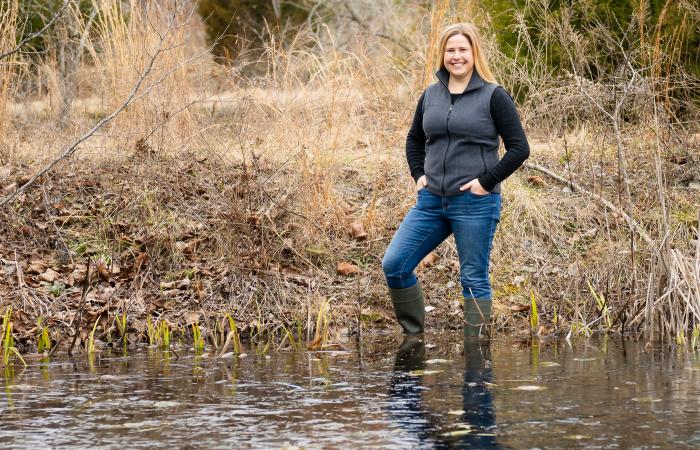 Marie Kurz is seen at a pond on the campus of Oak Ridge National Laboratory. Carlos Jones/ORNL
From California canyons to German creeks: Science is personal and practical for ORNL scientist Marie Kurz
Kristen Coyne is a writer for Oak Ridge National Laboratory.
OAK RIDGE — Spanning no less than three disciplines, Marie Kurz’s title — hydrogeochemist — already gives you a sense of the collaborative, interdisciplinary nature of her research at the Department of Energy’s Oak Ridge National Laboratory. Still, those six syllables only hint at the vast web of relationships encompassed in her work.
Kurz studies how rivers flow through landscapes; what kinds of nutrients, contaminants and other material sail through them; and how they transform along the way. As an experimentalist, her favorite part of the job is getting into the field. Depending on the season, Kurz can be found clad in tights, gloves reaching her shoulders, a neon vest and a ponytail-taming cap as she sloshes in olive hip waders through the particular stream under her scrutiny. The getup, she said, always makes her feel a bit like the Michelin Man.
- ornl
- kristen kurz
- watershed research
- ornl scientist
- oak ridge national laboratory
- east fork poplar creek oak ridge
- water pollution
- oak ridge scientist
- critical interface science
- water flow
- eddy
- swirl
- vortex
- stream ecology
- hydrology
- transient storage zone
- sediment
- biogeochemistry
- microbiology
- watershed modeling
- polyfluoroalkyl substance
- pfas
Bald eagles fly with the Tennessee angels who helped save them from extinction. We must keep them on the wing.
Written by Stephen Lyn Bales American Eagle Foundation founder Al Cecere releases a rehabilitated bald eagle at Ijams Nature Center on Aug. 12, 2016. The foundation named her Summit in honor of UT Lady Vols basketball coach Pat Summit. Photo by Chuck Cooper.
Is the bald eagle’s remarkable comeback fading down the stretch?
(Part one in a series)
It was a damp morning in early spring 2005 when Paul James and I met Linda Claussen at Seven Islands Wildlife Refuge along the French Broad River in east Knox County. Heavy rains had fallen through the night, but the clouds were beginning to break. As we walked down Kelly Lane toward the river the vocalized yearnings of thousands of chorus frogs could be heard singing from the soppy floodplain along the river. Spring was definitely here.
The refuge itself was the brainchild of Linda’s late husband, Pete. In the late 1990s, he formed the Seven Islands Foundation, a privately owned land conservancy, and began setting aside property to be protected and restored to a variety of natural habitats. Most of the acreage had recently been fescue pasture maintained for grazing livestock and hay production.