The Environmental Journal of Southern Appalachia

Marie Kurz: Helping science on watersheds flow across disciplines

Written by

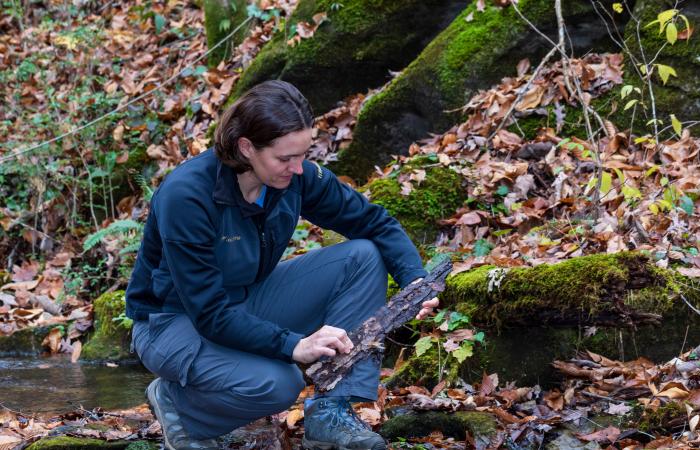
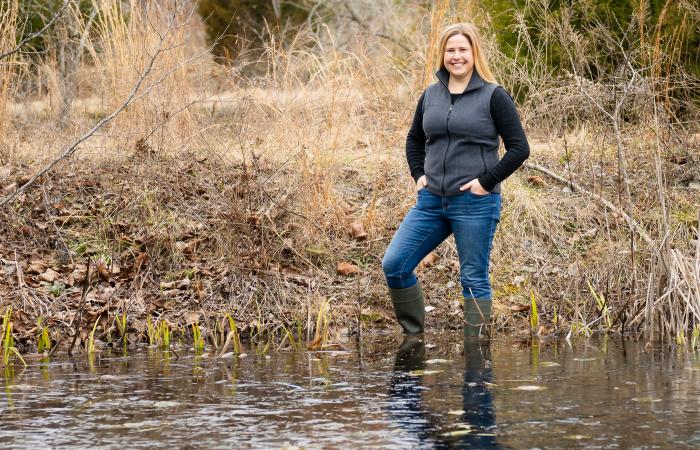
Kurz1Marie Kurz is seen at a pond on the campus of Oak Ridge National Laboratory.  Carlos Jones/ORNL

From California canyons to German creeks: Science is personal and practical for ORNL scientist Marie Kurz

Kristen Coyne is a writer for Oak Ridge National Laboratory.

OAK RIDGE — Spanning no less than three disciplines, Marie Kurz’s title — hydrogeochemist — already gives you a sense of the collaborative, interdisciplinary nature of her research at the Department of Energy’s Oak Ridge National Laboratory. Still, those six syllables only hint at the vast web of relationships encompassed in her work.  

Kurz studies how rivers flow through landscapes; what kinds of nutrients, contaminants and other material sail through them; and how they transform along the way. As an experimentalist, her favorite part of the job is getting into the field. Depending on the season, Kurz can be found clad in tights, gloves reaching her shoulders, a neon vest and a ponytail-taming cap as she sloshes in olive hip waders through the particular stream under her scrutiny. The getup, she said, always makes her feel a bit like the Michelin Man.

After setting up measurement equipment along a kilometer or two of stream, checking and re-checking calculations and calibrations, the fun part comes. From her perch on the bank, she upends two big buckets of non-toxic dye into the water — one purple, the other neon green — transforming the waterway into a vibrant, dynamic tableau. The dyes meld into a bright, leaf green, taking on new patterns as the water swirls, seeps and eddies.

“You’ve made the invisible visible for that short window of time,” Kurz said. “It’s fun to be able to actually see it.”

The scene is an apt metaphor for her life as a scientist. Kurz’s career, built on collaborating with experts from other fields and regions, has landed her everywhere from the creeks of Oregon’s Cascade Mountains to the karst springs of North Florida, from the vast Delaware River to forest streams in northern Germany. Now, after joining ORNL last fall, Kurz gets to dip a rubber-shod toe into the Tennessee River watershed, working with world-leading modeling experts and other scientists to build on decades of data on one of the world’s most intensively studied waterways.

“I’ve always been drawn to the large, collaborative initiatives,” Kurz said. “It’s where I get a lot of my motivation and stimulation.”

Her dyes’ complex, kaleidoscopic colors also reflect Kurz’s science. She works to untangle relationships among the many factors affecting stream ecology, research she hopes will ultimately help protect waterways.

Complex problems, complex solutions

As an outdoorsy kid, Kurz’s stomping grounds were as diverse as her path as a scientist. A self-described “astronomy brat,” she followed her physicist dad and astronomer mom from one observatory to another, roaming through California canyons, exploring Arizona arroyos, then later wandering through the alpine foothills of Germany.

While the surroundings changed, her way of interacting with them never did: Thanks to her parents, the scientific method was a way of life.

“I was always inquisitive, asking, ‘Why is this rock here? Why is that mountain shaped like that?’ And they’d encourage me to look for answers,” Kurz recalled. Science was personal and practical.  

She majored in geology at the College of William & Mary as an undergraduate. The field took a practical, “problem-first” approach, which resonated with her. “I've always been drawn to the more applied research side of things,” Kurz said, “to having a clear definition of, ‘Why am I studying this? Why is it important — especially societally?’”

As she pursued graduate work at the University of Florida, the answers to those questions became clearer: There were plenty of problems hiding in the waters of the world, including mercury released from coal-fired power plants; PFAS chemicals (also known as “forever chemicals”) originating from sources such as takeout boxes and firefighting foam; and excess nitrogen and phosphorous from fertilizers.

Kurz continued her studies as a doctoral student, learning just how intertwined the myriad factors relating to stream health actually are. Her thesis focused on the filamentous algae that had overtaken many Florida springs by that time. Conventional wisdom held that excess nutrients from fertilizer runoff had caused the algae to run amok, but the research group she belonged to at UF found evidence that multiple processes were in play. Kurz’s research revealed that increased iron levels were one factor likely contributing to the growth. The group’s findings could help watershed stewards better understand how to save the springs.

“This world is so amazingly complex,” said Kurz, “and most solutions — especially to these complex problems like climate change, degraded water quality and loss of biodiversity — are as complex as the problem, if not more.”  

A storied creek’s science legacy

Kurz’s primary tools for probing these complexities are her colorful tracers. The green is her “non-reactive tracer,” and corresponds to the “hydro” part of her title. The same fluorescent green concoction used to give the Chicago River a shamrock hue every St. Patrick’s Day can be used to measure the water’s highly variable flow. It shoots swiftly down the middle of the waterway but takes several minutes to appear in the shallow margins. Along the edges of waterways and in the sediments below — areas known as transient storage zones — the flow is hampered by nooks and crannies, debris and rocks where water can linger.

Those are the spaces targeted by Kurz’s purple dye. This “reactive” tracer is used to gauge the amount of cellular respiration at different points in a stream. That measurement tends to be higher in certain transient storage zones where microbes are active. Microbes play a critical role in transforming nutrients and contaminants that wash into waterways. They turn mercury, for example, into the much more toxic methylmercury, which then makes its way up the food chain.

Examining the effects of mercury cycling has long been an area of expertise at ORNL. The Y-12 National Security Complex used mercury for weapons development in the 1950s and 1960s, and mercury contamination ended up in the surrounding environment. That included East Fork Poplar Creek, which originates at Y-12 and flows through the city of Oak Ridge. ORNL has collected data on the 23-kilometer long creek since the 1950s and for the past decade through its Critical Interfaces Science Focus Area, which is sponsored by the Biological and Environmental Research program in DOE’s Office of Science.

Over that time, ORNL has developed extensive expertise in disciplines related to this effort, including biogeochemistry, hydrology, microbiology and watershed modeling, said Eric Pierce, director of the lab’s Environmental Sciences Division. But perhaps even more importantly, ORNL has created an environment where a diverse team of specialists can piece together the elaborate puzzle of how these systems operate, each contributing unique insights.

“Having people from different scientific disciplines bring their talents to understand the stream — whether it’s fish community populations, whether it’s microbial community populations, whether it’s [remote sensing] data of the tree canopy, hydrology data, water chemistry measurements — that’s rare,” Pierce said. “And we have that in East Fork Poplar Creek. It’s the synthesis of all of that data that allows us to gain insights on not just our system, but other systems outside Oak Ridge.”

Pierce plans to expand beyond the East Fork Poplar Creek stream corridor to study the entire watershed and provide an even fuller understanding of the system’s complexity.

Kurz is the latest expert to join this long-running ORNL effort. She has arrived at a time when watersheds are facing new pressures, including increased development and more frequent and intense rains, causing more flooding and erosion. All these factors will impact how watersheds store, process, transport and discharge materials.

Kurz is clearly cut out for the work: “Fun” is her go-to adjective when discussing her job. But it’s the potential impact of her research that really drives her. What she and her colleagues learn in a modest Tennessee tributary can be leveraged to understand and help protect watersheds around the world.   

“Once you have that understanding, you can apply it to different places, to different problems,” Kurz said. “That’s to me the perpetual challenge that keeps me going.”
Rate this item
(1 Vote)

Related items

  • 5 big threats to the world’s rivers
    in News

    fresh water Conservation FisheriesA biologist with Conservation Fisheries surveys a stretch of Little River near Walland, Tennessee to determine fish viability and identify rare species for transplantation. Thomas Fraser/Hellbender Press

    Human activities have imperiled our waterways — along with a third of freshwater fish and other aquatic species

    This story was originally published by The Revelator.

    If we needed more motivation to save our ailing rivers, it could come with the findings of a recent study that determined the biodiversity crisis is most acute in freshwater ecosystems, which thread the Southern landscape like crucial veins and arteries.

    Rivers, lakes and inland wetlands cover 1 percent of the Earth but provide homes for 10 percent of all its species, including one-third of all vertebrates. And many of those species are imperiled — some 27 percent of the nearly 30,000 freshwater species so far assessed by the IUCN Red List. This includes nearly one-third of all freshwater fish.

    How did things get so bad? For some species it’s a single action — like building a dam. But for most, it’s a confluence of factors — an accumulation of harm — that builds for years or decades.

  • ORNL researcher models fire’s growing footprint in a changing climate
    in News

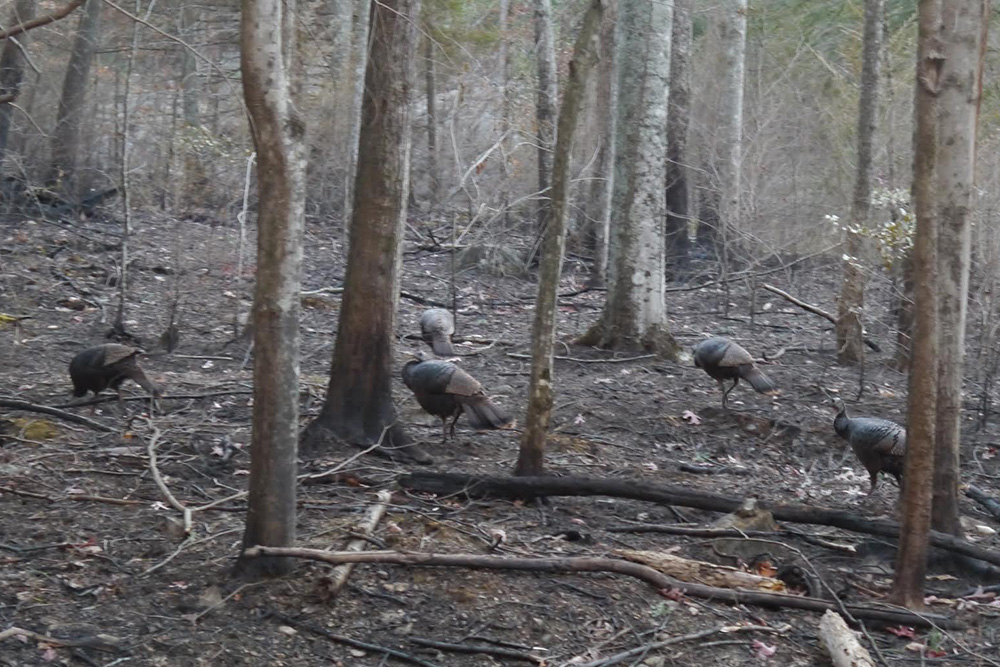
    COVER 1208 GatlinburgsInferno3Wild turkeys forage in charred hardwood forest soon after the 2016 Gatlinburg fires, which moved from the Smokies to developed areas in Sevier County. An ORNL model predicts wildfire threats will increase in the Southern Appalachians because of climate change. Thomas Fraser/Hellbender Press via Knoxville Mercury

    ORNL report: Local wildfire danger will likely loom larger because of climate change

    OAK RIDGE — This cruel summer, the Southern Appalachian region is already baking in above-normal temperatures and basking in poor air quality. 

    Air temperatures in Knoxville flirted with 100 degrees on July 6, which were well above average and prompted the National Weather Service to issue a heat advisory for much of the metropolitan area.

    It’s hard to definitively link a heat wave to global warming, but one oft-cited consequence of climate change is the growing intensity of wildfires, even in the traditionally moisture-rich Appalachians. The range of climate change effects is difficult to pin down, but one constant in the study of climate change is an expected increase in overall temperatures, which can power wildfires via both fuel increases and volatility.

  • Lost and found: The long-awaited return of the robust redhorse
    in News


    Georgia’s Ocmulgee River is a case study in the decline of Southern river fisheries, and their revival

    Ethan Hatchett is a writer for the Georgia Department of Natural Resources.

    MACON — The Ocmulgee River has changed. The cloudy water once ran clear. The sandy bottom was once rocky. Fish swam upriver to breed from places as distant as the Altamaha River, which the Ocmulgee and Oconee rivers join to form near Lumber City and the Atlantic Ocean.

    European settlement changed the river. Centuries of agriculture and development stripped away much of the land’s vegetation that filtered the flow, causing the Ocmulgee to fill with sediment. The soil particles gradually moved through the waterway, covering gravel that fish spawned in, smothering fishes’ eggs, mucking up the water and even building up on the banks, saturating the ground with sediment.

    It is impossible to know how many freshwater fish the Ocmulgee lost since the first Europeans arrived. Many species disappeared without being discovered. Yet on a clear afternoon in May, DNR aquatics biologist Paula Marcinek led a team on the upper Ocmulgee in search of robust redhorse, a “lost” fish found in 1991.

    Read DNR’s blog post about efforts to restore the robust redhorse, plus news of a new grant that will expand the work and rare video of these fish spawning.

  • Like a message in a bottle, washed-up plastic signals a growing threat to global health
    in News

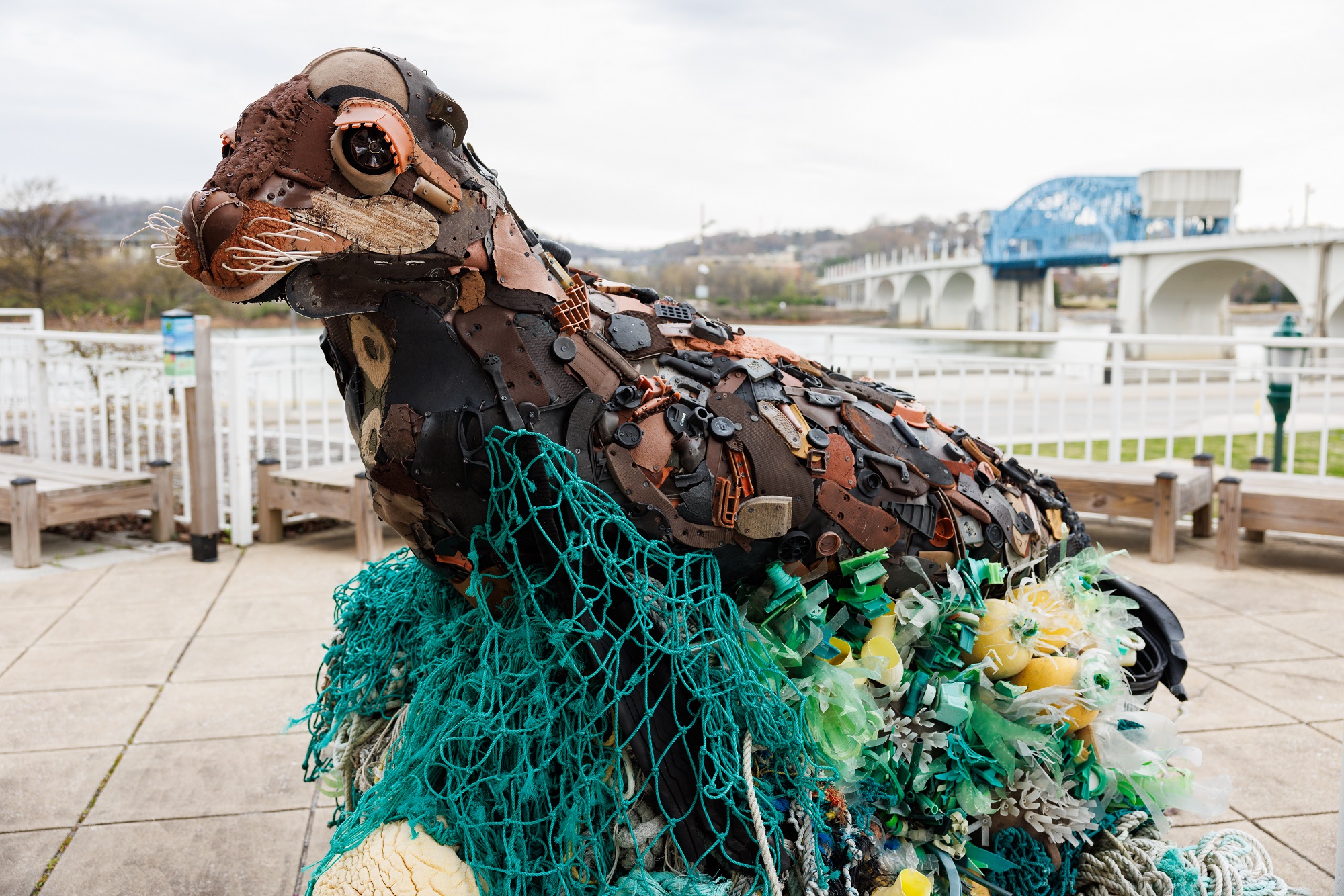
    A Sea Lion sculpture from the Washed Ashore art exhibit.A sea lion sculpture from the Washed Ashore art exhibit that will open this weekend at the Tennessee Aquarium in Chattanooga.  Tennessee Aquarium/Washed Ashore

    Poignant plastic-waste art exhibit washes ashore at Tennessee Aquarium  

    CHATTANOOGA — Visitors to the Tennessee Aquarium will see a dire warning in the guise of colorful art crafted from plastic debris at a unique exhibit beginning April 16.

    Washed Ashore is an Oregon-based nonprofit organization dedicated to repurposing plastic waste through artists and sparking conservation conversations. The Tennessee Aquarium will host an exhibit of its sculptures and collages.

    Those who walk ocean and lake beaches see the accumulated debris. Some may try to ignore it. Others may abandon their favorite places for recreation and relaxation because they can no longer bear the unsightly wreckage. Plastics impact every living creature.

  • Keeping energy inside: Grant to install 3-D printed walls at Knoxville’s oldest public housing complex
    in News

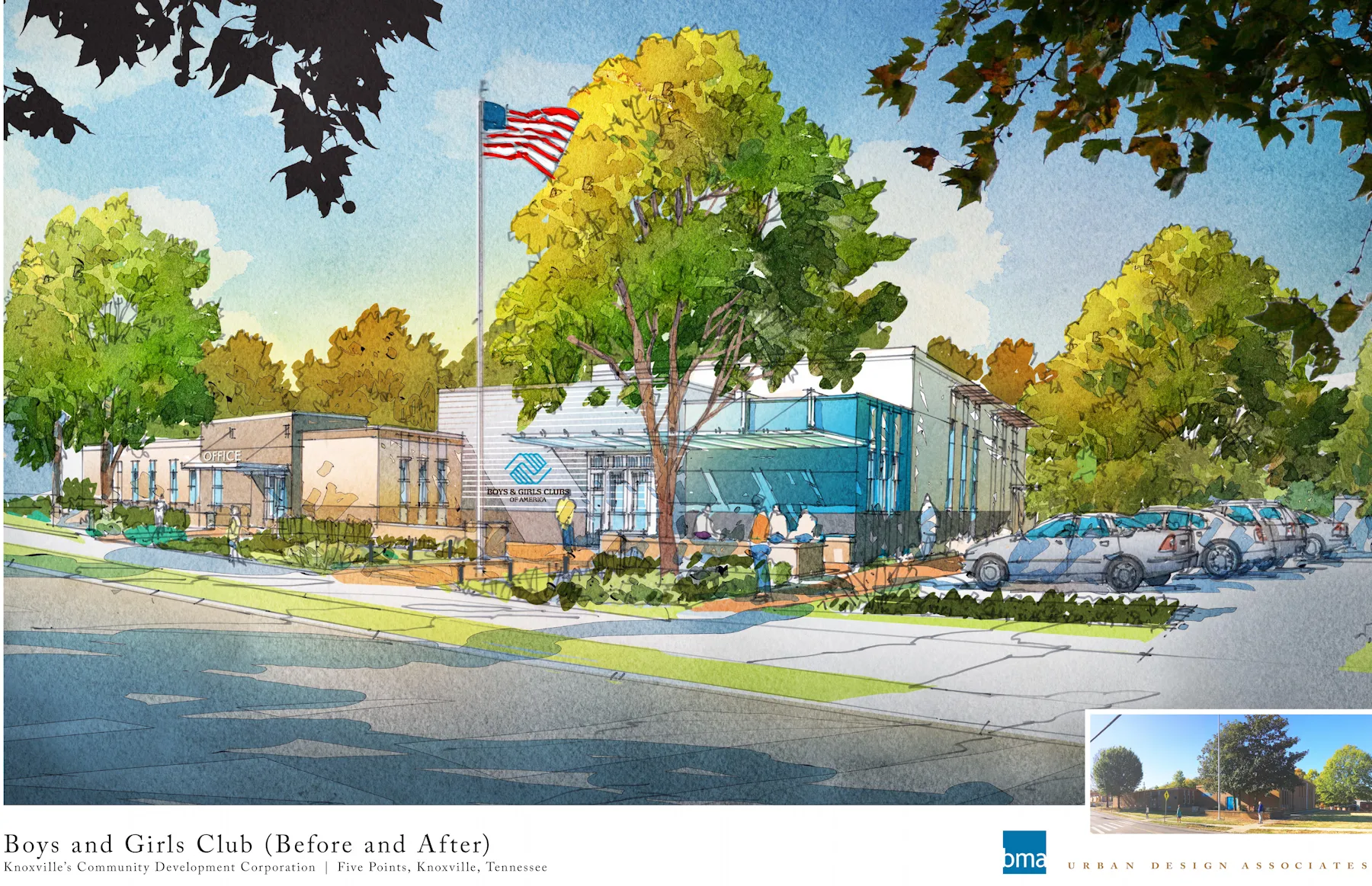
    boys and girls club before and afterThis is a possible result of ORNL/KCDC energy efficiency improvements set for Knoxville public housing funded by a Department of Energy grant. The project will include the Boys & Girls Club.  © 2016 urban design association

    Energy-efficiency upgrades based on ORNL walls set for Knoxville public housing

    KNOXVILLE — A city public housing project almost a century old is going to receive 3-D printed energy efficiency upgrades thanks to a grant from the U.S. Department of Energy.

    Scientists at Oak Ridge National Laboratory will partner with Knoxville’s Community Development Corporation to retrofit eight to 12 buildings at Western Heights using 3-D printed exterior “overclad” panels equipped with heat pumps and heat recovery systems. The Boys & Girls Club building at Five Points in Morningside will receive the same treatment.

  • Zigging and zagging to find the Zigzag
    in News

    Zigzag salamander UT doctoral student Bryce Wade examines a Southern zigzag salamander he found at Ijams Nature Center in South Knoxville. Keenan Thomas/Hellbender Press

    On the happy herping trail: Bryce Wade searches for salamanders

    KNOXVILLE — Bryce Wade scours the nature trail, turning over rocks and logs. On this overcast day at Ijams Nature Center, he searches beneath the leaves on the ground for one creature: salamanders.

    Underneath the rocks, logs and leaves, salamanders populate the cool, moist earth, avoiding the sun whenever they can. Wade is looking for a particular type: a winter species informally called the Southern zigzag salamander (Plethodon ventralis). 

  • Aerosols and atoms: ORNL supercomputer models airborne spread of Covid-19

    covid virus image

    New York Times: Oak Ridge supercomputer simulates spread of Covid-19 in water droplets

    Scientists studying the spread of the novel coronavirus utilized the world’s second-fastest computer at Oak Ridge National Laboratory to model the movements of millions of individual atoms that make up the virus and aerosols that can transport and transmit it. 

    The virus has killed nearly 1 million Americans and infected more than 50 million since a pandemic was declared in early 2020.

    “The researchers started by creating a model of the coronavirus, known as SARS-CoV-2, from 300 million virtual atoms,” the New York Times reported.

    Researchers then placed the virtual virus model in an intricately detailed and microscopic model of a water droplet such as the type exhaled by those infected with the virus. The supercomputer then calculated how the droplet and its attendant virus could, for example, move within a room where people are in close quarters and exhaling and inhaling the virus.

    To carry out this vast set of calculations, the researchers had to take over the Summit Supercomputer, the second most powerful supercomputer in the world

  • ORNL’s comprehensive mapping of built environments aids disaster response

    Compass: ORNL mapping effort will aid rescue, risk assessment

    Oak Ridge National Laboratory scientists spent five years mapping virtually every structure in the U.S. and the data is bearing early fruit as it is used for response to disasters such as hurricanes and severe floods. 

    Mark Tuttle and Melanie Lavardiere, the team leaders of the project, have mapped “virtually every single structure in the United States and its territories,” Compass reports. 

    The information is used by disaster responders from the FEMA level and down. During a hurricane, for example, authorities can focus response efforts on the most vulnerable areas using the building-mapping database. 

    The database can also be used by insurers to charge rates more according to risk, and for structures covered under the National Flood Insurance Program, as is already happening.

    But the data is most valuable for saving lives and determining the most likely location those lives will have to be saved. 

    “After disaster strikes, the data can give a rapid indication of the scope of the damage and point responders in the right direction to assist in the recovery. Using the powerful computers available at ORNL, the team can process data quickly — producing in a matter of hours work that used to take months — and get it into FEMA’s hands for analysis,” Compass reports.

  • Oak Ridge National Laboratory land is an international treasure of biodiversity
    in News

    res1.jpgAquatic ecologist Natalie Griffiths studies nutrients and contaminants in the Weber Branch watershed, which is in the Oak Ridge Environmental Research Park. Courtesy Carlos Jones/ORNL

    ORNL research lands are an international ecological benchmark and diverse wonderland of trees, plants, mammals, reptiles and amphibians

    Abby Bower is a science writer for Oak Ridge National Laboratory.

    The Department of Energy’s Oak Ridge National Laboratory (ORNL) is a hub for world-class science. The nearly 33,000-acre space surrounding the lab is less known, but also unique. The Oak Ridge Reservation (ORR) is a key hotspot for biodiversity in the Southeast and is home to more than 1,500 species of plants and animals.

    At the intersection of Anderson and Roane counties is an important subset of the reservation — the Oak Ridge National Environmental Research Park, or NERP — a 20,000-acre ORNL research facility that has been internationally recognized by UNESCO as an official biosphere reserve unit.

    “The National Environmental Research Park is a living laboratory and a major resource for conducting ecological studies,” said Evin Carter, an ORNL wildlife ecologist and director of the Southern Appalachian Man and the Biosphere Program, or SAMAB. The NERP has been a core part of SAMAB, which has focused on sustainable economic development and conserving biodiversity in Southern Appalachia since 1989.

    With ORNL researchers and scientists from government agencies and academia using the NERP for diverse experiments each year, the park lives up to its status as a living laboratory.

    It also lives up to its reputation as a biodiversity hotspot. As one of seven DOE-established environmental research parks reflecting North America’s major ecoregions, it represents the Eastern Deciduous Forest. The NERP comprises parts of this ecoregion that have been identified repeatedly as priorities for global biodiversity conservation, Carter said.

    This designation means more than ever as climate change alters ecosystems and biodiversity declines worldwide. According to a landmark international report, on Biodiversity and Ecosystem Services, around one million plant and animal species are currently threatened with extinction. 

  • The 17-year cicada brood left behind some calling cards in the trees

    Tree browning cicadas1 1 Here is some evidence of tree browning and “flagging” caused by the recent appearance of Brood-10 cicadas earlier this summer. Courtesy Oak Ridge National Laboratory 

    Tree “flagging” is a lingering sign of the 17-year cicadas’ brief time on Earth

    (Alexandra DeMarco is an intern in ORNL’s media relations group.)

    On the road leading to the U.S. Department of Energy’s Oak Ridge National Laboratory, drivers may notice that many of the green trees lining the entrance to the lab are dappled with brown leaves. At first glance, the sight isn’t extraordinary, as deciduous tree leaves turn hues of oranges and browns before falling to the ground each autumn.

    Yet, just weeks past the summer solstice, this phenomenon is out of place and is in fact evidence of another natural occurrence: cicada “flagging.”

    This spring, Brood X cicadas emerged from the ground after 17 years and swarmed across the eastern United States, leaving a trail of exoskeletons and echoes of mating calls. Cicadas emerge in such large quantities to withstand predation and successfully maintain their populations, and trees actually play a key role in their life cycle.

    A male cicada attracts a female through a mating call, the sound responsible for cicadas’ shrill hum. After the two mate, the female cicada uses a sharp tubular organ called an ovipositor to slit the bark and split the sapwood of young tree branches to deposit her eggs there. These incisions, however, damage a tree’s vascular system and can cause stalks beyond the incision to die and wither, leaving behind twigs with brown leaves that resemble flags dangling from the trees.

    The eggs then grow into nymphs that make their way to below ground. An oft-repeated misconception is that they’ll stay dormant for 17 years. Actually, during that time, they go through 5 life stages while feeding on the xylem (tree sap) of roots. This may further weaken saplings that were heavily infested with cicadas.