
Displaying items by tag: tennesse wildlife resources agency
Falcons in flight: Gatlinburg couple earns top conservation honors from Tennessee Wildlife Federation
![Worsham Conservationist of the Year1]() Arrowmont supporters Margit and Earl Worsham named Conservationists of the Year by Tennessee Wildlife Federation
Arrowmont supporters Margit and Earl Worsham named Conservationists of the Year by Tennessee Wildlife Federation

This story was provided by Arrowmont School of Arts and Crafts.
GATLINBURG — Margit and Earl Worsham stood in front of family, friends, and fellow conservationists on stage in Nashville this spring and were presented with a unique award of mahogany shaped like a peregrine falcon in flight.
They were named the Tennessee Wildlife Federation’s 2022 Conservationists of the Year at the federation’s 57th Annual Conservation Awards in May.
It’s a prestigious honor presented to nominees considered to have the most significant contribution to the cause of natural resources conservation in Tennessee.
Dinosaurs released in Chattanooga to honor Earth Day 2022
 Tennessee Aquarium Director of Hospitality and Marketing Meredith Roberts and her daughter Lucy release a juvenile lake sturgeon during an Earth Day event on the Chattanooga riverfront. Tennessee Aquarium
Tennessee Aquarium releases endangered sturgeon on a fin and a prayer
CHATTANOOGA — Lake sturgeon are living fossils.
They are dinosaur fish. They have no scales. They are protected by a tough skin with boney plates, and are unchanged for millennia. They are part of a widespread related group of fish, with 23 species worldwide, and are an endangered species in Tennessee.
Tennessee Aquarium staff released some of these dinosaurs into the Tennessee River here on Earth Day, observed this year on April 22. Aquarium staff were joined by 30 students from Calvin Donaldson Elementary School and the public to release 65 juvenile lake sturgeon into the Tennessee River at Chattanooga’s Coolidge Park.
Limbless bears break hearts but donuts may be worse than leg traps
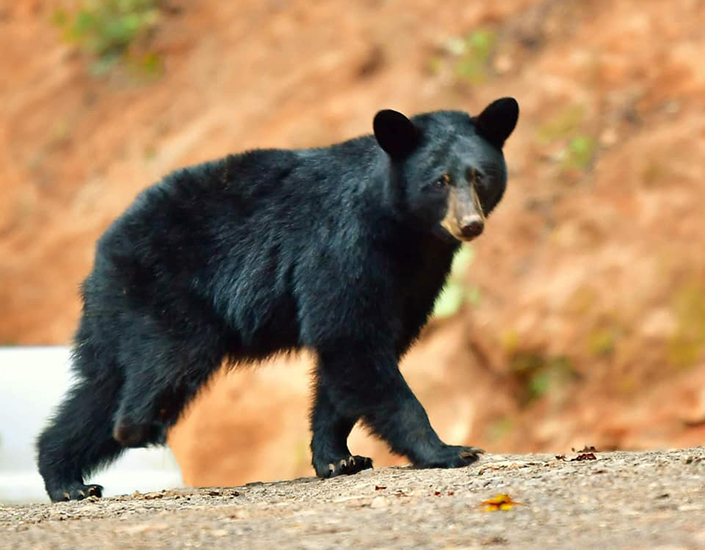 Courtesy of Help Asheville Bears
By any other name: From poaching to cars and traps, black bears face diverse human threats in Southern Appalachians
Activists and state agencies agree bear poaching is an age-old problem in the mountains of Tennessee and North Carolina, but they diverge when it comes to some key aspects of the crime and its prevention.
The non-profit Help Asheville Bears is raising awareness of threats to bears on both sides of the state lines and getting coverage on local media outlets like this piece on Knoxville-based WBIR. Its message has also appeared on a billboard in Sevierville. The Arden, N.C.-based group offers a tip line, rewards and also supports what could be described as a self-styled anti-poaching militia.
“Bear poaching is a big deal. It happens anywhere where there are bears,” said Jody Williams, the founder of Help Asheville Bears, which is responding to what its members see as an increasing threat to the very symbol of wild Southern Appalachia. HAB is especially concerned about trapping that Williams said has left limbless bears limping throughout the mountains.
The group is demanding Amazon quit selling leg-snare traps with a petition on Change.org that has gotten more than 220,000 signatures.
A video at the top of the page shows images and footage of bears with missing limbs as sad flute music plays.
“We currently follow 12 cases of bears missing limbs in a 25 mile radius of the Asheville area and 15 missing limbs within 90 miles of Asheville,” according to the Help Asheville Bears website.
“Help Asheville Bears intends to help prevent illegal bear trapping in the South Asheville and Arden areas, where there has been much photographic evidence of illegal trapping, especially bears missing limbs.”
- bear poaching
- smoky mountains bear poaching
- limbless bear
- legless bear
- save asheville bears
- twra bear
- bear trap
- trap sold on amazon
- poacher strike force
- help asheville bear
- leg trap
- leg trap amazon petition
- danger to bear
- don't feed bear
- bearwise
- tennesse wildlife resources agency
- north carolina wildlife resources commission
- black bear
Biodiversity in crosshairs as burgeoning Middle Tennessee fears water shortage
 This biologically rich stretch of the Duck River could soon be the site of a large municipal water intake facility.
Duck River targeted by thirsty, growing municipalities in Nashville area
This story was originally published by Tennessee Lookout
Marshall County, located outside what was once considered the boundary edge of growing suburbs circling Nashville, has seen explosive growth of its own in recent years — call it the Williamson County overflow effect, says County Mayor Mike Keny.
Drawn by more affordable housing, jobs and the rural character of the county — about an hour from Nashville in the “heart of the Southern Automotive Corridor” (as local economic development officials call it) — the influx of residents, and some relocating business and industry, has brought new urgency to a long-standing reality.
The county doesn’t have its own water supply. For decades, it has had to pay wholesale for drinking water from the cities of Murfreesboro and Lewisburg. That supply is no longer adequate.
A new proposal by county officials calls for building a water treatment facility along the banks of the Duck River in northern Marshall County capable of siphoning up to 6 million gallons of water per day; establish a reliable local water supply for decades to come.
- tennessee water supply
- murfreesboro water
- tennessee lookout
- williamson county water supply
- duck river
- biodiversity
- mussels
- most biologically diverse river in the united states
- duck river biodiversity
- most biodiverse us river
- drinking water
- water treatment facility
- water supply
- urbanization
- marshall county tn
- southern automotive corridor
- tennesse wildlife resources agency
- aquatic biodiversity
- pale liliput mussel
- rabbitsfoot mussel
- the nature conservancy
- tennessee department of environment and conservation
- tdec
- twra
Tennessee Aquarium and partners are stocking another East Tennessee mountain stream with imperiled Southern Appalachian brook trout
 Juvenile brook trout swim into the water of their new home during a joint effort to return the species to its rightful range in the Tellico River watershed in the southeastern Cherokee National Forest. Photo courtesy Tennessee Aquarium.
In a virtuous cycle of life, native brookies return to Tellico River watershed in southeastern Cherokee National Forest.
(The writer produced this original piece for the Tennessee Aquarium).
Navigating through a thicket of branches while clambering across slick boulders in a rushing mountain stream is a difficult task in the best of times. Doing so while attempting to balance 40-pound buckets of water filled with imperiled fish takes the challenge to an entirely new level.
A team of scientists from the Tennessee Aquarium Conservation Institute drove to one of the lush, high-elevation streams in the southern reaches of the Cherokee National Forest. During a brief lull between rainstorms, they were joined by Tennessee Wildlife Resources Agency representatives and the U.S. Forest Service to celebrate a homecoming for 250 long-lost residents of this gorgeous landscape: juvenile Southern Appalachian brook trout.
Carefully navigating through a snarl of streamside vegetation, participants paused to release five or six trout at a time into pools with overhangs where the young fish could hide from predators and ambush floating insects that washed into the stream. The going was tough, but those involved in the effort to restock almost a kilometer of this pristine creek say the challenge was worth the reward of seeing Tennessee’s only native trout back in its ancestral waters.
“The days when we release fish, especially brook trout, are really special moments,” said Tennessee Aquarium Aquatic Conservation Biologist Dr. Bernie Kuhajda. “We’re with these fish all the way from when we first bring adults into the Conservation Institute to spawn, to watching the eggs start to develop, to the juveniles that are just a few inches long and ready to release here.
“It really is knowing that we get to help restore trout to the full circle of life. Days like today are the culmination of all that work to put trout back into the Southeastern streams where they belong.”
Like many Appalachian streams, this tributary of the North River in the Tellico River watershed hasn’t hosted the brook trout for almost a century. Clearcutting of forests in the early 1900s made waters in the region too warm. Combined with the introduction of brown and rainbow trout, “brookies” were effectively lost from more than 75 percent of the waterways where they once thrived.
- tennessee aquarium
- tellico river
- cherokee national forest
- native brook trout
- brook trout
- tennessee aquarium conservation institute
- heigh elevation stream
- headwater
- tennesse wildlife resources agency
- spawn
- brookie
- southern appalachia
- trout unlimited
- aquatic wildlife
- natural heritage
- research project
- freshwater science
- conservation
- biological diversity
- biodiversity
- watershed