
Displaying items by tag: virgin falls state natural area
Tennessee Lookout: (Part II) Thick covey of opposition to TWRA quail management at expense of mature hardwood forest
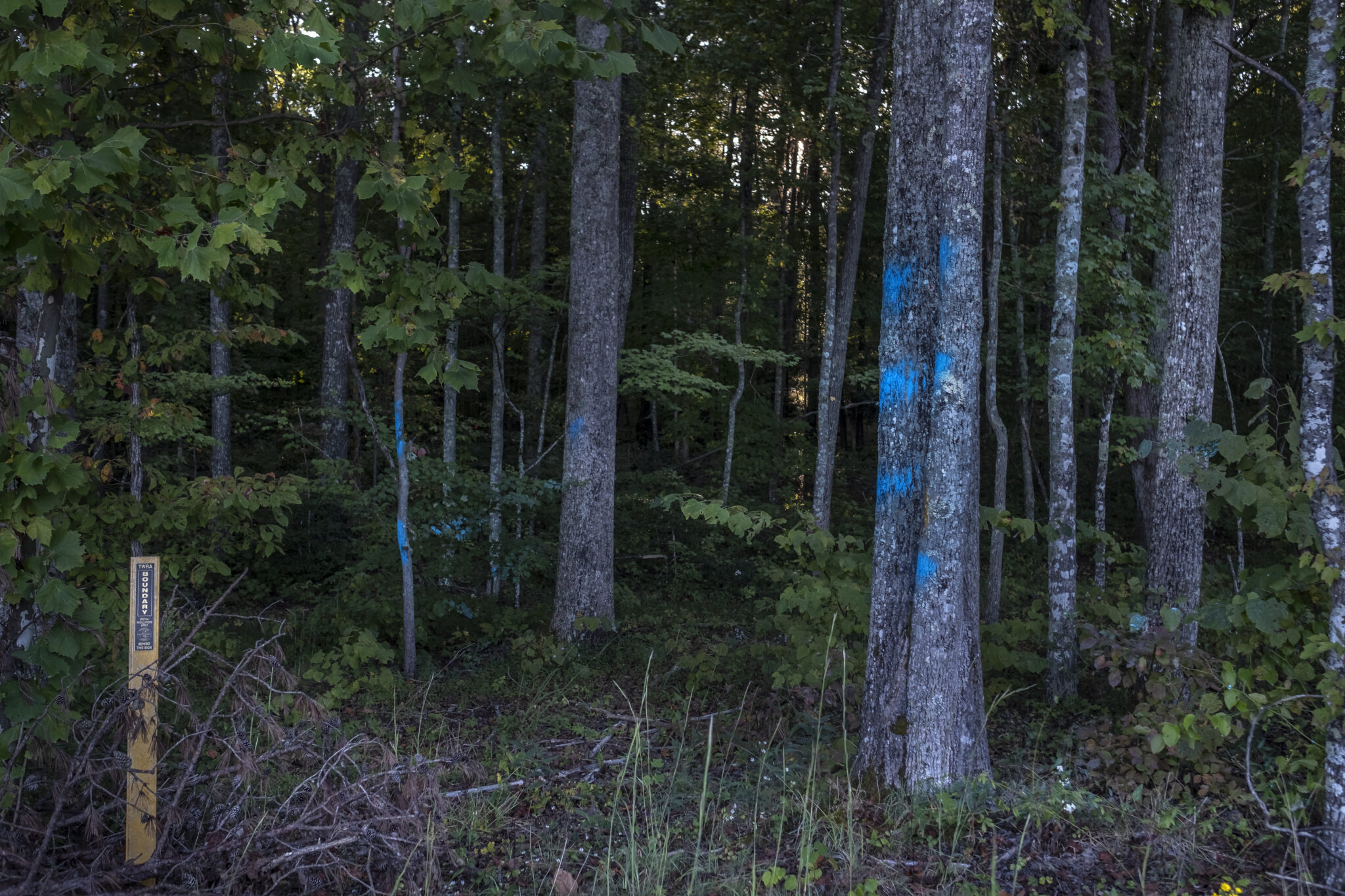 Tree trunks in the Bridgestone Firestone Centennial Wilderness Area in Sparta marked for clearcutting, despite local opposition. John Partipilo/Courtesy Tennessee Lookout
Hundreds of citizens publicly reject TWRA Middle Tennessee deforestation plans
This story was originally published by the nonprofit Tennessee Lookout and is shared (with much appreciation) with Hellbender Press via Creative Commons License.
Officials with the Tennessee Wildlife Resources Agency faced considerable pushback Monday night (Oct. 4) at a public meeting in Sparta over plans to raze old growth forest in a popular hunting and recreation area located about halfway between Nashville and Knoxville.
A standing room-only crowd of more than 200 people filled the town’s small civic center to hear directly from state officials about what had been — until now — an unpublicized internal agency plan to clear forest on public lands in the Bridgestone Firestone Centennial Wilderness Area to create grassland habitat for northern bobwhite quail, a game bird whose populations have plummeted in Tennessee.
“Bridgestone Firestone is one of the gems of White County,” said Elizabeth McDonald, one of two dozen people who spoke against the plan until the meeting grew too late to get through the long line of residents who signed up to address the TWRA.
“It’s a place that is so beautiful, so intact, and it can never be replaced. I appreciate caring about quails, but you have people in this room who, for generations, have called this home. You have to understand you are attacking our homes.”
The meeting was organized by Rep. Paul Sherrell, a Republican who represents the area, after an internal TWRA map leaked to a local resident revealed plans to cut 2,000 acres of hardwood trees on the property bequeathed to the state by the Bridgestone Corporation in 1998.
The map quickly circulated among residents, and so did the outrage. The old-growth timber slated for demolition lines the path heading to Virgin Falls State Natural Area, where the tree canopy also shades hiking trails through a series of scenic waterfalls. The forested area slated for removal forms part of a popular deer and turkey hunting area, too.
Sen. Paul Bailey, R-Sparta, and Sen. Heidi Campbell, D-Nashville — who said she has heard complaints from her Nashville constituents and others across the state who routinely visit the wilderness area — also attended the meeting.
In a series of powerpoint presentations, TWRA officials outlined the urgent need to establish grassland habitats in Tennessee, not only for the Northern Bobwhite, but for native plants and birds for whom savannas — sparsely treed grassland — are critical to survival.
Clearing forest would benefit at least 70 species with the greatest conservation needs, said Wally Akins, TWRA’s wildlife and forestry assistant chief.
“Closed-canopy forests have limited value to many species,” he said.
Hundreds of native plant species remain essentially dormant underneath the forest canopy, waiting to emerge, said Dwayne Estes, executive director of the Southeastern Grasslands Initiative. Savannas are “the forgotten landscape of the South,” he said.
Tennessee Lookout: Tennessee Wildlife Resources Agency reportedly plans to raze mature hardwood forest
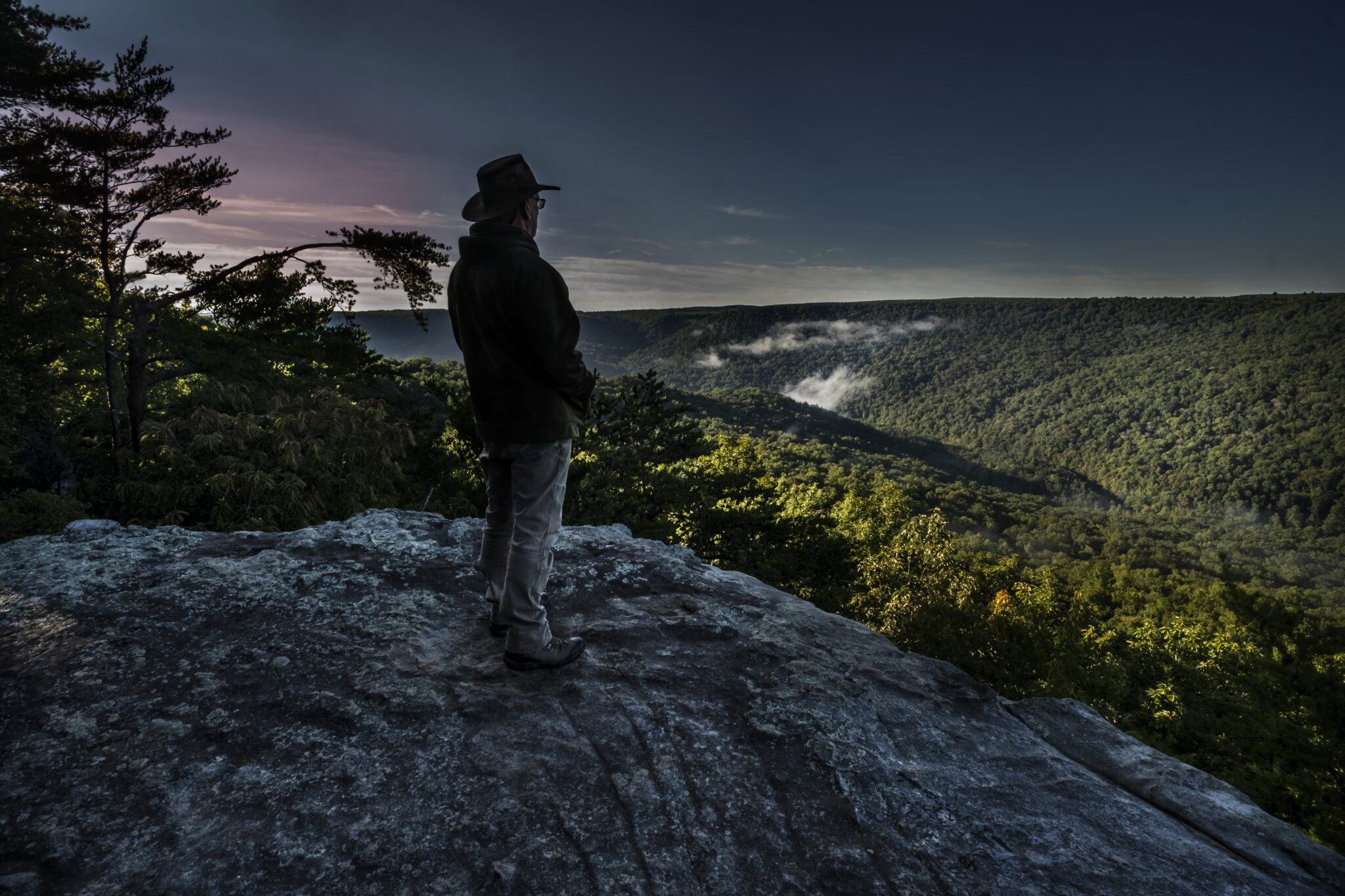 Mike O’Neal, a longtime hunter, surveys an expanse of the Bridgestone Firestone Centennial Wilderness Area in Middle Tennessee where clearcutting of public hardwood forest is planned to create quail habitat. John Partipilo/Courtesy of Tennessee Lookout
The plan to clear forest for quail habitat is raising the ire of hunters and hikers, as well as a bipartisan group of state lawmakers
This story was originally published by the nonprofit Tennessee Lookout and is shared (with much appreciation) via Creative Commons License.
It’s a pretty bird, easily recognizable by dark stripes on rust colored feathers and a distinct two-syllable chirp that announces its name: “bob” (the high note) then “white” at a lower pitch — also known as the northern bobwhite, a species of quail.
The otherwise unassuming bird is now at the center of a fight over public lands in White County, Tennessee, pitting the Tennessee Wildlife Resources Agency against an unlikely coalition of hikers, hunters, cavers, local business leaders and state lawmakers on both sides of the political aisle.
Internal TWRA documents leaked to a local hunter last month revealed plans to clearcut 2,000 acres of old-growth hardwood forest in the Bridgestone Firestone Centennial Wilderness Area to establish quail habitat and a research center focused on the birds, whose steeply declining populations have spurred national efforts to restore grasslands where the species thrive.
The land slated for deforestation, a late-1990s gift to the state from the Bridgestone Corporation – then the Bridgestone/Firestone company — is part of stunning and centuries-old vistas visible along the path heading to Virgin Falls State Natural Area, where 7 waterfalls are connected by trails through tall canopies just north of Fall Creek Falls. For generations, the area has also drawn deer and turkey hunters to state owned land that offers hunting access at a fraction of the cost often associated with hunting on private property.
“It’s going to scar the view-shed for most of the Bridgestone property,” said Marvin Bullock, president of the Sparta-White County Chamber of Commerce.
Bullock is an energetic booster who grew up in the area and takes pride in his track record at the chamber. The county has seen a tourist-driven economic turnaround in recent times – aided, in some respects, by the pandemic. Six years ago, when Bullock first started the job, there were 50 empty storefronts and office spaces in downtown Sparta.
“Now you’d be hard-pressed to find 10,” he said. “We have 400 remote workers and 80 Airbnbs. That’s a good indication of what an attraction Virgin Falls is. Right now we have some hardwoods that three of us together couldn’t reach around. It would take generations to grow them back. This is a really terrible idea that is not just aesthetically unattractive, it is economically unattractive.”
TWRA gets pushback
Since the map was leaked last month, hikers and hunters, and environmental groups such as the Sierra Club and the Tennessee Scenic Rivers Association, which is concerned about potential erosion damage to the Caney Fork River from clearcutting, have mobilized members across the state to weigh in. A bipartisan trio of lawmakers, Rep. Paul Sherrell, R-Sparta, Sen. Heidi Campbell, D-Nashville and Rep. John Ray Clemmons, also a Nashville Democrat, have pressed TWRA for answers. A community meeting organized by Sherrell is set for Monday evening in Sparta.
“You’re going to be walking through a burned-out wasteland if this happens,” said Campbell, who said she has been getting emails from constituents upset by the plans.
After weeks of pushback, TWRA has begun to respond publicly — a step it has not been required to take in its deforestation plans for public lands. The agency has no public notice requirements when it clears timber on the nearly 1.5 million acres is controls across the state, a sore point among those now learning of the plans in White County.
TWRA biologist Aubrey Deck told the Lookout last week that some of the pushback is a result of a misunderstanding.
The leaked map, Deck said Friday, is a “conceptual map for a larger project, not a planning map,” he said.
“The only plan right now is for 250-290 acres (of deforestation),” he said. “The exact acreage is still to be determined.”
But Deck made clear that agency officials have hopes for a wider deforestation effort.