The Environmental Journal of Southern Appalachia

Tennessee Lookout: GOP legislators move to usurp even more local control with pro-pipeline bill

Written by

GOP-led Legislature aims to ban local decisions on fossil-fuel infrastructure

This story was originally published by Tennessee Lookout.

Per updated TL reporting, this bill was deferred to March 15 for committee consideration.

Memphis activist Justin Pearson spent years trying to pass legislation to protect his city’s natural drinking water, but a bill being fast tracked through the state Legislature is threatening his efforts.  

Last week, environmental activists learned that Rep. Kevin Vaughan, R-Collierville, and Sen. Ken Yager, R-Kingston, are seeking to pass a bill aimed at removing local government control over land use zoning for fossil fuel infrastructure. 

Both the Tennessee State House and Senate Commerce Committees will vote on HB2246 and SB2077 on Tuesday, and if the bill passes, it could be on the Legislature floor by Thursday. 

By the time Pearson learned of the legislation, a vote had already been scheduled with little time to alert those affected. 

“We really have to talk about the timing of this. This law came into being on Tuesday as an amendment, giving no time for local governments to have a say in the ramifications or citizens a significant amount of time to scrutinize and understand its impacts,” said Pearson, who co-founded Memphis Against the Pipeline, which has become the Memphis Community Against Pollution (MCAP).

Vaughan did not return a Lookout reporter’s calls for comment. 

In the meantime, Pearson and other environmental organizations, including Protect Our Aquifer, the Sierra Club and the Southern Environmental Law Center, have worked to protect Memphis residents from fossil fuel companies attempting to build pipelines through their neighborhoods.

In 2020, the joint-companies Plains All American Pipeline and Valero announced their intentions to build the Byhalia Pipeline through South Memphis, including historic Black neighborhoods. 

Residents, community leaders and environmental activists then rallied against the Byhalia pipeline, calling it a form of environmental racism. 

Pearson and others noted that residents  in South Memphis were already exposed to potentially hazardous materials from other industrial facilities in the area, and oil spills from the pipeline could seep under the city into wellheads directly above the Memphis Sand Aquifer, which provides Shelby County with natural drinking water. 

Environmental activists and community leaders spent nearly a year in legal battles with the pipeline company, who attempted to use eminent domain to take land from residents. Plains All American and Valero pulled their plans for the Byhalia Pipeline, but Pearson and others have since attempted to pass legislation within the Memphis City Council and the Shelby County Commission aimed at protecting local interests. 

In 2021, the Shelby County Commission passed an ordinance to prevent pipelines from being built within 1,500 feet of most residential areas, such as churches and schools. That same month, the Memphis City Council  delayed a vote on a joint ordinance with the county commission but passed an ordinance to create wellhead protections from development near areas where the city pumps its drinking water, (as reported by Hellbender Press in August ’21).

Pearson is still seeking to push for environmental justice in South Memphis, to promote more protections for the aquifer and to allow local residents a say in the risks associated with infrastructures carrying potentially dangerous material.  

But Tuesday’s vote could erase all his work over the past two years, since the legislation seeks to void and preempt any local governments from restricting energy infrastructure projects. 

“This type of legislation is overreaching into local affairs. It’s legislation that propagates the power of corporate people that are out of state, in foreign companies, over the desires or will of Tennessee citizens,” said Pearson, adding that ordinances to protect their drinking water would be illegal.

Rep. Dwayne Thompson, D-96, who alerted environmental groups, said the legislation was created in response to protests and efforts by local government officials against the Byhalia Pipeline.

“I believe that this bill has come from interests that wanted the pipeline as a partial reason to avoid having to work with local interests,” said Thompson. 

“We will have testimony about the need to keep these decisions in the hands of local governments tomorrow and it will hopefully persuade the majority to oppose this bill,” he added.

The Sierra Club, Appalachian Voices, Protect Our Aquifer, the Southern Alliance for Clean Energy and others have urged the House and Senate committees to stop the legislation so it can be examined more carefully. 

“We’re getting calls from concerned county commissioners and county mayors,” said Scott Banbury, conservation program coordinator for the Sierra Club.

The public should also be concerned, said Banbury, since the legislation could eliminate any public say in fossil fuel projects built near residential areas and allow private property to be taken by pipeline companies. 

“The much more compelling message is this is taking away your local power,” Banbury said.
Rate this item
(1 Vote)
Published in News

Related items

  • Public comment: Environmental group leaders say TVA makes input difficult
    in News

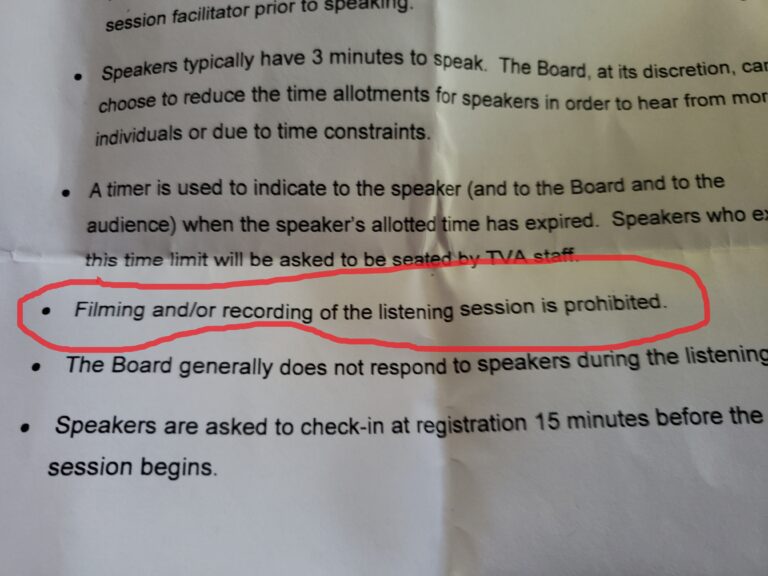
    Handout from TVA Listening Session Aug. 30 2022Scott Banbury with the Tennessee Chapter of the Sierra Club said a handout provided at TVA’s Aug. 30 listening session stated recordings of the meeting were not allowed; a TVA spokesperson said recordings are, in fact, allowed. Flyer provided by Scott Banbury

    Is TVA trying to gag its critics?

    This story was originally published by Tennessee Lookout.

    KNOXVILLE — While the Tennessee Valley Authority, a utility company that provides power to millions in Tennessee and other states, allows for public input into decisions, the process isn’t simple or transparent, say some regular attendees.

    Take, for instance, a recent public listening session: representatives of the Tennessee Chapter of the Sierra Club say they were told they could not record the session despite a spokesman for TVA saying the opposite.

    According to TVA spokesperson Scott Brooks, attendees are always allowed to record public meetings, provided they don’t cause a disturbance, but minutes before the session, members of the Tennessee chapter of the Sierra Club were prohibited from doing so.

  • Activists urge TVA to take advantage of historic US climate bill for energy-efficiency improvements
    in News

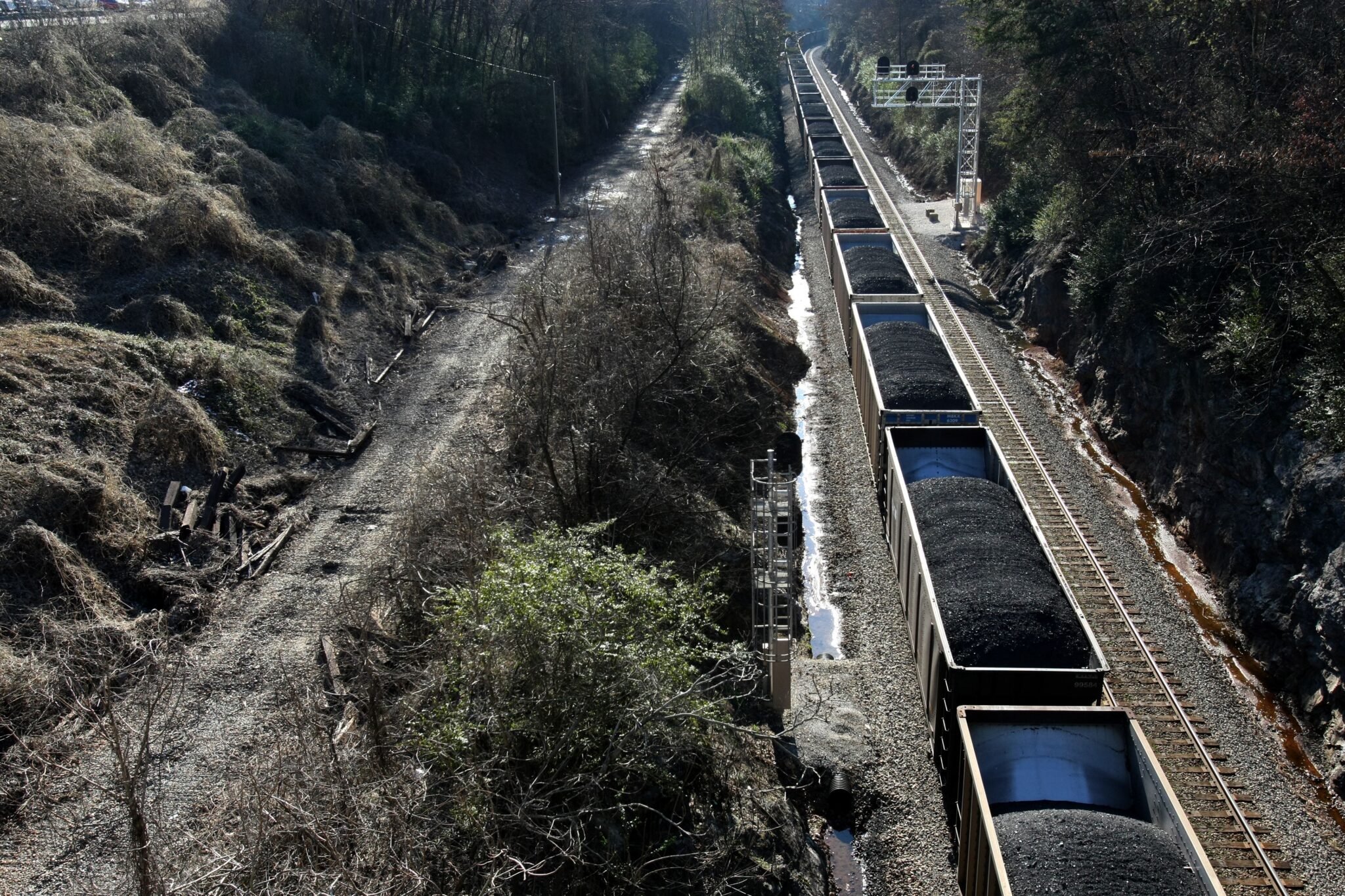
    TVA 1 2048x1365A hopper car on a train filled with coal to be delivered to a TVA coal-fired plant. John Partipilo/Tennessee Lookout

    Climate bill designates TVA as a potential recipient of clean energy investments and loans

    This story was originally published by Tennessee Lookout.

    KNOXVILLE  Clean-energy advocates are urging the Tennessee Valley Authority to use funds provided through the Inflation Reduction Act to deliver environmentally friendly energy to Tennessee customers. 

    The massive bill Congress passed Friday includes $370 billion for clean energy investments and listed TVA as an entity that is eligible to take advantage of clean energy credits and loans to significantly reduce the cost of energy-efficient infrastructure. 

    On Aug. 12, the Clean Up TVA Coalition, including the Sierra Club, the Southern Alliance for Clean Energy and Appalachian Voices, urged TVA to take advantage of the legislation and make funds available to its affiliated local power companies, which can then offer energy-efficient options for customers.

  • Dems pass huge climate bill assailed by some as another fossil energy sop
    in News

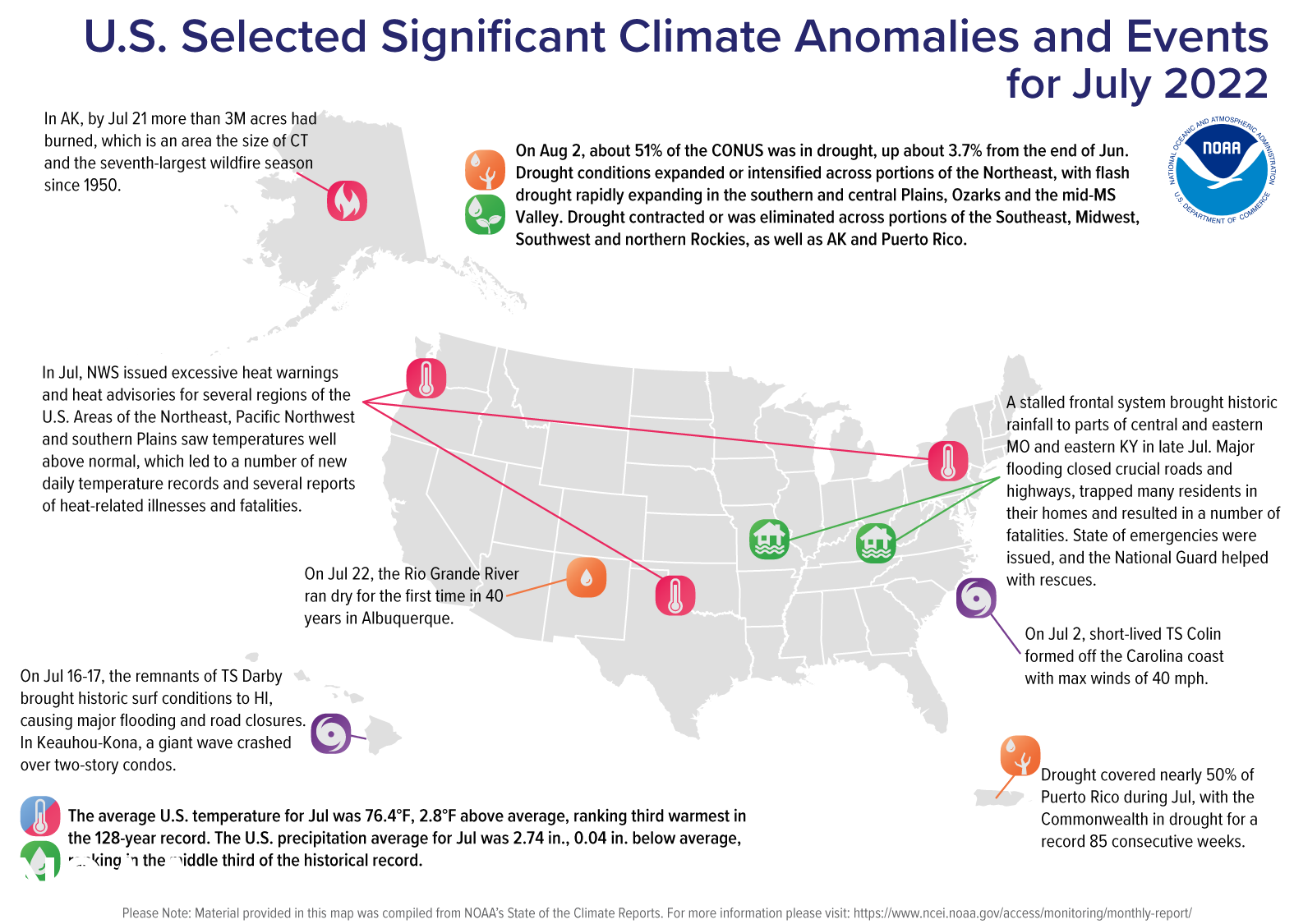
    5 July 2022 US Significant Climate Events Map

    Record-setting bill will fund extensive efforts to address climate change, but the sausage-making deal is decried by some as a ‘suicide pact’

    This story was originally published by Tennessee Lookout.

    WASHINGTON — The U.S. Senate, along party lines, passed a sweeping energy, health care, climate and tax package Sunday afternoon, following an overnight marathon of votes that resulted in just a handful of notable changes to the legislation.

    The 755-page bill was passed after Vice President Kamala Harris broke a 50-50 tie in the evenly divided Senate. It now heads to the House, where Democratic leaders have announced they will take it up on Friday.

    At last, we have arrived,” Senate Majority Leader Chuck Schumer said.  Democratic senators broke out into applause as Harris announced passage of the bill, expected to total more than $700 billion.

    Schumer, a New York Democrat, said he dedicated the measure to young Americans who have pushed and protested for the Senate to take action on climate change. 

  • Carson-Newman professor hosts installment of worldwide “Climate Teach-in”
    in Air

    Brian SohnCarson-Newman University Professor Brian Sohn is hosting a climate-oriented webinar on March 30.  Thomas Fraser/Hellbender Press

    Local installment of worldwide virtual Climate Teach-In is set for 2:30 p.m. March 30

    JEFFERSON CITY — Brian Sohn had “the closest thing to a panic attack” when his second daughter was born.

    He had long been alarmed by climate change and its potentially disastrous effects, but her arrival brought home the need to address the environmental challenges of a rapidly changing planet.

    So now the Carson-Newman University education professor is putting some final touches on a virtual climate-related “teach-in” he’ll host from 2:30 to 3:30 p.m. Wednesday, March 30.

  • Fossil-fuel pipeline in your front yard, anyone? Senate passes bill blocking local power over pipeline placement
    in News

    pipelineThis pumping station in Dickson County was the site of a 1992 gas line rupture. John Partipilo/Tennessee Lookout

    Bill eliminating local oversight of fossil-fuel infrastructure passes state Senate at behest of fuel companies, now on to House

    This story was originally published by Tennessee Lookout.

    UPDATE: The state House approved the bill March 29 with moderating amendments sought by local governments and environmental and social justice advocates.

    NASHVILLE — The Tennessee Senate passed a controversial pipeline preemption bill on Thursday in spite of concerns about the effect oil and gas pipelines could have on personal property and drinking water.

    Before passage, Sen. Ken Yager, R-Kingston, sponsor of SB2077, amended the bill to allow for wellhead protections and to align with its House counterpart. Critics still contended that with local governments lacking the ability to regulate fossil fuel infrastructure, communities could do little to protect themselves from unwanted pipelines. 

  • Tennessee Lookout: TWRA delays clearcut in Cumberlands as tourism official files suit
    in News

    DSCF8531 scaledMarvin Bullock, president of the Sparta-White County Chamber of Commerce, opposes deforestation efforts in the Bridgestone-Firestone Centennial Wilderness Area to create quail habitat. John Partipillo/Courtesy of Tennessee Lookout

    Oak Ridge Rep. John Ragan joins bipartisan pushback against state plans to raze forest for quail habitat

    This story was originally published by Tennessee Lookout.

    SPARTA For decades, the Tennessee Wildlife Resources Agency has kept the profits from the sale of timber and other natural resources on publicly owned lands, folding the payments from logging companies into the agency’s annual operating budget.

    bipartisan bill introduced in the Tennessee Legislature this week seeks to bring that practice to an end. The measure, introduced by Rep. John Ragan, R-Oak Ridge, and Sen. Heidi Campbell, D-Nashville, would require TWRA officials to transfer all proceeds from the sale of the state’s natural resources into Tennessee’s general fund — the process typically followed by other Tennessee agencies that generate income.

  • Part IV: Clear-cut controversy. Thoughts and prayers
    in News

    service pnp pga 09600 09690vLibrary of Congress

    Citizens and scientists weigh in on controversial TWRA logging plan

    For months, Tennessee Lookout has bird-dogged a Tennessee Wildlife Resources Agency proposal to clear at least 1,000 acres of hardwood forest in the Bridgestone Centennial Wildlife Reserve in White County to create habitat for dwindling bobwhite quail

    Hellbender Press has published most of the stories, with much appreciation to Tennessee Lookout. Most recently, the online news outlet reported that legal hurdles had been cleared to allow TWRA to proceed, at least for now, with its game-bird reintroduction plans at the expense of acres of approximately 65-year-old hardwood forest. 

    Though it was not Hellbender’s original reporting, on our end the social media response to the articles has been thoughtful and reasoned — with, of course, occasional disagreements among commenters. With permission from the posters, I’ve compiled an edited and abridged recitation of some comments, which were too good to languish in the social media ether.

  • Memphis takes a stand against convenience stores that feed health disparities
    in News
    By

    IMG 0447

    Citing a dearth of grocery stores and healthy food options, Memphis officials mull action 

    This story was originally published by Tennessee Lookout.

    “In the poorest Memphis neighborhoods, gas stations serve as the nearest and sometimes the only store with groceries for nearby communities, albeit ones offering unhealthy fast and convenience foods. The University of Memphis noted that the city’s overall poverty rate is 21.7 percent, and rates are even higher among communities of color and among children, with a child poverty rate of 35 percent.”

    In some areas of Memphis, there are more gas stations than grocery stores. While a citywide moratorium placed a hold on new gas stations, businesses are still seeking permission from City Council to open against the wishes of local communities.

    In March, City Council voted in favor of halting permitting of any new gas stations. Businesses now need to go through the Land Use Control Board of Memphis and Shelby County for permission, and their request would need final approval from City Council. 

    “It seemed like every week we were passing an ordinance to allow two or three more service stations and we didn’t  feel like we had a handle on it. We felt like that needed to calm down,” said Councilman Jeff Warren.

    At an October meeting, council members debated whether Broad Avenue needed another gas station (and convenience store). Hundreds of residents in the nearby neighborhoods signed a petition urging council members to vote against allowing another gas station in their community. 

    “We do not want nor need a gas station at this site. That would make four gas stations within a mile radius. . .I fully expect you to listen to the money, rather than the neighbors,” said one resident.

    Council members concluded the meeting without making a decision, opting to delay the vote for a month, but the response from local residents was clear: there were more than enough gas stations in communities needing other types of stores. 

    “Who in their right mind would add a fourth gas station on a street that’s a mile long?” said another resident.

    Over the span of 20 to 30 years, Memphis officials permitted gas station after gas station to open throughout the city to the point that “there’s 10 times more per population than Nashville has,” said Warren. 

    Gas service stations are a lucrative business. According to Forbes, the market relies on minimizing the distance that consumers have to travel, and competition means that at any given intersection, gas stations are often located on each corner. 

  • Memphis City Council bans Byhalia Pipeline over aquifer contamination concerns

    01312021 VALERO Memphis Refinery Focht 008Memphis residents have pushed back against the Byhalia Pipeline project. The proposed pipeline has been the subject of controversy since 2019. The joint venture project would build a 49-mile pipeline between Memphis and Mississippi and would run through several Black communities in Memphis. VALERO Memphis Refinery, shown here, is along the Mississippi River’s Lake McKellar in South Memphis. Photo by Karen Pulfer Focht

    Opponents of Memphis pipeline cite textbook examples of environmental racism

    (This story was originally published by Tennessee Lookout).

    Memphis City Council passed an ordinance this month protecting the Memphis Sand Aquifer after environmental activists spent nearly a year fighting to protect it against a crude-oil pipeline.

    The city council passed on second reading an ordinance establishing the city government’s role in  overseeing future developments in Memphis and how they may impact the aquifer, which serves as the area’s main drinking water supply. 

    The ordinance will be up for a third and final vote on Aug. 17.

    Since 2019, environmental and racial justice advocates have protested plans to build the Byhalia Pipeline, a joint venture between Texas-based Plains All American Pipeline and Valero Energy Corporation, in a historically Black neighborhood located in Southwest Memphis. What started as criticisms turned into full-blown protests that gathered national attention and support from prominent political figures, including former Vice President Al Gore and civil rights leader the Rev. William Barber.

    The council used the Federal and Tennessee Safe Drinking Water Act as an authorizing agent for local government’s ability to protect public drinking water.

    The Memphis City Council first discussed legislation to protect the aquifer in May 2021 and introduced ordinances that would affect the Byhalia Pipeline. 

    The resolution established an Underground Infrastructure Advisory Board to review all future developments within Memphis and prohibit those that carried hazardous liquids. According to council documents, developments must not pass within 1,000 feet of the Wellhead Protection Areas, which access existing public water supplies. 

    Byhalia Pipeline representatives threatened to file a lawsuit against the city council if they were to pass legislation that regulated future developments, causing the council to delay the vote. 

    Byhalia Pipeline representatives then abandoned the project in July but said they still considered filing a lawsuit if the resolution were to pass. 

    Councilman Jeff Warren, who sponsored the resolution, said “lawsuits are always possible.”

    Local community leaders and critics called the Byhalia Pipeline an example of environmental racism, adding that Memphis communities were already burdened by harmful environmental issues caused by nearby oil refineries, wastewater treatment facilities, industrial manufacturers and power plants.

    These factors led to cancer risks four-times the national average, and any contamination of the area’s drinking water could potentially turn the area into another Flint, Michigan, a city whose water system was contaminated with lead.

  • Biodiversity in crosshairs as burgeoning Middle Tennessee fears water shortage

    Duck RiverMarshall CoThis biologically rich stretch of the Duck River could soon be the site of a large municipal water intake facility.

    Duck River targeted by thirsty, growing municipalities in Nashville area

    This story was originally published by Tennessee Lookout

    Marshall County, located outside what was once considered the boundary edge of growing suburbs circling Nashville, has seen explosive growth of its own in recent years — call it the Williamson County overflow effect, says County Mayor Mike Keny.

    Drawn by more affordable housing, jobs and the rural character of the county — about an hour from Nashville in the “heart of the Southern Automotive Corridor” (as local economic development officials call it) — the influx of residents, and some relocating business and industry, has brought new urgency to a long-standing reality.

    The county doesn’t have its own water supply. For decades, it has had to pay wholesale for drinking water from the cities of Murfreesboro and Lewisburg. That supply is no longer adequate.

    A new proposal by county officials calls for building a water treatment facility along the banks of the Duck River in northern Marshall County capable of siphoning up to 6 million gallons of water per day; establish a reliable local water supply for decades to come.

    The need for Marshall County,  to have its own water supply, which it has never had, is becoming more urgent with an influx of new residents. But environmental activists say the nearby Duck River, which is biologically diverse, may not be the best option.