
border, but a few remain, against all odds, in East Tennessee.
This particular barren was described years ago by the late Hal DeSelm, a prominent East Tennessee-based botanist who was fascinated by barren and glade communities and whose work recording these terrestrial systems was featured in a previous Hellbender Press article.
Bigelow is the informal caretaker of the seven-acre cedar barren adjacent to the middle school. He once attended Jefferson, and its students now use the natural area as an outdoor laboratory.
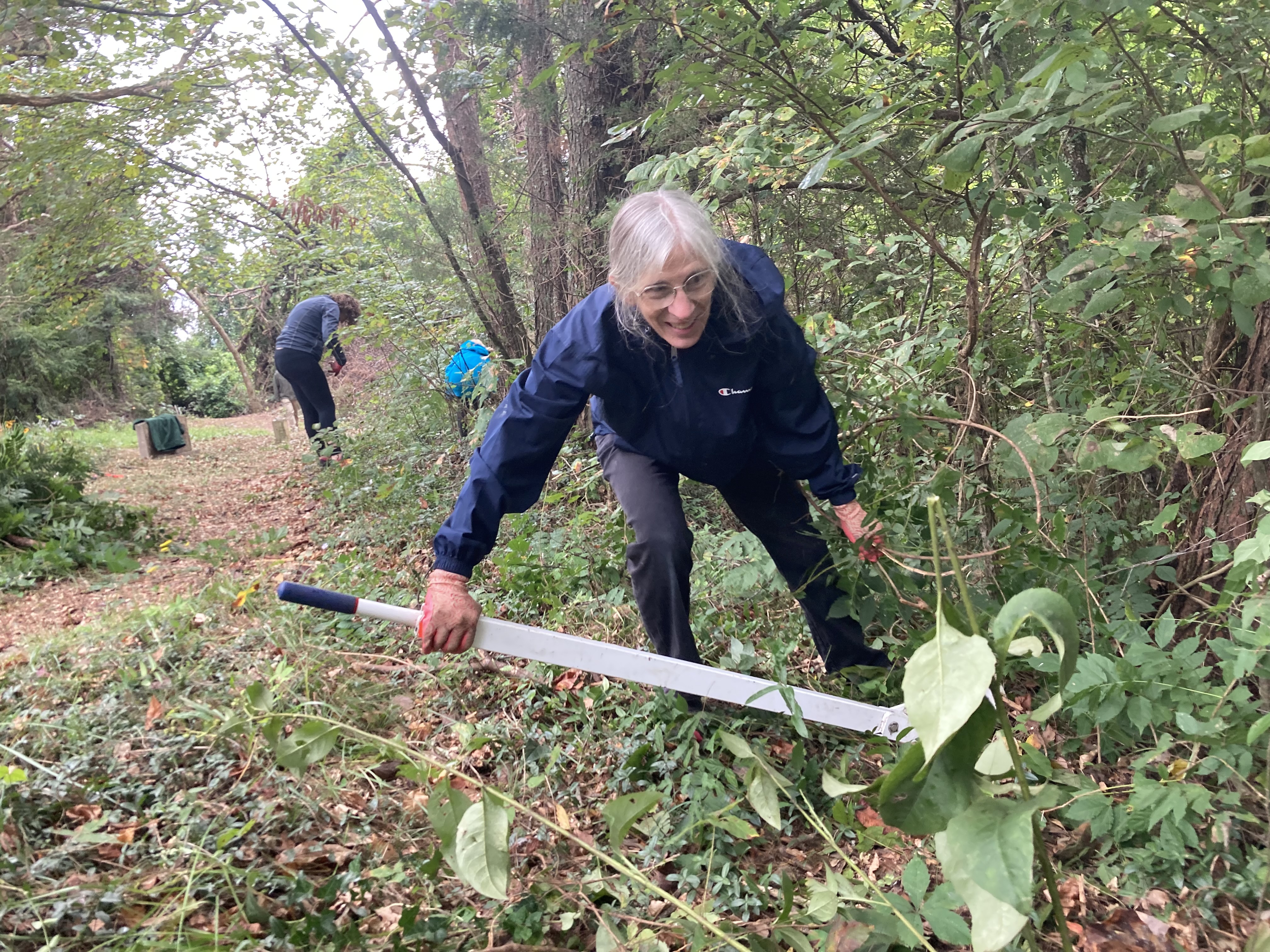
Tennessee Citizens for Wilderness Planning, an Oak Ridge-based conservation group, organizes about three such “weed-wrangling” work days at the barrens each year. The main targets are invasive species such as bush honeysuckle, privet, English ivy, and lespedeza, but work crews also remove native woody plants that can hinder growth of the native grasses endemic to the peculiar plant community.
“The habitat is unique and uncommon in East Tennessee. Because of the ecological characteristics there are a lot of rare plants, and the habitat itself is unique,” said Jimmy Groton, a biologist, forest ecologist and member of TCWP.
“This little patch of cedar barren has three state-listed rare plants,” Groton said as dozens of determined volunteers fanned out before him armed with saws, shovels, loppers and elbow grease. Those rare plants are prairie goldenrod, naked stem sunflower and mountain mint.
This particular pine barren has been whittled away in every direction, but what remains is very special to a lot of people.
Larry Pounds, a well-known East Tennessee ecologist associated with Oak Ridge Natural Laboratory, actually takes umbrage at the word “barren” when used as a descriptive term for these unique natural communities.
“Barren is a word that means a bad place to have a farm,” he said half jokingly as he made way for volunteers dragging downed saplings up a trail.
“There go the redbuds!” he exclaimed. “Native stuff can wipe out a prairie just as fast as invasive species,” if they are not controlled by fire or otherwise removed, Pounds noted.
Thus the semi-regular work crews don’t shy from the redbud and other hardwoods or pines during the wrangles. They even remove the eponymous cedars. The trees are associated with the barrens because they can easily establish themselves in the shallow, rocky, calcium-rich soil that underpins traditional Tennessee Valley and Cumberland Plateau prairie communities.
The importance of maintaining these barrens is not just about preserving grasses and aesthetic open spaces, Pounds said. Many insect and animal communities depend on these prairies for shelter and food.
Numerous bird species call prairie communities home, including the now-elusive bobwhite quail, once a common, wide-ranging and oft-hunted bird known for its familiar call.
“Bobwhites, you never hear them any more. It’s a strange thing,” Pounds said.
The habitat available at the moment for bobwhites and other grass-nesting birds in the Oak Ridge barrens is limited, but Pounds and a host of other volunteers are expanding it, slowly but surely.
“We keep pushing out the edges a little bit … so we can give the rest of the vegetation a chance to grow,” he said.
And nature is lending a hand. Some rare plant species originally recorded in one area of the small preserve have expanded into other parts of the landscape without any human intervention.
That in itself represents a small but important victory.
“Rare plants, by definition, are not a large part of the ecosystem. A lot of these species are connected to insects. When the plant goes extinct, they go extinct, too.
If you lose a species, it’s like losing a library,” Pounds said.
Carinne Cheney, an Oak Ridge High School graduate studying microbiology at the University of Tennessee, joined the wrangle as a member of the service fraternity Alpha Phi Omega.
But she was motivated by more than that. Cheney, who has helped with similar weed wrangles at Seven Islands State Birding Park, said she enjoys making friends and hearing stories from like-minded individuals on such work parties, as well as the immediate and visible results the work yields.
“You can see the change you’ve made,” she said.
“I personally love nature, and hiking,” she said, but “it’s important to go out and make an impact on the community around you.”
That applies to plant communities, too, including the disappearing native cedar barrens so many are helping and hoping to preserve.
Tennessee Citizens for Wilderness Planning offers frequent Knoxville-area volunteer opportunities to support its mission.
Recommended further reading and viewing