
News (340)
Oak Ridge National Laboratory land is an international treasure of biodiversity
Written by Abby Bower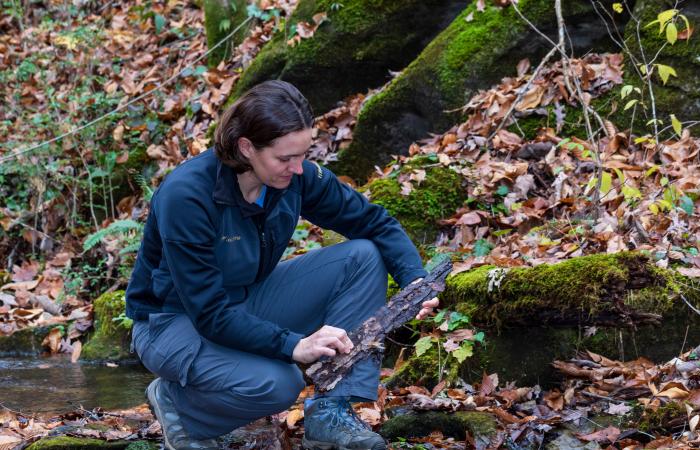 Aquatic ecologist Natalie Griffiths studies nutrients and contaminants in the Weber Branch watershed, which is in the Oak Ridge Environmental Research Park. Courtesy Carlos Jones/ORNL
ORNL research lands are an international ecological benchmark and diverse wonderland of trees, plants, mammals, reptiles and amphibians
Abby Bower is a science writer for Oak Ridge National Laboratory.
The Department of Energy’s Oak Ridge National Laboratory (ORNL) is a hub for world-class science. The nearly 33,000-acre space surrounding the lab is less known, but also unique. The Oak Ridge Reservation (ORR) is a key hotspot for biodiversity in the Southeast and is home to more than 1,500 species of plants and animals.
At the intersection of Anderson and Roane counties is an important subset of the reservation — the Oak Ridge National Environmental Research Park, or NERP — a 20,000-acre ORNL research facility that has been internationally recognized by UNESCO as an official biosphere reserve unit.
“The National Environmental Research Park is a living laboratory and a major resource for conducting ecological studies,” said Evin Carter, an ORNL wildlife ecologist and director of the Southern Appalachian Man and the Biosphere Program, or SAMAB. The NERP has been a core part of SAMAB, which has focused on sustainable economic development and conserving biodiversity in Southern Appalachia since 1989.
With ORNL researchers and scientists from government agencies and academia using the NERP for diverse experiments each year, the park lives up to its status as a living laboratory.
It also lives up to its reputation as a biodiversity hotspot. As one of seven DOE-established environmental research parks reflecting North America’s major ecoregions, it represents the Eastern Deciduous Forest. The NERP comprises parts of this ecoregion that have been identified repeatedly as priorities for global biodiversity conservation, Carter said.
This designation means more than ever as climate change alters ecosystems and biodiversity declines worldwide. According to a landmark international report, on Biodiversity and Ecosystem Services, around one million plant and animal species are currently threatened with extinction.
- oak ridge national laboratory
- ornl
- ecological benchmark
- oak ridge national environmental research park
- nerp
- biosphere reserve
- southern appalachian man and the biosphere
- samab
- biodiversity
- unesco
- oak ridge reservation
- orr
- ecoregion
- culturally significant plant species initiative
- cspsi
- evin carter
- kitty mccracken
- eastern band of cherokee indians
- neon
- national ecological observatory network
- northern longeared bat
- indiana bat
- grey bat
- endangered species
- threatened species
- purple gallinule
Catch a beer and documentary on the importance of freshwater fish and their current swim into oblivion
Albright Grove Brewing Company will host a viewing Wednesday, Sept. 29 of “Hidden Rivers,” a documentary detailing the smaller, gilled denizens of Southern Appalachian creeks, rivers and streams and the threats they face.
The screening of “Hidden Rivers” by Freshwaters Illustrated is planned for 6 p.m. at Albright Grove Brewing, 2924 Sutherland Ave. in Knoxville.
“This film aims to show off the stunning freshwater biodiversity of the Southern Appalachian region, and to highlight conservation efforts, beauty, and vulnerability of these ecosystems,” according to Conservation Fisheries, a Knoxville-based nonprofit geared toward the preservation of native Appalachian fishes and their ecosystems.
Conservation Fisheries is in its 35th year of breeding, sharing and releasing broods of threatened fishes collected from points ranging from the Conasauga River to Little River and beyond.
Another slice of the wild preserved in Cumberlands
Knox News: Nearly 12,000 acres added to Skinner Mountain preserve on the Cumberland Plateau
The Conservation Fund and state wildlife and forestry officials reached a deal to conserve and manage thousands of wild acres in Fentress County.
The expanse was previously held by an out-of-state speculative investment company likely originally tied to timber companies.
The Cumberland Plateau and escarpments have been increasingly recognized for their biodiversity along with the Smokies to the east beyond the Tennessee Valley. The Cumberlands are along a songbird and fowl migration route, and host a niche population of mature timber, mosses, lichens, fungi, mammals and amphibians. Elk were reintroduced a decade ago, and black bears have begun to range across the Cumberlands and their base.
The area is pocked with caves and sinkholes, some containing petroglyphs and other carvings from previous populations.
"On the Cumberland Plateau, the key to maintaining biodiversity is to retain as much natural forest (both managed and unmanaged) as possible," a forestry expert told the News Sentinel's Vincent Gabrielle.
The Foothills Land Conservancy has also helped protect thousands of acres along the plateau and its escarpments in recent years.
Pellissippi Parkway punches: Vocal opposition slams highway extension plans at public meeting
Written by Thomas Fraser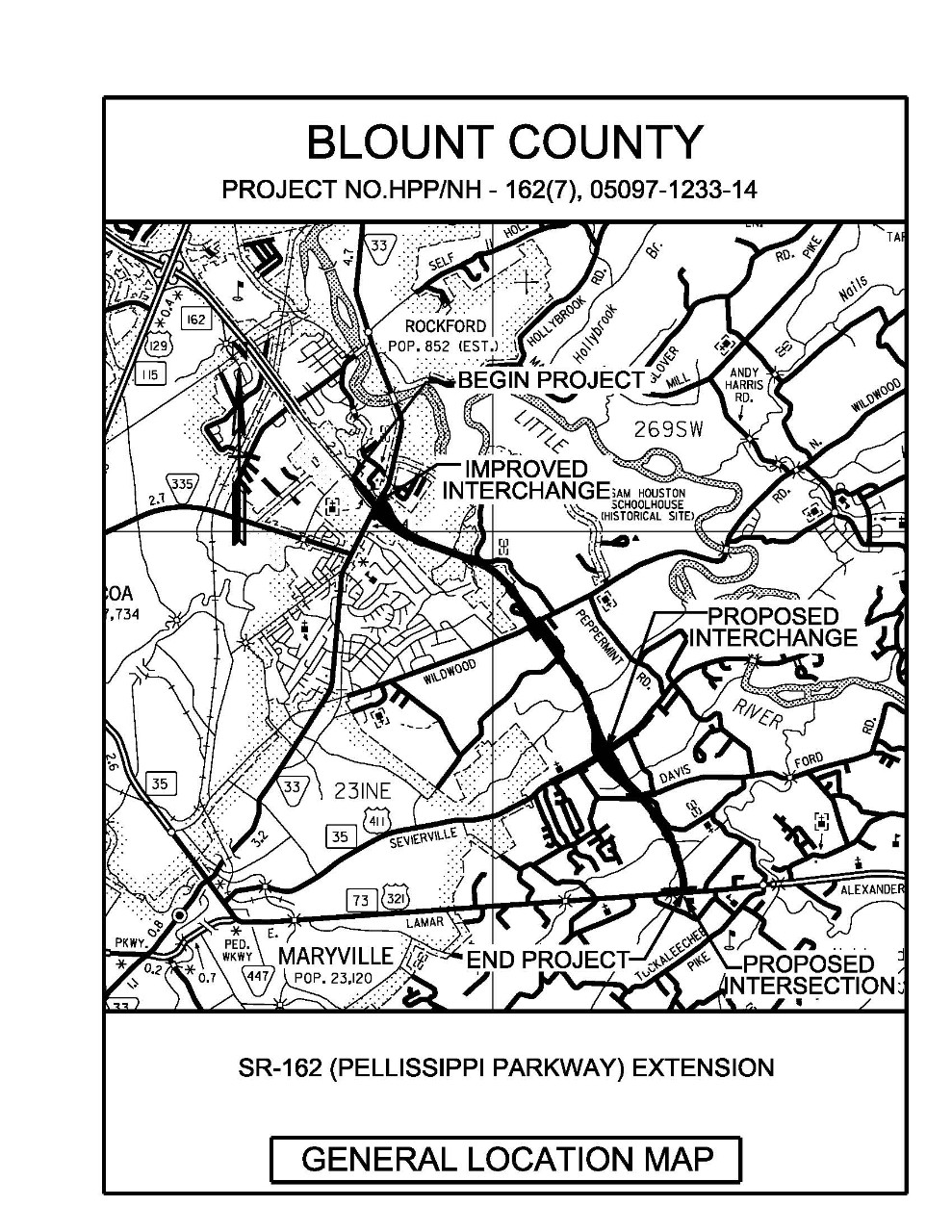
UPDATED: Opponents of Pellissippi Parkway Extension hammer bureaucrats, unelected economic development officials at public meeting
(This story has been updated with this link to the Tennessee Department of Transportation recording of the Sept. 21 public hearing on the proposed Pellissippi Parkway Extension project).
Raw emotions spilled over at a Tennessee Department of Transportation public meeting to collect citizen input on a nearly 5-mile, four-lane highway that would carve through creeks, forests, farms and homes in rural Blount County in the foothills of the Great Smoky Mountains.
The meeting was held Tuesday evening at Heritage High School, not far from where the proposed Pellissippi Parkway Extension (which would originate at the terminus of the current parkway near Rockford) would abruptly bisect East Lamar Alexander Parkway, just to the west of Walland Gap and the Little River Gorge.
As Hellbender Press has reported on the Pellissippi extension, many people aren’t happy with the proposition of spending at least $100 million on a 4.5-mile stretch of highway, and people are uncomfortable with both the use of eminent domain to force them from their homes or seize portions of their property and the unavoidable and long-lasting environmental and cultural impact such a project would have on the rural areas of Blount County. The projected cost of the project has vacillated by millions of dollars.
East Lamar Alexander Parkway (U.S. 321) terminates in Townsend; along the way are turnoffs to many valuable pieces of real estate and immensely successful high-end hospitality venues, such as Blackberry Farm. Hellbender Press reached out to Blackberry Farm through its Nashville-based public relations team about the nearby highway project and was simply told “we have no comment.”
- pellissippi extension right of way
- pellissippi parkway extension
- pellissippi public hearing
- little river
- threats to little river
- little river endangered fish
- rockford
- east lamar alexander parkway
- opposed to pellissippi parkway extension
- citizens against the pellissippi parkway extension
- cappe
- townsend
- rural blount county
- tdot public hearing on pellissippi parkway extension
- walland
- little river gorge
- great smoky mountains national park
- great smoky mountains national park visitation
- us 321 to townsend
- video of pellissippi parkway extension hearing
Share your ride and learn about other electric whips during Drive Electric Week
One of the biggest electric vehicle loads in state history is set for Saturday at Pellissippi State Community College in Knoxville.
The Knoxville Electric Vehicle Association; Pellissippi State Community College; and Drive Electric Tennessee are all plugging to make the 2021 Knoxville Drive Electric Week Event the largest ever in the state, according to organizers.
Vendors, test drives and educational activities will be held on the PSCC Hardin Valley campus just off Pellissippi Parkway from 10 a.m. to 3 p.m. Saturday, Sept. 25.
The only criteria for displaying your electric scooter, ATV, car or motorcycle: They must be plugged in to recharge. Everyone who drives an electric vehicle, or is interested in alternative fuel sources, is welcome to attend.
After pushback, TDOT to host public hearing Tuesday for Pellissippi Parkway extension through rural Blount County at foot of Smokies
Written by Lesli Bales-Sherrod
TDOT says right-of-way funds already secured despite protest; questions remain about cost that could exceed $100 million for 4.5 miles of new roadway
Those who want to weigh in on the proposed Pellissippi Parkway Extension in Blount County have another opportunity this week to voice their opinions on the controversial $60 million, 4.4-mile highway extension.
An earlier, virtual public hearing on the matter was deemed insufficient by members of the public and, notably, Blount County commissioners.
The Tennessee Department of Transportation will hold an in-person public meeting 5-7 p.m. Tuesday at Heritage High School, 3741 E. Lamar Alexander Parkway, Maryville.
The state transportation department is holding the meeting at the request of Blount County Commission and in conjunction with the virtual design meeting that was open April 15-29.
As previously reported by Hellbender Press, the proposed 4.4-mile stretch of four-lane highway would lengthen State Route 162, known as Pellissippi Parkway, from where it ends at Knoxville Highway (State Route 33) to East Lamar Alexander Highway (State Route 73/U.S. 321) in Maryville.
Transportation projects are developed in four phases: planning and environmental; design; right of way; and construction. The Pellissippi Parkway Extension is in the design phase.
“The public meeting is one of the first things we do as we kick off and get a lot of input with the initial design,” says TDOT Region 1 Director Steve Borden in a video uploaded to YouTube on Sept. 15. “After we complete this phase, we will be heading into the right of way phase, which is funded, so once this process is complete we will start the right-of-way phase of the project.”
The purpose of Tuesday’s meeting is to allow affected property owners and the general public to comment on the proposed design elements for the Pellissippi Parkway Extension.
A formal presentation will begin at about 5:30 p.m., followed by a short Q&A, according to TDOT.
“Beyond this initial presentation and group Q&A, most of the evening will be reserved for one-on-one conversations between TDOT representatives and individual attendees,” according to TDOT’s Pellissippi Parkway webpage. “TDOT asks that questions and comments raised during the group Q&A be limited to the general design of the project and that questions or comments regarding a single property be reserved for the one-on-one conversations while reviewing project displays.”
A Design Meeting Display, a Design Meeting Handout and a Design Meeting Video Flythrough that were available for April’s virtual design meeting are still online for those who want to review the design before Tuesday’s meeting.
Borden noted the virtual design meeting was held because of COVID-19 and that TDOT will record Tuesday’s meeting for those who are uncomfortable attending in person due to the rising number of COVID-19 cases.
“We are going to videotape the meeting so they will be able to hear all the questions and all the answers, see all of the presentations online, and they will also be able to comment on our website as well so that we can extend that period of comments,” he said.
The Pellissippi Parkway Extension has been part of the Knoxville regional transportation planning vision since 1977, according to a 2010 Draft Environmental Impact Statement. A Record of Decision issued in August 2017 selected a preferred route for the new stretch of road, which would cross Old Knoxville Highway, Wildwood Road, Brown School Road, Sevierville Road and Davis Ford Road before terminating near Morning Star Baptist Church in Maryville.
TDOT estimates the project would impact 56 properties and result in 11 single-family relocations, according to the Record of Decision. Cost estimates have ranged between $60 million and $65 million, an estimate prepared by TDOT in June 2017, and $194 million in “Horizon Year 2026” dollars, according to the TPO’s Mobility Plan 2040 finalized in 2016.
Nagi told Hellbender Press earlier this year that the discrepancy in the figures was due to a change in methodology. No new figures are available for the project on the TDOT website.
J.J. takes a bus down Electric Avenue
![884E1F2D 2A2F 4F68 A15E 80F9458D1FB0]() Hard Knox Wire: City takes media and politicos on a spin aboard KAT’s newest electric bus
Hard Knox Wire: City takes media and politicos on a spin aboard KAT’s newest electric bus

The city demonstrated and offered rides aboard the Knoxville Area Transit’s new electric buses at Caswell Park on Thursday. The city and Knoxville Area Transit (KAT) plan to acquire a total of 18 electric buses as part of a plan to reduce the city’s carbon emissions by 80 percent over the next thirty years. Five of the buses, built by Canada-based manufacturer New Flyer, have arrived.
“In the United States, transportation is the largest contributor to greenhouse gas emissions and consequently climate change. Transit has the power to change that,” city transit director Isaac Thorne told Hard Knox Wire.
“By drawing new people to consider transit, reducing reliance on cars, opening up opportunities, and providing sustainable mobility choices, transit can make cities more livable, make the air cleaner, and help meet our challenging but achievable climate goals,” he said.
The city plans to have 18 electric buses representing 26 percent of KAT’s fleet in regular operation by the end of next year. Another 41 percent of the existing fleet are hybrids, according to KAT.
The Knoxville Utilities Board is installing multiple chargers to service the electricity needs of the new fleet.
The new buses will undergo multiple trial runs before they hit the road with public passengers in January, probably along the Sutherland and Magnolia routes.
“KAT’s fleet of 71 buses carry around 3 million passengers each year on its 23 bus routes and three downtown trolley routes. There are 1,150 bus stops scattered throughout the city, and bus routes come within a half-mile of 80 percent of the population,” Hard Knox Wire reported.
“Today marks a dramatic milestone for Knoxville — this is a major step on our path toward a more clean and resilient future for our children and grandchildren,” Mayor Indya Kincannon said in a news release from KAT.
“These high-efficiency electric buses are an investment in clean air, in healthy neighborhoods, and mobility for our residents.”
Lawsuit alleges TVA paid dues to industry trade groups that undermine environmental protections
Written by J.J. Stambaugh and Thomas Fraser The Kingston Fossil Plant in Kingston, Tennessee is shown in this file image from the Tennessee Valley Authority.
TVA denies lobbying or cronyism, cites need for “expertise and analysis”
Editor's Note: This report is a collaboration between Hellbender Press and Hard Knox Wire.
A coalition of environmental groups who joined forces to stop the Tennessee Valley Authority from using ratepayer money to fund trade groups who lobby against the Clean Air Act and other environmental protections filed a federal lawsuit against the utility.
The environmentalists claim the practice potentially raises conflicts of interest and throws into doubt TVA’s willingness to comply with clean air laws even as the utility retires its coal plants in order to transition to a mix of fossil gas and nuclear power.
The 20-page lawsuit was filed Sept. 9 in federal court in Knoxville by a half-dozen groups, including the Knoxville-based Southern Alliance for Clean Energy and the Center for Biological Diversity (CBD). The groups aren’t seeking monetary damages other than court costs and legal fees.
TVA has invested millions of dollars in measurable air quality improvements as it prepares to divest from coal as a main electricity source. Nevertheless, TVA paid membership dues to interest groups such as Edison Electric Institute (which is headquartered five blocks from the U.S. Capitol) and Energy and Wildlife Action Coalition, according to the plaintiff’s suit.
“TVA has not been officially served with the lawsuit, so it would be inappropriate to comment on its specifics,” TVA spokesman Jim Hopson said early Thursday.
“As the nation’s largest public power provider and a federal agency, the Tennessee Valley Authority needs to demonstrate leadership by halting the financing of groups propping up the fossil fuel economy,” said Howard Crystal, legal director at CBD’s Energy Justice program. “Instead it funds these groups to do its dirty work while it moves forward with building new fossil gas plants. TVA can and must do better.”
TVA contends it merely wants to get input from multiple stakeholders with multiple perspectives.
“As a federal agency, TVA is prohibited from participating in lobbying activities, and the TVA Board has directed that any dues, membership fees, or financial contributions paid to external organizations not be used for purposes inconsistent with TVA’s statutory mission or legal obligations.“Like other major utilities, TVA’s membership in a diverse array of external organizations allows TVA access to specialized expertise and analysis that directly benefits all of our customers at a cost significantly lower than if TVA were to undertake such work alone.”
Maggie Shober, director of utility reform at the Southern Alliance for Clean Energy, said TVA has a special responsibility to support environmental protections.
“TVA is unique in the power industry in that environmental stewardship and economic development are codified in the agency’s founding mission,” she said. “It is imperative that the largest public power utility operate with accountability and transparency, stop funding anti-environment and anti-green jobs work, and invest in clean energy that will support the health of the Valley and the people who depend on it.”
Daniel Tait, chief operating officer of plaintiff Energy Alabama, said: “TVA has forced its customers to make political speech by taking money from their utility bills and using it for anti-clean energy advocacy. We have repeatedly called on the TVA inspector general to investigate this misuse of customer funds but after hearing and seeing nothing, we felt compelled to act.”
The path to the lawsuit began when the groups used the Freedom of Information Act to discover that TVA paid $200,000 in 2018 to the Utility Water Act Group, which lobbies against parts of the Clean Water Act. They also learned the utility was paying $500,000 a year to join the Edison Electric Institute, a group that represents all private, investor-owned utility companies in the country.
Deadly natural disasters have ravaged hardscrabble Knoxville for generations. Covid-19 takes the cake.

Hard Knox Wire: A brief history of Ktown's worst natural disasters
The Covid-19 pandemic currently could go down in history as Knoxville's worst hard time (to borrow a phrase from Timothy Egan), but a litany of natural disasters preceded the international outbreak of respiratory disease that killed 629 people in Knox County as of Sept. 8, according to the Knox County Health Department. Only half of the county's residents have been vaccinated, according to a New York Times database, and more than 10 percent of the population has been infected with Covid-19, which can carry life-long health implications.
Hard Knox Wire has a great rundown of the Covid crisis and other natural disasters that the city and region have faced in its ongoing Knoxville history series. They include the far-flung effects of the New Madrid earthquake; periodic flooding that devastated downtown and outlying areas before TVA dammed the Tennessee River; a Cocke County plane crash that killed all aboard, including noteworthy Knoxvillians; and, perhaps, appropo, the smallpox and cholera breakouts that struck the city in the 1800s.
History is a great teacher, and thanks to JJ Stambaugh of Hard Knox Wire and Jack Neely of the Knoxville History Project for keeping us on our toes in regard to the past.
Tragedy of the commons: Plant poaching persists in Smokies and other public lands
Written by Ben Pounds A red trillium is seen in the Southern Appalachians. It is often the target of poachers who aspire to place it in an ill-suited domestic ornamental garden. Courtesy Wiki Commons
Forest service withholds ginseng permits to protect native Southern Appalachian plants as overall poaching persists
Paul Super has a message for people who take plants and animals from Great Smoky Mountains National Park:
It’s stealing.
“We’re trying to protect the park as a complete ecosystem and as a place that people can enjoy the wildlife and everything that lives here … but they have to do it in a sustainable way, and poaching doesn’t fit,” said Super, the park’s resource coordinator.
“Be a good citizen. Enjoy the park without damaging it.”
Super said the novel coronavirus pandemic led to the second-highest visitation to the park in 2020, just over 12 million, even with the park being closed briefly.
“This year will likely have the highest visitation ever,” he said, adding that the park is, in terms of the pandemic, a “relatively safe place for family and friends.”
Super said this higher visitation rate may lead to more poaching but it may also lead to more people who “appreciate something that a poacher would take away from them.
“Besides being illegal, that’s just selfish and rude,” Super said regarding plants and animals, and even cultural artifacts that are taken from the park.
Super is the park’s research coordinator, and is in charge of recruiting researchers to help better understand the nuances and full ramifications of stealing public natural resources. He said his researchers don’t enforce the laws, but they do alert law enforcement rangers to poaching incidents and suspicions.
- ginseng poaching
- poaching in great smoky mountains national park
- poaching in southern appalachia
- pink lady slipper
- ginseng
- smokies ginseng
- trillium
- great smoky mountains national park
- paul super
- smokies research coordinator paul super
- is removing plant from mountain illegal?
- insect poaching
- rare plant species
- ginseng trade
- butterfly poaching
- beetle poaching
- big south fork poaching
More...
Dozens of oil spills tracked in Gulf of Mexico nearly two weeks after Hurricane Ida

Washington Post: Thousands of reports spill in about pollution following Hurricane Ida
It was a perfect storm of imperfect planning that led to southern Louisiana's prominent role as both a producer and transporter of fossil fuels -- and its vulnerability to storms such as Hurricane Ida.
Ida pitched one of the highest hurricane gusts (175 mph) ever recorded in the U.S. when it came ashore at Port Fouchon. Its storm surge also inundated and destroyed both residential neighborhoods and refineries, pumps, pipelines and petroleum storage facilities associated with the high-dollar, polluting petrochemical complex of southern Louisiana.
The Coast Guard is tracking 350 documented oil spills that have occurred since Ida's violent arrival on Aug. 29. Overall, the Washington Post reported "the Coast Guard has received 2,113 reports of pollution or contamination in the waterways to date, with plans to follow up on each.
"The most significant incident so far has been the oil spill off Port Fourchon, in a lease area known as Bay Marchand Block 5," the Post reported.
The Gulf Coast and gulf itself are littered with thousands of miles of abandoned pipelines and imperfectly capped wellheads. Ida ruptured many, but this is a common headline every time a hurricane strikes the Gulf Coast. It just seems to be getting worse.
Tennessee Aquarium floats citizen-scientist app to extend the reach of public research
Written by Ray Zimmerman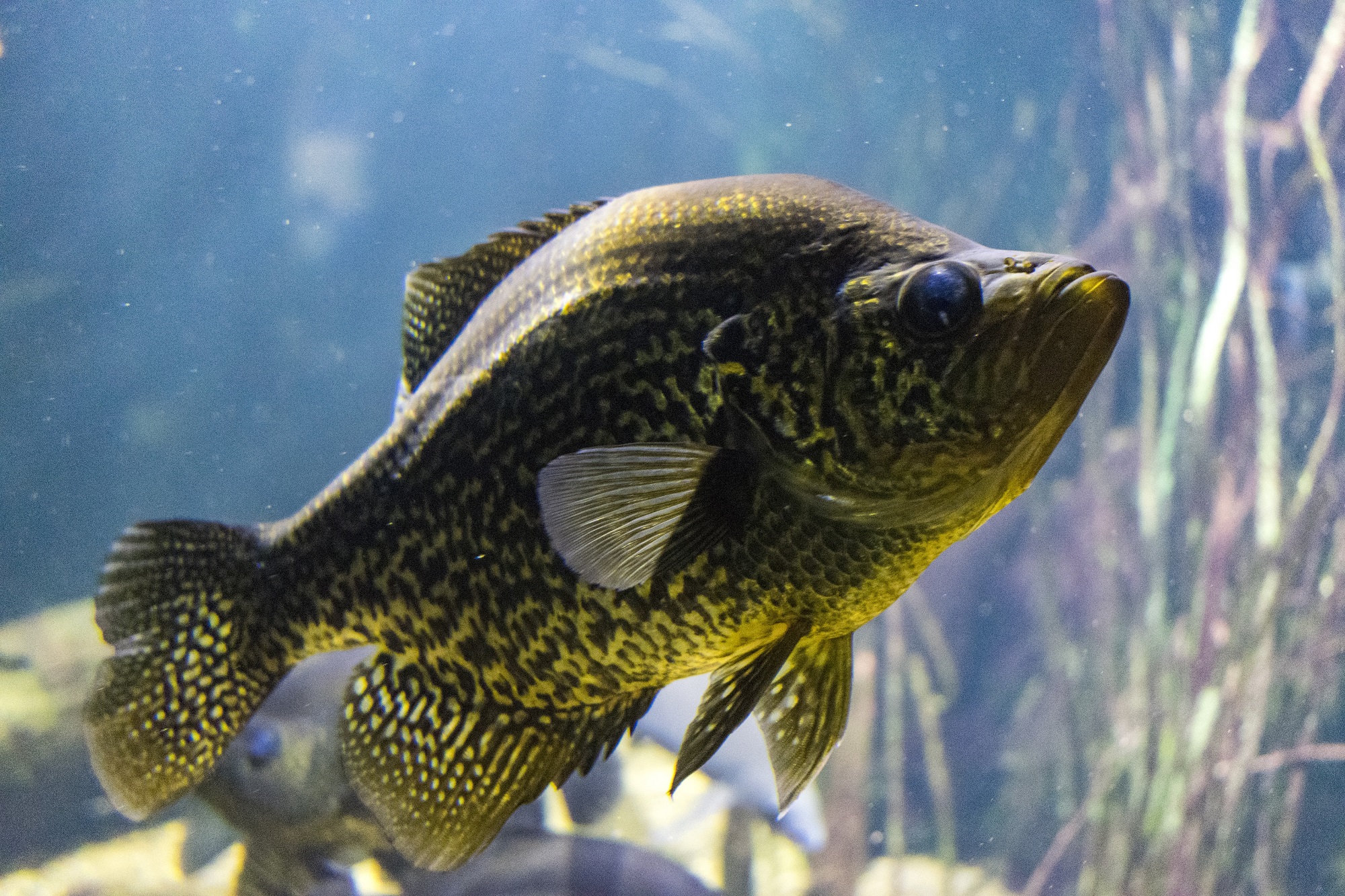 A black crappie is seen in the Tennessee Aquarium. Citizen scientists across the region can now plug their fish findings into a new database. Courtesy Tennessee Aquarium
So you want to be a citizen scientist? There’s a new app for that!
The Tennessee Aquarium Conservation Institute wants to assess the status of various fish populations throughout the Southeast so it released a new app to help outdoor folks and anglers identify the fish they spot, report the sighting, and enter their discoveries into a regional fish database.
The Freshwater Information Network (FIN) accepts and includes data for three major watersheds: The Tennessee and Cumberland rivers, and Mobile Bay.
Tennesseans may be familiar with the two rivers, but may think of Mobile Bay as a distant place with no connection to them, but its headwaters touch Tennessee in the Conasauga River. With its geographic isolation, the Conasauga is home to species of fish found nowhere else in the world.
Our region has more species of fish than any other part of the country, and the open FIN database and application includes information on nearly half the U.S. species of fish. When hikers, boaters or anglers spot a fish, they can participate by first photographing it and then uploading the photograph to the app.
Park service seeks public input on regulation of Smokies helicopter flights
A public input session has begun as part of a joint effort between the Federal Aviation Administration and the National Park Service to establish limited helicopter tour routes over Great Smoky Mountains National Park along with protocols geared to reduce the environmental and visitor impact of the flights.
The flights are already occurring, and have been for years; park service officials said in a news release that 946 flights per year would be allowed under the Air Tour Management Plan, in line with current levels of helicopter tours conducted each year by two operators outside the park.
The park service and FAA plan a virtual public meeting on the proposed tour routes at 4:30 p.m. Sept. 16. Public comment is accepted through Oct. 3, and can be entered into the record at the Smokies Air Tour Management Plan website.
"Great Smoky Mountains National Park is among 24 parks of the National Park System developing air tour management plans in cooperation with the FAA," park officials said in a press release.
"The agencies hope to complete all air tour management plans by the end of August 2022. The schedule is part of a plan approved by the U.S. Court of Appeals for the District of Columbia Circuit for the agencies to comply with the National Parks Air Tour Management Act of 2000 within two years."
From the Gulf Coast to the most densely populated American corridor, Ida laid bare our flimsy climate-change preps
Hurricane Ida hit the Gulf Coast with flooding rains, catastrophic winds, storm surge and the highest wind gust (170 mph) ever recorded in the United States.
The hurricane devastated Louisiana barrier islands and left at least 10 people dead and millions without electricity before it peeled off for a destructive jaunt up through the Mid-Atlantic region, where it joined with a slow-moving Northeastern warm front for what was truly the perfect storm.
Many forecasters, once again, said that climate change was largely responsible for the devastation that spanned the good part of a nation.
Record rain amounts were registered at both Central Park and Newark (New Jersey) airport.