
Thomas Fraser
Ocoee Whitewater Center destroyed in huge fire
 U.S. Forest Service
WKRN: Building a total loss after overnight fire
Investigators are on the site of Polk County’s Ocoee Whitewater Center after it burned down in the early morning hours of April 26. No injuries were reported, and the building was closed to the public because of the COVID-19 pandemic, according to the Forest Service website. Several trails in the area were closed as authorities, including state arson investigators, probed the cause of the massive fire.
The center featured native stone and massive beams and overlooked the Class V rapids of the section of river used for whitewater events during the 1996 Olympics.
It later became a great place for spectators to watch commercial rafters hit such holes as Humungous, and was used as a regional visitors center, event venue and educational facility.
Some 300,000 people visited or paddled by the center every year. It was a center for educational programs and hiking, biking and watersports.
“Native gardens honoring Olympic athletes and Cherokee Indians invite you to stroll through the grounds. A historic trail, built by Cherokee Indians and used by 19th century miners to transport copper ore by mules and wagons follows the river upstream. Along the way you can see rock formations deposited more than 750 million years ago,” according to a Forest Service description of the facility.
“The Ocoee Whitewater Center was a unique site not just here on the Cherokee National Forest, but across the Forest Service. It is a difficult loss for us,” Mike Wright, acting forest supervisor for the Cherokee National Forest, told WKRN of Nashville.
This article has been corrected to note WKRN is a Nashville TV station.
Updated: It’s your Earth Day week! You should connect with your mother.
 The horizon over Argentina is seen in this image taken from the International Space Station. NASA
Earth Day is every day, but it’s officially on Friday, April 22 this year. Get involved.
The 2022 observance of Earth Day is officially Friday, April 22, but the Knoxville area plans celebrations, work parties and seminars in honor of the 50-year-old annual recognition of Mother Nature through Saturday. Here’s a quick look at some local ways to love your mama. This list will be updated.
Another look at the parallel war Russia is waging against the natural environment

New York Times: Ukraine environmental holocaust just the latest in ways war scars the Earth
Open armed conflict understandably abrogates immediate concerns about the natural environment.
Despite the tens of thousands of human deaths already caused by Russia’s invasion of Ukraine, the war’s impact on natural systems can’t be understated.
In some cases, Russian troops have taken up positions in natural parks and protected ecological areas in Ukraine. The Black Sea coast is an important remaining area of biodiversity in Europe. Ukrainian counterattacks, while understandable, have also inflamed environmental consequences.
There are also immediate risks to human respiratory health from the fires sparked by attacks on fuel depots and chemical facilities.
War’s negative environmental impacts are by no means a new thing: See the use of Agent Orange by the U.S. in Vietnam and the wasteland of burning oil fields left behind in the Gulf War.
War is bad for every living thing.
Blount County Commission committee rallies against Smokies parking fees ahead of superintendent Q&A
GATLINBURG — Great Smoky Mountains National Park Superintendent Cassius Cash hosted a dgital meeting April 14 urging the implementation of a $5 daily parking fee for Smokies visitors to raise money for park maintenance, law enforcement and visitor services.
The meeting included an overview presentation introducing the rate changes and a question and answer session.
Step up for fresh produce at New Harvest Park
KNOXVILLE — The New Harvest Park Farmers Market kicked off in East Knoxville on April 14 and will be open from 3-6 p.m. every Thursday through Sept. 29.
The market will feature 15 small, locally owned businesses and showcase a wide variety of seasonal produce, meats, eggs, plants, prepared foods, and artisan crafts, and will grow to 20 vendors during peak season, according to a release from Knox County.
A community booth will house the Nourish Moves walking program in which market patrons can track their steps and redeem them for Produce Bucks to be spent at market on fresh fruits and vegetables. New Harvest Farmers’ Market Nourish Moves is a free, weekly walking program for adults and children 2 years or older. To participate, stop by our Community Booth to pick up a pedometer. Each participant receives $3 in Produce Bucks per visit that can be spent on any fruits, vegetables, and food-producing plants at the market.
Nourish Knoxville will continue to offer SNAP & P-EBT processing and doubling at the market through the Double Up Food Bucks Program. SNAP & P-EBT purchases will be doubled, up to $20 per day in Double Up Food Bucks tokens that are redeemable at the market for free fresh fruits and vegetables.
Fly away on an adventure at Avian Discovery Days
 Chattanooga Audubon Society
CHATTANOOGA — Birds of a feather are called to flock together this week at Chattanooga Audubon Society’s Avian Discovery Days April 5-7. This is the third year of this event at the Audubon Acres sanctuary, and reservations are required.
Call (423) 892-1499 or check out Avian Discovery Days for more information.
Participants will learn about birds during four activities, including bird walks specifically designed to teach identification skills. They will also learn how birds survive migration in the Great Migration Challenge game.
Updated: Hatcher Mountain fire nearly extinguished; 300 structures affected
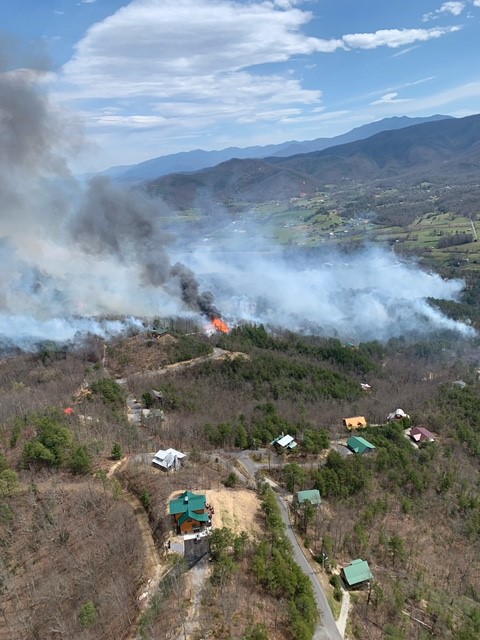 Sevier County Emergency Management Agency
Forest fire above Wears Valley in Sevier County nears full containment; Seymour fire under control
UPDATE APRIL 4: The Sevier County Emergency Management Agency said the Hatcher Mountain/Indigo Lane fire is largely extinguished. Fire crews continue to further subdue the Millstone Gap fire near the Sevier/Blount county line.
The National Weather Service warns of continued high fire danger citing breezy winds and low humidity. Widespread rainfall is forecasted to fall beginning tomorrow.
Officials said the Hatcher Mountain fire ultimately burned 2,500 acres, and damaged or destroyed 300 structures.
UPDATE APRIL 1: Fire crews focusing on the stubborn Hatcher Mountain fire had to pivot in part early Friday to also fight a new wildfire in Seymour near the Blount and Sevier county lines.
Sevier County officials said the Wears Valley-area fire was 45-percent contained this afternoon following a significant brew-up late Thursday. At least 100 structures/dwellings had been “affected” by the fire, which has consumed at least 3,739 acres. Numerous rental cabins and homes have been lost.
Bobcats vs. pythons in the swamps of Florida
 USGS
USGSNew York Times: Evolving native predation may help stem invasion of Burmese python
The proliferation of the exotic and invasive Burmese python in the swamps and wilds of Florida is demonstrably bad for native birds and mammals.
Researchers now have evidence the best solution might have been there all along.
A bobcat was captured on a trail camera by the U.S. Geological Survey eating python eggs and challenging one of the gigantic snakes. It was the first instance of natural, native predation on the snake’s eggs. Bobcats are already known to target reptile eggs, including those of sea turtles.
“While it is possible that this interaction was just an isolated incident, it is also possible that native species are beginning to respond to the presence of the python," the New York Times reported.
“‘Most cat species adapt their diet to what is available, so bobcats predating on python eggs is actually not that surprising’” said Mathias Tobler, a wildlife ecologist at the San Diego Zoo Wildlife Alliance.”
Carson-Newman professor hosts installment of worldwide “Climate Teach-in”
 Carson-Newman University Professor Brian Sohn is hosting a climate-oriented webinar on March 30. Thomas Fraser/Hellbender Press
Local installment of worldwide virtual Climate Teach-In is set for 2:30 p.m. March 30
JEFFERSON CITY — Brian Sohn had “the closest thing to a panic attack” when his second daughter was born.
He had long been alarmed by climate change and its potentially disastrous effects, but her arrival brought home the need to address the environmental challenges of a rapidly changing planet.
So now the Carson-Newman University education professor is putting some final touches on a virtual climate-related “teach-in” he’ll host from 2:30 to 3:30 p.m. Wednesday, March 30.
Parson Branch Road improvements under way in Smokies
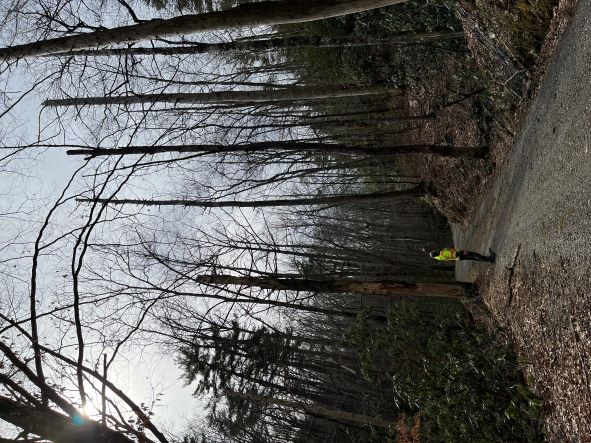 Dead hemlocks are seen along Parson Branch Road near Cades Cove. National Park Service
CADES COVE — Great Smoky Mountains National Park contractors began removing at least 800 dead hemlock trees along Parson Branch Road, an eight-mile primitive backcountry road that connects Cades Cove with U.S. 129 on the western edge of the park.
The road has been closed since 2016 because of the tree hazards and damage to the road surface. The hemlocks succumbed to the hemlock woolly adelgid, an exotic insect that has wreaked havoc on hemlock stands and their accompanying ecosystems.
The road passes several trailheads, and is used by emergency vehicles as needed. The park initially identified some 1,700 trees that posed a hazard to the adjacent roadway, but that number has naturally declined by about half over the past six years.
Friends of Great Smoky Mountains National Park provided $100,000 for the hazard-mitigation project. That was matched with $50,000 from the federal government.
Once the dead trees are removed, work will begin to rehabilitate the roadway and ensure its safety.
The roadway could reopen this summer, according to a news release from the National Park Service.