
7 Affordable and Clean Energy (7)
Ensure access to affordable, reliable, sustainable and modern energy for all
Austria to sue the European Union if it labels nuclear and gas power plants as “green infrastructure”
VIENNA — Leonore Gewessler, Austria’s energy and climate minister announced that she would take the case to the European Court of Justice if the union’s executive proceeds with plans to include nuclear and natural gas in the EU taxonomy of sustainable finance.
About gas, Gewessler said that it releases unconscionable amounts of greenhouse gases. “Just because something is less bad than coal doesn’t make it good or sustainable.”
Regarding nuclear energy she said it has unpredictably high risks, referring to Chernobyl and Fukushima. She also mentioned as great concerns, the safe disposal of spent nuclear fuel and lack of a global solution for its final storage.
Since the COP26 climate summit in Glasgow, Austria is aligned with Germany, Luxembourg, Denmark and Portugal in opposing further investments in nuclear power.
However, France, Finland and ten other EU countries have been pushing for nuclear expansion. They still claim it is a low-carbon technology and trust that the radioactive waste problem can be solved.
Luxemburg, Germany and Spain stated they will join Austria before the court, if necessary. Svenja Schulze, Gewesser’s German counterpart said of nuclear power, “it is too risky, it is too slow, it is too expensive!"
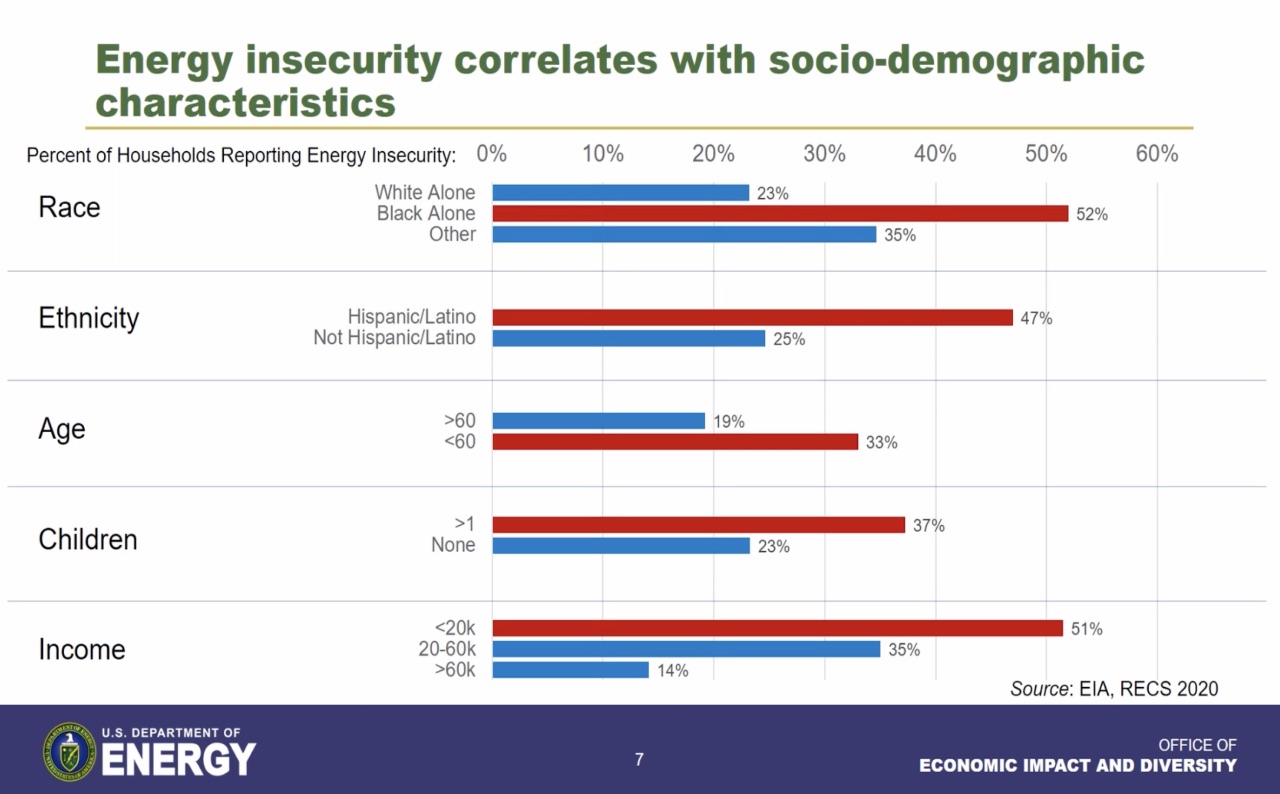 The inordinate burden of energy costs is shown in this slide presented by Tony Reames during a discussion of energy injustice at the University of Tennessee Howard Baker Center. U.S. Department of Energy
Department of Energy official pushes goals for energy equity in midst of power turmoil
KNOXVILLE — Energy injustice seems abstract until you run extension cords to your neighbor’s house and store their food in your fridge because their power got cut off.
What else are you supposed to do? Maybe start raising hell about the utility inequities faced by poor people that are clearer every day in an energy marketplace scarred by war and inflation and manipulated by global petroleum cartels?
“We’re at a critical moment in our society. Across the globe, we are hearing about energy insecurity, energy, affordability issues, a lack of resources,” said Tony Reames, Department of Energy deputy director of energy justice, a newly created position at DOE.
- howard h baker jr center for public policy
- tony reames
- energy injustice
- energy conservation
- minority energy use
- doe energy justice
- inflation reduction act
- inflation reduction act clean energy
- energy injustice black americans
- poverty
- utility disconnection
- energy insecurity
- make home more energy efficient
- social justice
- lowincome household
- minority household
MEMPHIS — Area residents were invited to a film screening of “Keep the Lights On” and a panel discussion at the Memphis Rox climbing gym with community members, local advocates and policy experts. The event, which ran from 10 a.m. to 4 p.m. Saturday, Aug. 20, coincided with Global Climbing Day, and professional rock climbers Nina Williams, Manoah Ainuu (who recently summited Everest), Olympic Silver Medalist Nathaniel Coleman, and Fred Campbell hosted and participated in community and climbing-oriented events prior to the film screening and conversation.
The film follows Memphis Rox staff member and leader Jarmond Johnson, recounting his experiences with intermittent energy access growing up in South Memphis, his growth into a gang activist and mentorship role at Rox, and, ultimately, working with professional rock climber and environmental activist Alex Honnold (best known for the academy award-winning film, Free Solo) to bring solar energy to the gym. Following the screening, Jarmond and a panel of experts discussed takeaways from the film, and how equitable access to solar energy could help all Memphians keep their lights on.
— Southern Alliance for Clean Energy
SACE released its annual utility decarbonization tracking report, and it’s not pretty
Written by Heather Pohnan and Maggie Shober Bloomberg reports that methane leaks from the natural gas sector may be far worse than estimated by the EPA. While replacing coal-fired power plants with natural gas ones reduces air pollution it may not help at all with climate change because methane is 30 times more effective as a greenhouse gas than CO2. Image source: Kayrros SAS
Report: Many utilities are not reducing carbon emissions despite public assurances to the contrary
KNOXVILLE — Global greenhouse gas emissions must peak by 2025 and experience rapid and deep reductions to avoid a potentially catastrophic future, according to a new analysis by air-quality and climate advocates. Emissions must reach net zero by the early 2050s to limit warming to 1.5 degrees (C) in order to avoid the worst impacts of the climate crisis.
Many utilities and municipalities have acknowledged this dynamic, but the Southern Alliance for Clean Energy s fourth annual “Tracking Decarbonization in the Southeast" report highlights that current utility resource plans are not in line with this overarching target. Obstacles to getting utilities on track that are discussed in our report include: increasing reliance on fossil gas, underutilizing energy efficiency, and placing limitations on popular technologies such as rooftop solar. There’s still a lot of work to do before any Southeast utility is on track to decarbonize.
New SACE report documents shortfalls and headwinds against utility decarbonization
Written by Amy RaweSouthern Alliance for Clean Energy's fourth annual “Tracking Decarbonization in the Southeast: Generation and Carbon Emissions” report will be released Wednesday, June 22
Amy Rawe is communications director for Knoxville-based Southern Alliance for Clean Energy.
KNOXVILLE — The report examines power-sector generation and emissions throughout the Southeast, which is home to some of the biggest utility systems in the nation, including Duke Energy, Southern Company, NextEra Energy, and the Tennessee Valley Authority.
Many of these Southeastern utilities have been in the national spotlight for their professed commitment to decarbonization, but there are often inconsistencies between stated goals and resource plans.
 The Tennessee Valley Authority's fossil plant at Kingston. TVA
Southern Alliance for Clean Energy: TVA is not coming clean in Congressional inquiries
In historic move, Tennessee Valley Authority finally swears off coal; are power replacements up in the air?
Written by Thomas Fraser
“Our intelligence and flexibility as a society will be tested as the financial and industrial giants all figure out what they’re going to do.”
The Tennessee Valley Authority intends to phase out its aging fleet of coal plants by 2035, potentially replacing the age-old carbon-rich power source with increased use of natural gas and refreshed, concentrated supplies of nuclear energy as the vast utility moves to drastically reduce its greenhouse gas emissions.
The plan emerged Wednesday, about a month after the Biden administration called on the U.S. power sector to eliminate pollutants linked to climate change by 2035.
The Tennessee Valley Authority is the largest public provider of electricity in the United States. It provides wholesale power to every major municipal provider in Tennessee, as well as other metropolitan areas and smaller utility districts and cooperatives within its seven-state service area.