
16 Peace, Justice and Strong Institutions (5)
Promote peaceful and inclusive societies for sustainable development, provide access to justice for all and build effective, accountable and inclusive institutions at all levels
Food myths hurt Mother Earth
The average American family of four annually spends more than $2,000 on food they never eat!
Nearly one in nine people suffer from hunger worldwide.
Agriculture contributes to global greenhouse gas emissions, deforestation and soil degradation.
Climate change increases crop losses.
One third of all food produced in the world is lost or wasted.
It’s not just the food that’s wasted.
Consider the energy wasted to grow, process and transport it.
That all contributes to climate change, food shortages and to the rising costs of food, energy and health care.
Food waste stresses our environment, humanity and the economy.
— EarthSolidarity™
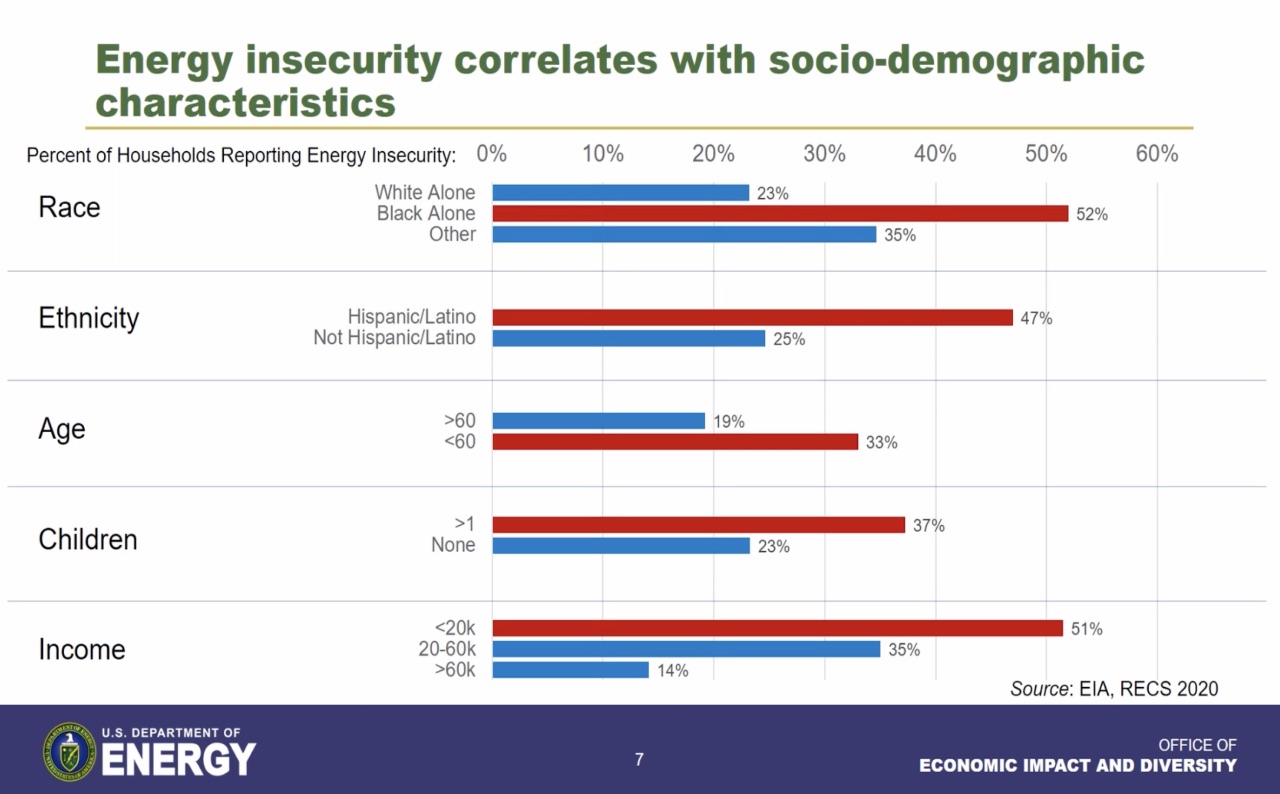 The inordinate burden of energy costs is shown in this slide presented by Tony Reames during a discussion of energy injustice at the University of Tennessee Howard Baker Center. U.S. Department of Energy
Department of Energy official pushes goals for energy equity in midst of power turmoil
KNOXVILLE — Energy injustice seems abstract until you run extension cords to your neighbor’s house and store their food in your fridge because their power got cut off.
What else are you supposed to do? Maybe start raising hell about the utility inequities faced by poor people that are clearer every day in an energy marketplace scarred by war and inflation and manipulated by global petroleum cartels?
“We’re at a critical moment in our society. Across the globe, we are hearing about energy insecurity, energy, affordability issues, a lack of resources,” said Tony Reames, Department of Energy deputy director of energy justice, a newly created position at DOE.
- howard h baker jr center for public policy
- tony reames
- energy injustice
- energy conservation
- minority energy use
- doe energy justice
- inflation reduction act
- inflation reduction act clean energy
- energy injustice black americans
- poverty
- utility disconnection
- energy insecurity
- make home more energy efficient
- social justice
- lowincome household
- minority household
APIEL, the 13th Appalachian Public Interest and Environmental Law conference is set for Saturday, October 1
Written by Wolf Naegeli ELO is a student-run organization at the University of Tennessee College of Law. It is not directly affiliated with the University of Tennesse or any particular non-profit organization. It is dedicated to providing students and attorneys with learning opportunities and leadership experiences.
Networking environmental leaders across Appalachia and the State of Tennessee
Knoxville — APIEL is a relative newcomer to the small circle of inclusive U.S. public interest environmental law conferences. Because it is organized by law school student volunteers, APIEL is affordable to attend for students as well as citizens from all walks of life.
APIEL is much loved and considered essential by regional nonprofit leaders and activists. It is also highly acclaimed by seasoned environmental lawyers. With just 12 conferences under its belt, APIEL has risen to rank among leading peer conferences with a much longer track record, such as the Public Interest Environmental Law Conference (PIELC) at the University of Oregon School of Law (39 events), the Red Clay Conference at the University of Georgia School of Law (34) and the Public Interest Environmental Conference (PIEC) at the University of Florida’s Levin College of Law (28).
- public interest
- environmental law
- university of tennessee college of law
- environmental issue
- tva
- pipeline controversy
- natural gas
- climate change
- dean rivkin
- john m rosenberg
- public interest lawyering in appalachia
- continuing legal education tennessee
- appalachian public interest and environmental law conference
MOTHER EARTH — Scarcity of food, lack of safety nets and paucity of solidarity lead to famine. 12-minute video raises awareness of how global crises combine with intricate national and international issues to precipitate local predicament.