
10 Reduced Inequalities (6)
Reduce inequality within and among countries
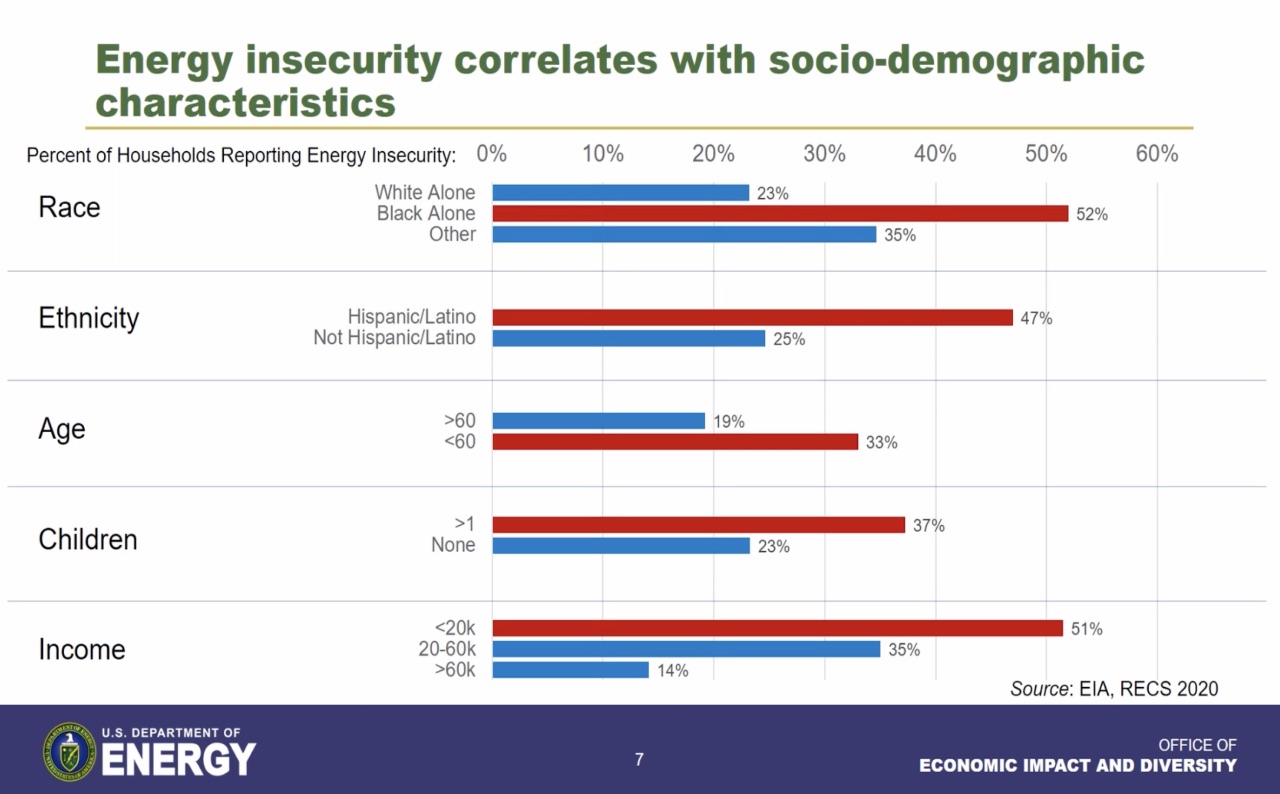 The inordinate burden of energy costs is shown in this slide presented by Tony Reames during a discussion of energy injustice at the University of Tennessee Howard Baker Center. U.S. Department of Energy
Department of Energy official pushes goals for energy equity in midst of power turmoil
KNOXVILLE — Energy injustice seems abstract until you run extension cords to your neighbor’s house and store their food in your fridge because their power got cut off.
What else are you supposed to do? Maybe start raising hell about the utility inequities faced by poor people that are clearer every day in an energy marketplace scarred by war and inflation and manipulated by global petroleum cartels?
“We’re at a critical moment in our society. Across the globe, we are hearing about energy insecurity, energy, affordability issues, a lack of resources,” said Tony Reames, Department of Energy deputy director of energy justice, a newly created position at DOE.
- howard h baker jr center for public policy
- tony reames
- energy injustice
- energy conservation
- minority energy use
- doe energy justice
- inflation reduction act
- inflation reduction act clean energy
- energy injustice black americans
- poverty
- utility disconnection
- energy insecurity
- make home more energy efficient
- social justice
- lowincome household
- minority household
APIEL, the 13th Appalachian Public Interest and Environmental Law conference is set for Saturday, October 1
Written by Wolf Naegeli ELO is a student-run organization at the University of Tennessee College of Law. It is not directly affiliated with the University of Tennesse or any particular non-profit organization. It is dedicated to providing students and attorneys with learning opportunities and leadership experiences.
Networking environmental leaders across Appalachia and the State of Tennessee
Knoxville — APIEL is a relative newcomer to the small circle of inclusive U.S. public interest environmental law conferences. Because it is organized by law school student volunteers, APIEL is affordable to attend for students as well as citizens from all walks of life.
APIEL is much loved and considered essential by regional nonprofit leaders and activists. It is also highly acclaimed by seasoned environmental lawyers. With just 12 conferences under its belt, APIEL has risen to rank among leading peer conferences with a much longer track record, such as the Public Interest Environmental Law Conference (PIELC) at the University of Oregon School of Law (39 events), the Red Clay Conference at the University of Georgia School of Law (34) and the Public Interest Environmental Conference (PIEC) at the University of Florida’s Levin College of Law (28).
- public interest
- environmental law
- university of tennessee college of law
- environmental issue
- tva
- pipeline controversy
- natural gas
- climate change
- dean rivkin
- john m rosenberg
- public interest lawyering in appalachia
- continuing legal education tennessee
- appalachian public interest and environmental law conference
MEMPHIS — Area residents were invited to a film screening of “Keep the Lights On” and a panel discussion at the Memphis Rox climbing gym with community members, local advocates and policy experts. The event, which ran from 10 a.m. to 4 p.m. Saturday, Aug. 20, coincided with Global Climbing Day, and professional rock climbers Nina Williams, Manoah Ainuu (who recently summited Everest), Olympic Silver Medalist Nathaniel Coleman, and Fred Campbell hosted and participated in community and climbing-oriented events prior to the film screening and conversation.
The film follows Memphis Rox staff member and leader Jarmond Johnson, recounting his experiences with intermittent energy access growing up in South Memphis, his growth into a gang activist and mentorship role at Rox, and, ultimately, working with professional rock climber and environmental activist Alex Honnold (best known for the academy award-winning film, Free Solo) to bring solar energy to the gym. Following the screening, Jarmond and a panel of experts discussed takeaways from the film, and how equitable access to solar energy could help all Memphians keep their lights on.
— Southern Alliance for Clean Energy
MOTHER EARTH — Scarcity of food, lack of safety nets and paucity of solidarity lead to famine. 12-minute video raises awareness of how global crises combine with intricate national and international issues to precipitate local predicament.
 Jim Hill Fellow for Conservation Breelyn Bigbee holds a viewing window with a logperch in Long Swamp Creek while conducting fieldwork in search of bridled darters near Jasper, Georgia. Tennessee Aquarium
Tennessee Aquarium fellowships bring minorities into the science space
CHATTANOOGA — Never let it be said that all summer jobs are created equal.
Squatting on his heels to dangle the flexible hose of an environmental DNA pump into a briskly flowing North Georgia stream, the last few weeks have been anything but ordinary for Spencer Trimpe. With the pump’s droning motor steadily collecting a sample of water to filter out genetic traces of the stream’s inhabitants, he doesn’t bother holding back a smile.
A lanky junior biology major from Thomas More University, Trimpe is one of two students selected as part of the Tennessee Aquarium’s George Benz Aquatic Ecology Fellowship. Instead of manning a cash register or waiting tables this summer, he’s assisting freshwater scientists from the Tennessee Aquarium Conservation Institute with a variety of research projects.
Reckoning with racism with a walk in the woods
Written by Thomas Fraser
Video documents success of ‘Smokies Hikes for Healing’ endeavor
Great Smoky Mountains National Park Superintendent Cassius Cash was as shaken as the rest of us this past spring and summer when a national reckoning of racism erupted across the country following the homicide of George Floyd under the knee of a Minneapolis police officer.
Also like many of us, Cash, who is Black, wondered what he could do to help heal 400-year-old wounds.
He determined we needed to take a walk in the woods and talk about things.
“As an African American man and son of a police officer, I found myself overwhelmed with the challenges we faced in 2020 and the endless news cycle that focused on racial unrest,” Cash said in a press release distributed Feb. 26.
“My medicine for dealing with this stress was a walk in the woods, and I felt called to share that experience with others. Following a summer hike in the park, I brought together our team to create an opportunity for people to come together for sharing, understanding, and healing.”
Sixty people directly participated in Cash’s Smokies Hikes for Healing program, Smokies Hikes for Healing, which ran from August to December in the national park. Hundreds of people visited an accompanying website to learn more or acquire information on how to lead their own such hikes.
Cash, who credited the park team who helped him organize the innovative project, correctly determined there was no more appropriate place to honestly discuss racism and the importance of diversity than a hike in one of the most biologically diverse places on the planet.
David Lamfrom, Stephanie Kyriazis, and Marisol Jiménez, facilitated the hikes and created a “brave space for open conversations about diversity and racism,” according to the park release, which also announced the availability of the Smokies Hikes for Healing video produced by Great Smoky Mountains Association.
Friends of the Smokies and New Belgium Brewing Company also contributed financial support to the effort.