
Displaying items by tag: oak ridge
Report Card for U.S. Department of Energy, Oak Ridge Operations: Failing grades in stakeholder engagement and environmental decision making
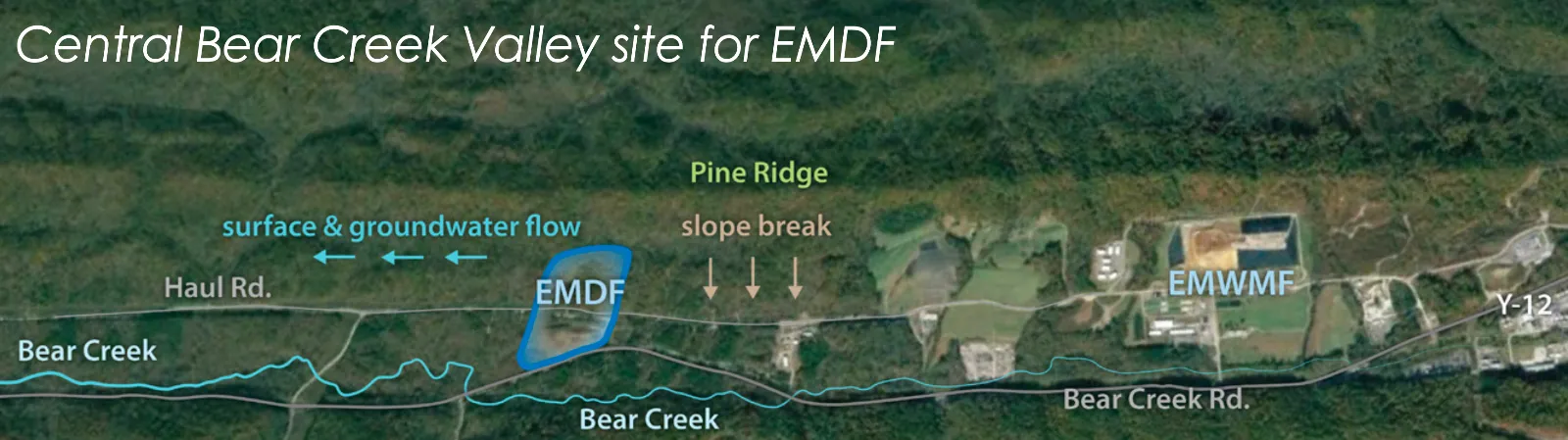
Editor’s note: As reported in Hellbender Press, the Department of Energy’s Oak Ridge Office of Environmental Management (OREM) was reprimanded by the Southern Environmental Law Center for neglecting its duty to follow guidelines and proper procedures mandated by the National Environmental Policy Act (NEPA). Of immediate concern was OREM’s pretext and information — or specifically lack of pertinent information — released ahead of the public meeting on May 17, 2022 about its project for a new “Environmental Management Disposal Facility” (EMDF).
With regard to NEPA compliance, Oak Ridge Operations has been the black sheep in DOE’s stable because it never prepared the required site-wide environmental impact statement (EIS) for the Oak Ridge Reservation (ORR). At said public meeting, Virginia Dale, Corporate Fellow Emeritus of Oak Ridge National Laboratory, commented on another tangent of shortcomings — not spelled out by Federal law — but matters of common sense, competent decision making and good community spirit.
- environmental management disposal facility
- emdf
- oak ridge office of environmental management
- orem
- national environmental policy act
- nepa
- bear creek valley
- oak ridge reservation
- us department of energy
- doe
- virginia dale
- oak ridge
- national science foundation
- nsf
- stakeholder
- stakeholder engagement
- environmental decision making
- waste acceptance criteria
- wac
- bear creek
- ground water characterization
- end use working group
- tennessee water quality control act
- comprehensive environmental response, compensation and liability act
- cercla
Opponents of Oak Ridge waste dump, citing comms breakdown, urge extension of public comment period
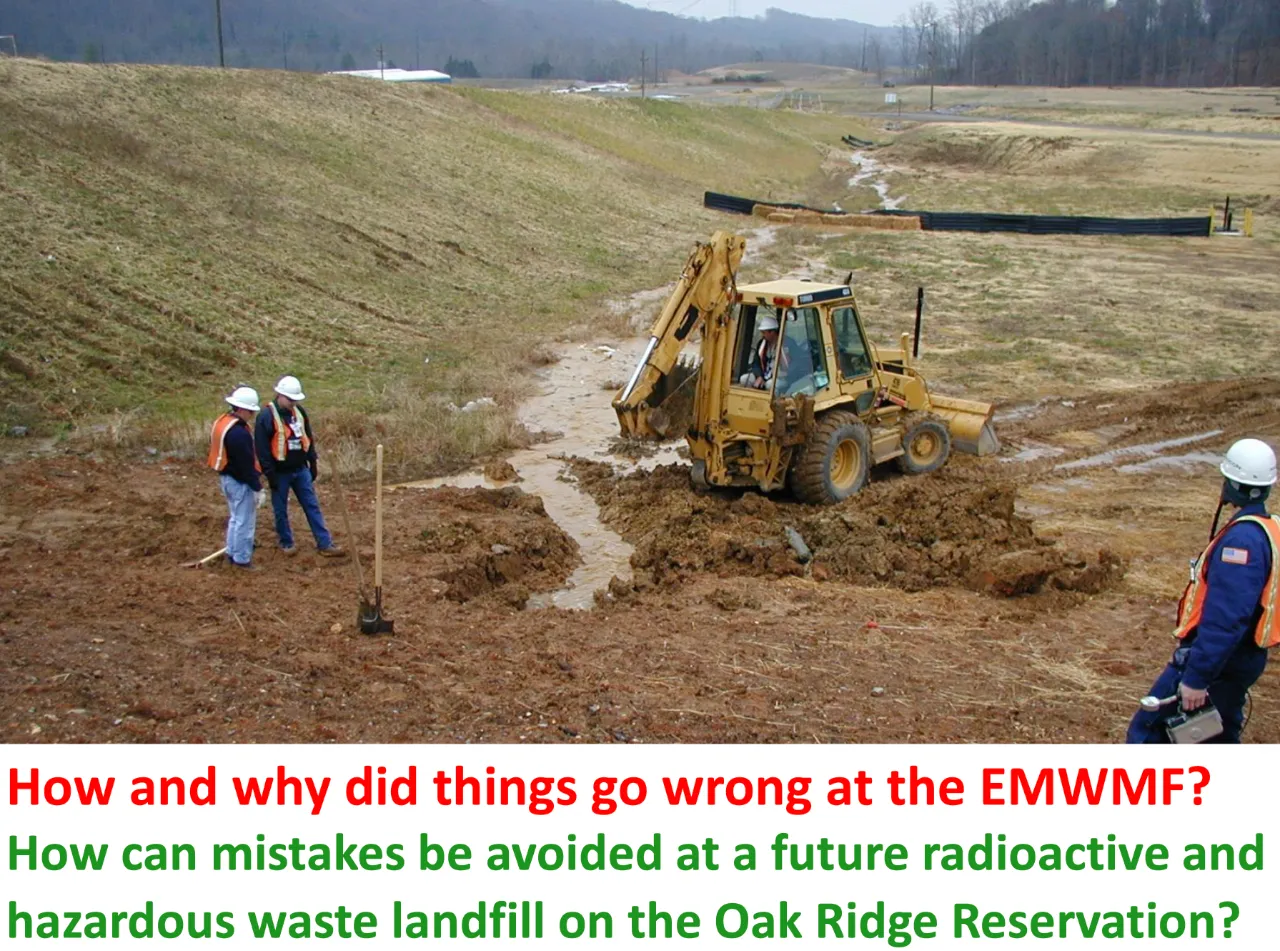 Image from a 2018 memorandum authored by experts including former Department of Energy employees in Oak Ridge. EMWMF is the present landfill that has a history of failures and is reaching capacity. Ecologists say, after a decade DOE still is not adequately addressing waste acceptance criteria and feasible alternatives.
Public can comment in person Tuesday night in Oak Ridge on proposed DOE waste dump
OAK RIDGE — The Southern Environmental Law Center blistered the Department of Energy in a letter ahead of a May 17 hearing on construction of a toxic-waste landfill that opponents said poses contamination threats to portions of the Clinch River watershed and downstream TVA reservoirs.
The hearing is set for 6-8 p.m. Tuesday, May 17 at the Pollard Technology Conference Center, 210 Badger Ave. This email address is being protected from spambots. You need JavaScript enabled to view it. will be accepted through June 7.
The Department of Energy wants to bury contaminated debris from demolition of Manhattan Project-era complexes and associated legacy toxins from the Oak Ridge Reservation. The drawn-out debate about how best to safely store the materials now focuses on the transparency of the decision process and the health of the Bear Creek watershed and downstream pollution threats to the Clinch River.
- doe
- doe waste dump
- does oak ridge have nuclear waste
- oak ridge landfill
- oak ridge
- bear creek valley
- oak ridge reservation
- radioactive waste
- hazardous waste
- advocates for the oak ridge reservation
- southern environmental law center
- selc
- aforr
- clinch river
- tva reservoir
- soggy bottom
- environmental quality advisory board
- eqab
- public participation
- public meeting
- environmental management disposal facility
- emdf
Developer slams brakes on proposed Oak Ridge motorsports park
Knox News: Developer pulls Oak Ridge motorsports park proposal after pushback
In a victory for local environmentalists, the developer who proposed and pushed for a motorsports park on the western end of Oak Ridge has abandoned the project in hopes of finding a more “attractive” community.
The park would’ve been located in the Horizon Center industrial park and required the development of natural areas preserved via a city agreement with the Department of Energy.
Individuals and groups such as the Oak Ridge-based Tennessee Citizens for Wilderness Planning said the proposal was inherently inappropriate for the site, citing the loss of diverse, mature hardwood forest, and noise pollution.
Being fire: Volunteers help preserve a classic East Tennessee cedar barren
 A volunteer removes invasive plants from an Oak Ridge cedar barren as part of a Tennessee Citizens for Wilderness Planning effort to keep the barren in its natural prarie state. Anna Lawrence/Hellbender Press
Volunteers play the part of fire to maintain the native grasses and wildflowers at an Oak Ridge cedar barren
OAK RIDGE — It’s called a barren, but it’s not barren at all. It’s actually a natural Tennessee prairie, full of intricate, interlocking natural parts, from rocks and soil to plants and insects and animals.
There’s lots of life in these small remaining unique collections of grasses and conifers that are typically known, semi-colloquially, as cedar barrens.
Many of these “barrens” have been buried beneath illegal dumping or asphalt, but remnants they are still tucked away here and there, including a small barren in Oak Ridge owned by the city and recognized by the state as a small natural area.
The seven-acre cluster of cedars, large hardwoods and small open patches of native grasses such as long stem, blue stem and Indian grass, used to be much larger. A large portion of the original barren now lies beneath medical facilities, commercial development and a community college campus in the area of Fairbanks Road and Briarcliff Avenue.
These unique ecosystems need fire to thrive, and modern firefighting practices, road building and development have stopped this semi-regular natural cleanse of woody plants, shrubs and natural and exotic invasives, which encroach upon and can ultimately overcome the natural plants in these vanishingly rare grasslands.
In many instances, humans have replaced fire to ensure these special places don’t disappear.
That’s why three dozen people showed up on a chilly but sunny Saturday in early March to strip shrubs, saplings and even larger trees from the small but classic barren adjacent to Jefferson Middle School. The goal: Help its small grassland expand and avoid terminal encroachment from incompatible vegetation.
Cedars take well to the shallow, rocky soil that is characteristic of these communities, but the most important features of these vanishing places are native prairie grasses and accompanying rare plants and wildflowers and their associated insect and animal species.
“We are doing what nature used to do with the occasional wildfire,” said Tim Bigelow, a board member of Tennessee Citizens for Wilderness Planning, which organizes the barren weed wrangles several times a year.
Natural and intentional low-intensity ground fires historically nurtured such landscapes, eliminating woody plants and ensuring there was enough open space and sunlight for the associated grasses and flowers to thrive in a prairie environment.
And yes, there are prairies in Tennessee. Historically, most of these barrens were on or near the Cumberland Plateau or along the Kentucky