
Displaying items by tag: oak ridge reservation
Report Card for U.S. Department of Energy, Oak Ridge Operations: Failing grades in stakeholder engagement and environmental decision making
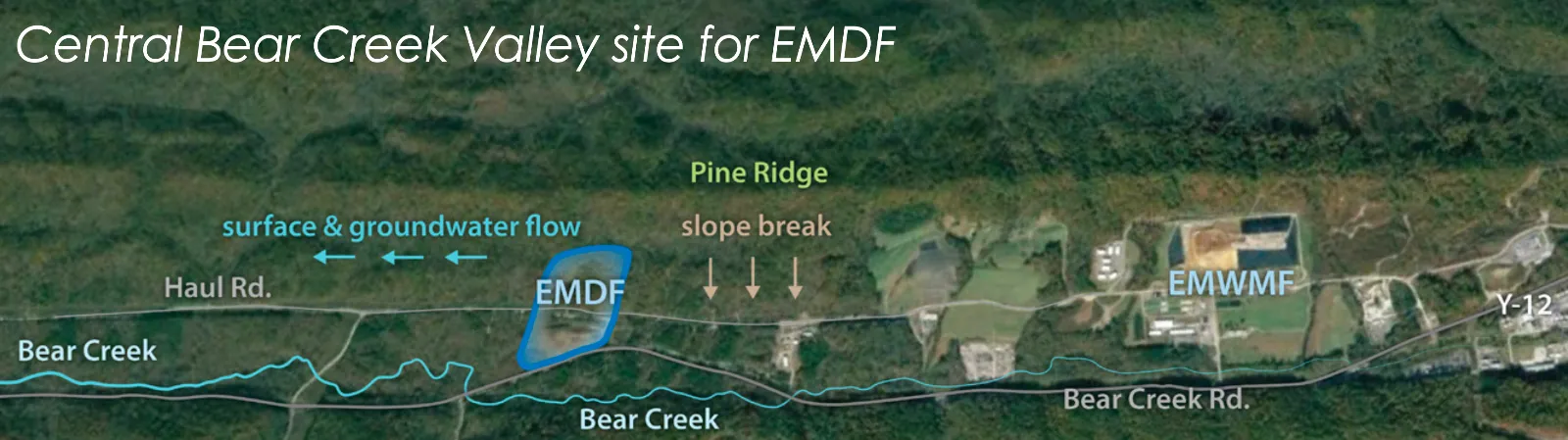
Editor’s note: As reported in Hellbender Press, the Department of Energy’s Oak Ridge Office of Environmental Management (OREM) was reprimanded by the Southern Environmental Law Center for neglecting its duty to follow guidelines and proper procedures mandated by the National Environmental Policy Act (NEPA). Of immediate concern was OREM’s pretext and information — or specifically lack of pertinent information — released ahead of the public meeting on May 17, 2022 about its project for a new “Environmental Management Disposal Facility” (EMDF).
With regard to NEPA compliance, Oak Ridge Operations has been the black sheep in DOE’s stable because it never prepared the required site-wide environmental impact statement (EIS) for the Oak Ridge Reservation (ORR). At said public meeting, Virginia Dale, Corporate Fellow Emeritus of Oak Ridge National Laboratory, commented on another tangent of shortcomings — not spelled out by Federal law — but matters of common sense, competent decision making and good community spirit.
- environmental management disposal facility
- emdf
- oak ridge office of environmental management
- orem
- national environmental policy act
- nepa
- bear creek valley
- oak ridge reservation
- us department of energy
- doe
- virginia dale
- oak ridge
- national science foundation
- nsf
- stakeholder
- stakeholder engagement
- environmental decision making
- waste acceptance criteria
- wac
- bear creek
- ground water characterization
- end use working group
- tennessee water quality control act
- comprehensive environmental response, compensation and liability act
- cercla
Opponents of Oak Ridge waste dump, citing comms breakdown, urge extension of public comment period
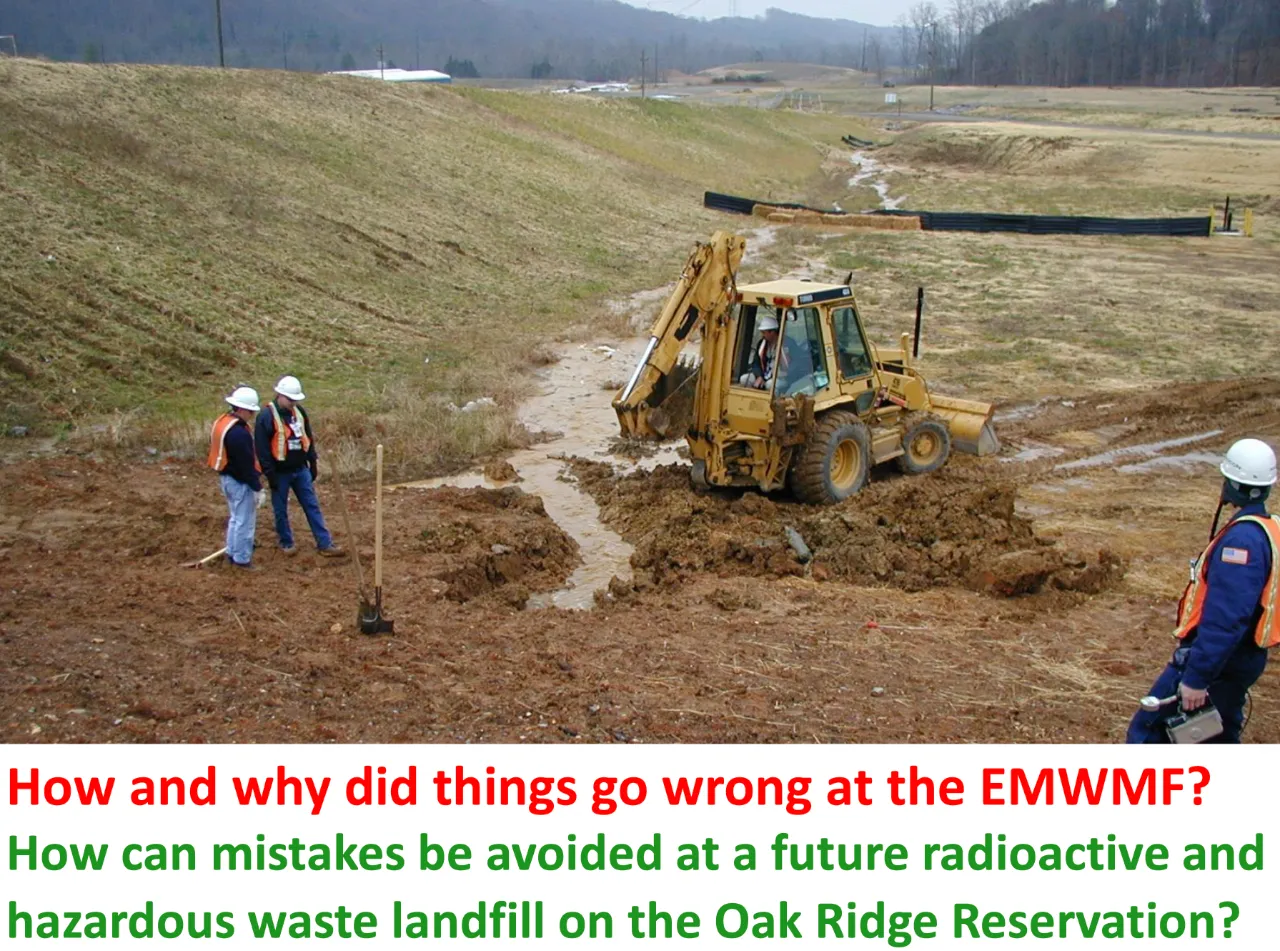 Image from a 2018 memorandum authored by experts including former Department of Energy employees in Oak Ridge. EMWMF is the present landfill that has a history of failures and is reaching capacity. Ecologists say, after a decade DOE still is not adequately addressing waste acceptance criteria and feasible alternatives.
Public can comment in person Tuesday night in Oak Ridge on proposed DOE waste dump
OAK RIDGE — The Southern Environmental Law Center blistered the Department of Energy in a letter ahead of a May 17 hearing on construction of a toxic-waste landfill that opponents said poses contamination threats to portions of the Clinch River watershed and downstream TVA reservoirs.
The hearing is set for 6-8 p.m. Tuesday, May 17 at the Pollard Technology Conference Center, 210 Badger Ave. This email address is being protected from spambots. You need JavaScript enabled to view it. will be accepted through June 7.
The Department of Energy wants to bury contaminated debris from demolition of Manhattan Project-era complexes and associated legacy toxins from the Oak Ridge Reservation. The drawn-out debate about how best to safely store the materials now focuses on the transparency of the decision process and the health of the Bear Creek watershed and downstream pollution threats to the Clinch River.
- doe
- doe waste dump
- does oak ridge have nuclear waste
- oak ridge landfill
- oak ridge
- bear creek valley
- oak ridge reservation
- radioactive waste
- hazardous waste
- advocates for the oak ridge reservation
- southern environmental law center
- selc
- aforr
- clinch river
- tva reservoir
- soggy bottom
- environmental quality advisory board
- eqab
- public participation
- public meeting
- environmental management disposal facility
- emdf
Zigging and zagging to find the Zigzag
 UT doctoral student Bryce Wade examines a Southern zigzag salamander he found at Ijams Nature Center in South Knoxville. Keenan Thomas/Hellbender Press
On the happy herping trail: Bryce Wade searches for salamanders
KNOXVILLE — Bryce Wade scours the nature trail, turning over rocks and logs. On this overcast day at Ijams Nature Center, he searches beneath the leaves on the ground for one creature: salamanders.
Underneath the rocks, logs and leaves, salamanders populate the cool, moist earth, avoiding the sun whenever they can. Wade is looking for a particular type: a winter species informally called the Southern zigzag salamander (Plethodon ventralis).
- ijams nature center
- salamander biodiversity
- southern zigzag salamander
- applachian salamander
- salamander hunting
- bryce wade
- fitzpatrick lab
- utk salamander research
- plethodon ventralis
- herping
- southeastern us
- biodiversity
- University of Tennessee
- oak ridge national laboratory
- oak ridge reservation
- oak ridge national environmental research park
Oak Ridge National Laboratory land is an international treasure of biodiversity
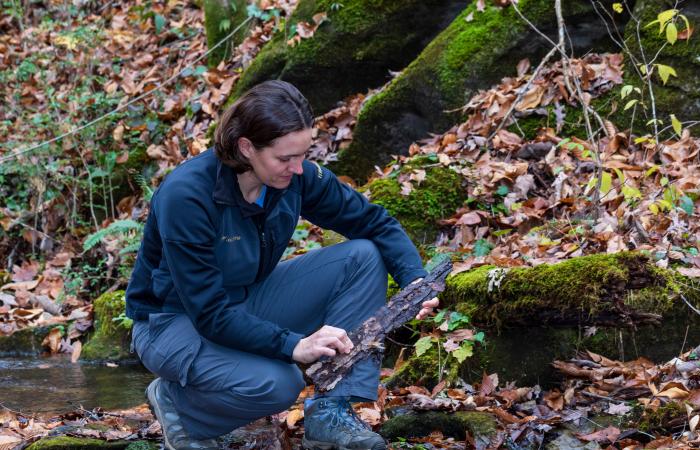 Aquatic ecologist Natalie Griffiths studies nutrients and contaminants in the Weber Branch watershed, which is in the Oak Ridge Environmental Research Park. Courtesy Carlos Jones/ORNL
ORNL research lands are an international ecological benchmark and diverse wonderland of trees, plants, mammals, reptiles and amphibians
Abby Bower is a science writer for Oak Ridge National Laboratory.
The Department of Energy’s Oak Ridge National Laboratory (ORNL) is a hub for world-class science. The nearly 33,000-acre space surrounding the lab is less known, but also unique. The Oak Ridge Reservation (ORR) is a key hotspot for biodiversity in the Southeast and is home to more than 1,500 species of plants and animals.
At the intersection of Anderson and Roane counties is an important subset of the reservation — the Oak Ridge National Environmental Research Park, or NERP — a 20,000-acre ORNL research facility that has been internationally recognized by UNESCO as an official biosphere reserve unit.
“The National Environmental Research Park is a living laboratory and a major resource for conducting ecological studies,” said Evin Carter, an ORNL wildlife ecologist and director of the Southern Appalachian Man and the Biosphere Program, or SAMAB. The NERP has been a core part of SAMAB, which has focused on sustainable economic development and conserving biodiversity in Southern Appalachia since 1989.
With ORNL researchers and scientists from government agencies and academia using the NERP for diverse experiments each year, the park lives up to its status as a living laboratory.
It also lives up to its reputation as a biodiversity hotspot. As one of seven DOE-established environmental research parks reflecting North America’s major ecoregions, it represents the Eastern Deciduous Forest. The NERP comprises parts of this ecoregion that have been identified repeatedly as priorities for global biodiversity conservation, Carter said.
This designation means more than ever as climate change alters ecosystems and biodiversity declines worldwide. According to a landmark international report, on Biodiversity and Ecosystem Services, around one million plant and animal species are currently threatened with extinction.
- oak ridge national laboratory
- ornl
- ecological benchmark
- oak ridge national environmental research park
- nerp
- biosphere reserve
- southern appalachian man and the biosphere
- samab
- biodiversity
- unesco
- oak ridge reservation
- orr
- ecoregion
- culturally significant plant species initiative
- cspsi
- evin carter
- kitty mccracken
- eastern band of cherokee indians
- neon
- national ecological observatory network
- northern longeared bat
- indiana bat
- grey bat
- endangered species
- threatened species
- purple gallinule
DOE moves ahead with plans for radioactive waste dump on Oak Ridge Reservation despite concerns about its ultimate holding power
Oak Ridger: Landfill moves ahead, for now, for DOE demolition debris in Oak Ridge
Hellbender Press contributor Ben Pounds has a great piece in the Oak Ridger about a long dispute over a plan to bury low-level nuclear onsite in a greenfield on Department of Energy property in Oak Ridge. Over the years, many such contaminated materials were typically transported to off-site storage points, namely the western U.S.
Detractors of the plan worry local landfill membranes and safeguards could ultimately fail or be compromised, leading to a surge of low-level radioactive materials and associated contaminants, into the surrounding area and its water tables. Most of the debris slated for storage comes from the demolished legacy buildings of the Oak Ridge Reservation, originally built as part of the Manhattan Project atomic weapons program during World War II.
“DOE released a Draft Record of Decision Monday, July 12, which goes over some of the aspects of this proposed landfill and environmental issues related to it, as part of the process to get approval from Tennessee Department of Environment and Conservation,” Pounds reported in the Oak Ridger.
“Kim Schofinski, TDEC deputy communications director, stated her agency is currently reviewing the document and its revisions, which could take around 120 days.”
- oak ridge landfill
- oak ridge legacy
- doe waste
- doe waste dump
- nuclear waste in oak ridge
- does oak ridge have nuclear waste
- nuclear waste storage
- nuclear waste storage failure
- oak ridge reservation
- draft record of decision
- manhattan project
- ben pounds
- low level nuclear waste
- environmental management disposal facility
- emdf