Displaying items by tag: public participation
Public comment: Environmental group leaders say TVA makes input difficult
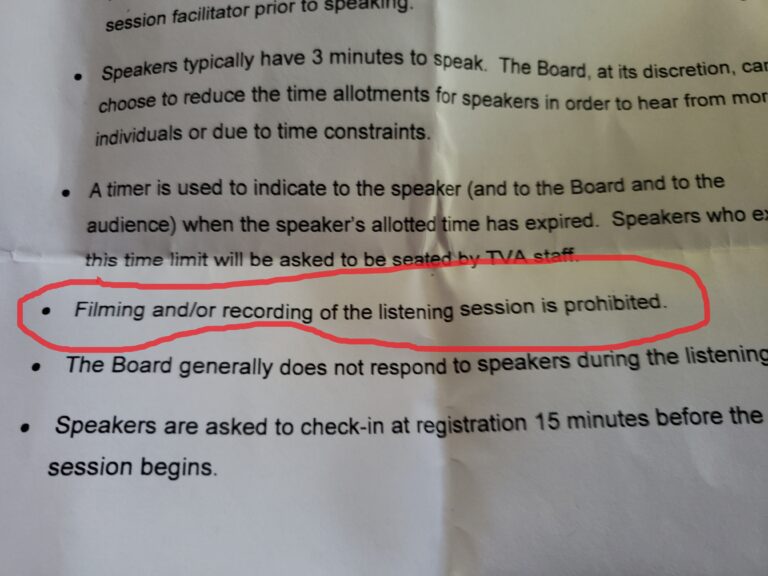 Scott Banbury with the Tennessee Chapter of the Sierra Club said a handout provided at TVA’s Aug. 30 listening session stated recordings of the meeting were not allowed; a TVA spokesperson said recordings are, in fact, allowed. Flyer provided by Scott Banbury
Is TVA trying to gag its critics?
This story was originally published by Tennessee Lookout.
KNOXVILLE — While the Tennessee Valley Authority, a utility company that provides power to millions in Tennessee and other states, allows for public input into decisions, the process isn’t simple or transparent, say some regular attendees.
Take, for instance, a recent public listening session: representatives of the Tennessee Chapter of the Sierra Club say they were told they could not record the session despite a spokesman for TVA saying the opposite.
According to TVA spokesperson Scott Brooks, attendees are always allowed to record public meetings, provided they don’t cause a disturbance, but minutes before the session, members of the Tennessee chapter of the Sierra Club were prohibited from doing so.
Opponents of Oak Ridge waste dump, citing comms breakdown, urge extension of public comment period
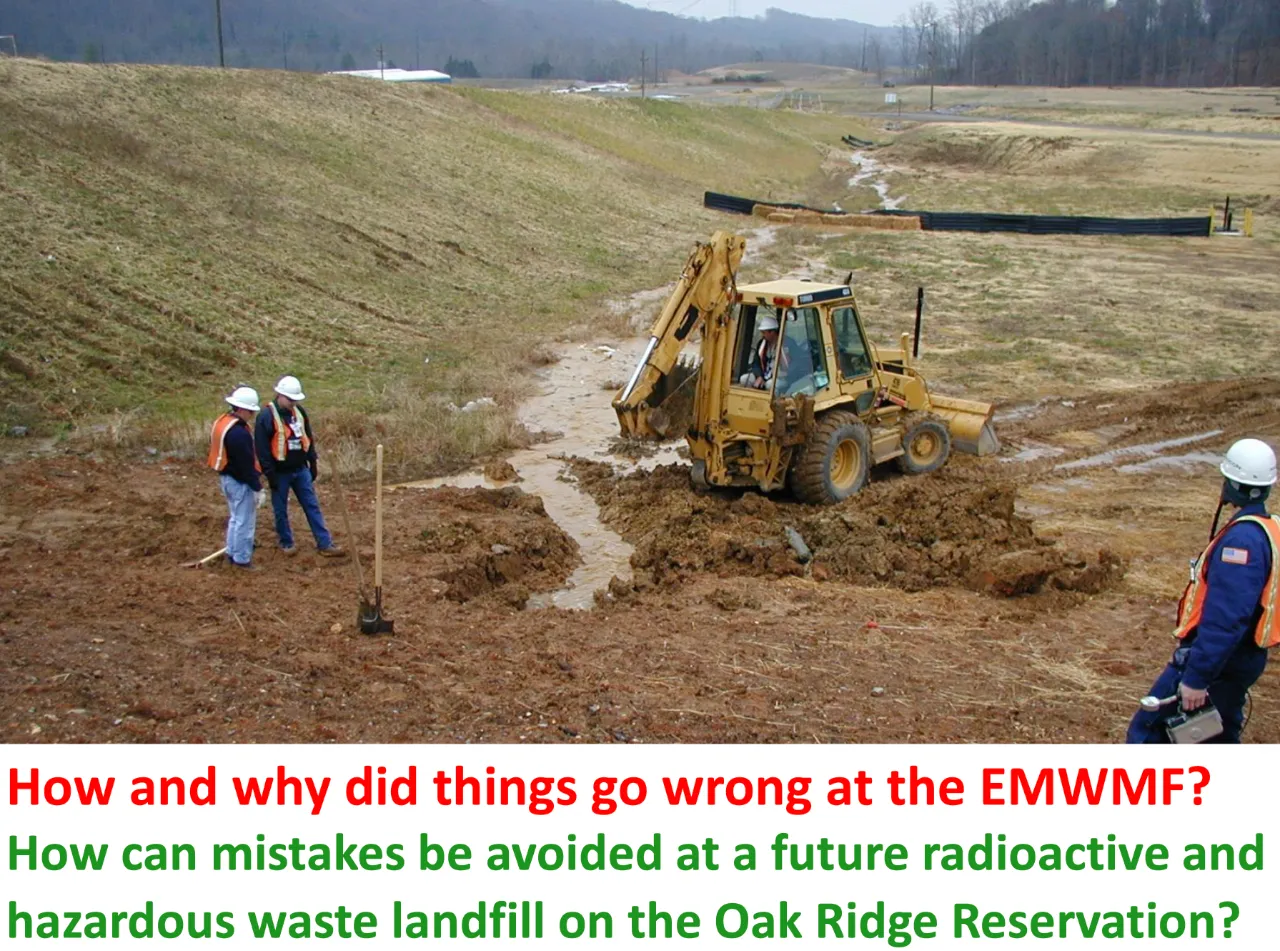 Image from a 2018 memorandum authored by experts including former Department of Energy employees in Oak Ridge. EMWMF is the present landfill that has a history of failures and is reaching capacity. Ecologists say, after a decade DOE still is not adequately addressing waste acceptance criteria and feasible alternatives.
Public can comment in person Tuesday night in Oak Ridge on proposed DOE waste dump
OAK RIDGE — The Southern Environmental Law Center blistered the Department of Energy in a letter ahead of a May 17 hearing on construction of a toxic-waste landfill that opponents said poses contamination threats to portions of the Clinch River watershed and downstream TVA reservoirs.
The hearing is set for 6-8 p.m. Tuesday, May 17 at the Pollard Technology Conference Center, 210 Badger Ave. This email address is being protected from spambots. You need JavaScript enabled to view it. will be accepted through June 7.
The Department of Energy wants to bury contaminated debris from demolition of Manhattan Project-era complexes and associated legacy toxins from the Oak Ridge Reservation. The drawn-out debate about how best to safely store the materials now focuses on the transparency of the decision process and the health of the Bear Creek watershed and downstream pollution threats to the Clinch River.
- doe
- doe waste dump
- does oak ridge have nuclear waste
- oak ridge landfill
- oak ridge
- bear creek valley
- oak ridge reservation
- radioactive waste
- hazardous waste
- advocates for the oak ridge reservation
- southern environmental law center
- selc
- aforr
- clinch river
- tva reservoir
- soggy bottom
- environmental quality advisory board
- eqab
- public participation
- public meeting
- environmental management disposal facility
- emdf
Updated: Your — once in 20 years — opportunity to influence the livability of Knox County
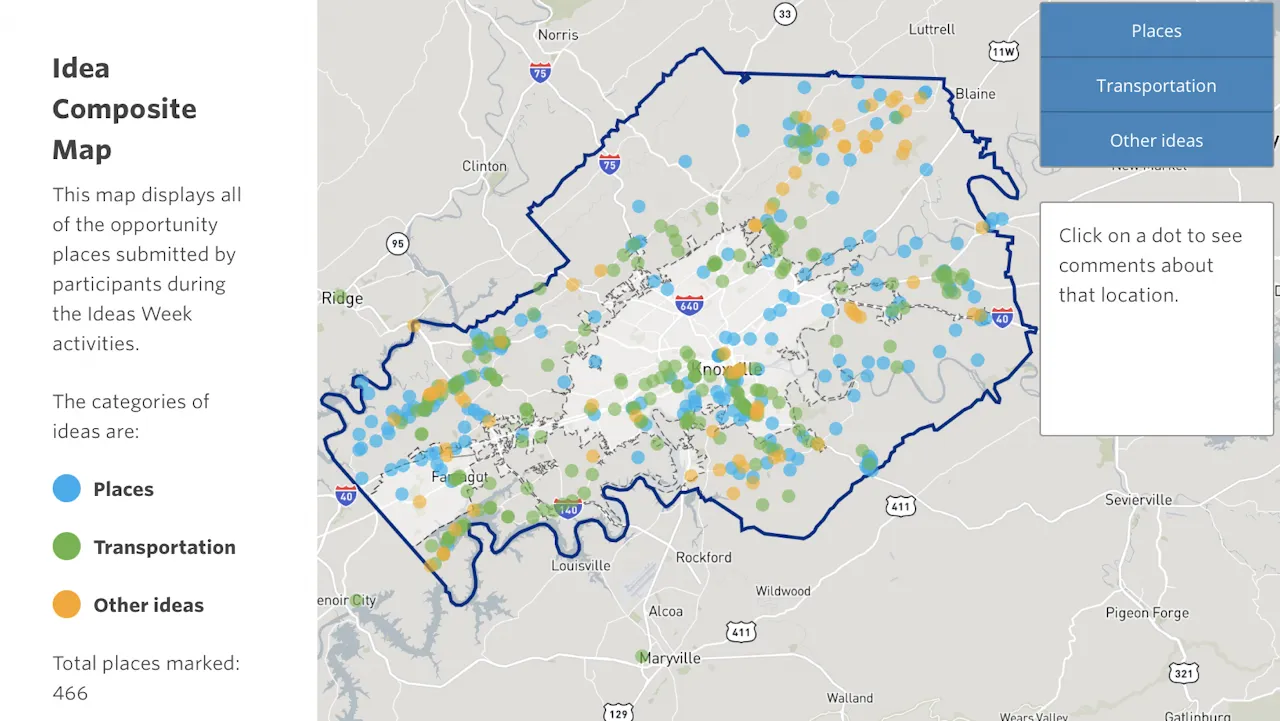 You can still share your own ideas to improve and protect our community Advance Knox
Updated again on May 4: Hundreds of ideas, complaints and comments, many of them with map locations, have been posted on the Advance Knox website.
As announced in Hellbender Press earlier, Advance Knox held a series of public input events across Knox County during its Ideas Week at the end of March.
If you missed those in-person gatherings and could not attend the virtual session, we hope you recorded your preferences and opinions online at the Advance Knox website.
You can now see what others had to say about your neighborhood and your favorite places.
And, even if you already participated, you may have had new ideas or important thoughts not recorded yet. Please let us know,
— what you treasure in Knox County
— what you miss
— what you think is most important to consider as the county keeps growing.
The interactive facility to submit ideas will remain open online through May 10, as suggested at the last Advisory Committee meeting.
Advance Knox — Ideas Week: Knox County invites public participation to guide land use and transportation decisions for years to come
 Knox County offers opportunities for public participation in the overhaul of planning guidelines Knoxville-Knox County Planning
Framework for growth in Knox County
Advance Knox is a comprehensive planning process initiated by Knox County Mayor Glenn Jacobs “to guide growth, land use, transportation, economic prosperity, and quality of life.”
The process is intended to result in a new Knox County general plan and subsequently shape revisions of the sector plans. Together, that set of major plans establishes criteria for further plans by Knoxville-Knox County Planning, such as local area and annual plans, as well as timing and implementation specifics for the Knox County portions of the Regional Transportation Planning Organization’s Long Range Regional Mobility Plan.
At each 90-minute Ideas Week event, you’ll learn about the process through idea generation and map-based activities. It’s a chance to share what’s important to you.
— Sunday, March 27 – 1:30 p.m. at Gibbs Middle School
— Monday, March 28 – 5:30 p.m. at Hardin Valley Middle School or Carter High School
— Tuesday, March 29 – 5:30 p.m. at West High School or Northshore Elementary School
— Wednesday, March 30 – 5:30 p.m. at Powell High School or South Doyle Middle School
Knoxville-Knox County General Plan 2033, adopted in 2003, established the framework for the current sector plans and was amended with the Knoxville-Knox County Park, Recreation and Greenways Plan in 2010.
Public biological survey searches for the Smokies most-wanted species
 A child snaps a photo of a flower beetle on a wild hydrangea in Great Smoky Mountains National Park. Valerie Polk
Grab your phone and get to some citizen science
Rhonda Wise writes for the public affairs office of Great Smoky Mountains National Park
Discover Life in America (DLiA), the nonprofit science research partner, is inviting the public to participate in the Smokies Most Wanted program. This initiative allows visitors to help preserve park species by recording sightings of animals, plants, and other organisms from their smartphones using the iNaturalist app.
You’ve got the whole world in your hands

Personal climate-change remedies have a wide cumulative impact and are part of the solution, so don’t give up
Tom Ptak is assistant professor of Geography and Environmental Studies at Texas State University. This story was originally published by The Conversation.
The average American’s everyday interactions with energy sources are limited. They range from turning appliances on or off, to commuting, to paying utility bills.
The connections between those acts and rising global temperatures may seem distant.
However, individuals hold many keys to unlocking solutions to climate change — the biggest challenge our species currently faces — which is perhaps why the fossil fuel industry spent decades misleading and misinforming the public about it.
I’m an assistant professor of geography and environmental studies at Texas State University. My research explores how geography affects the complex relationships between societies, energy and contemporary environmental challenges. I’ve found that the human element is critical for developing creative, effective and sustainable solutions to climate challenges.
There’s a large and growing body of evidence showing that individuals can have a major impact on climate change in a number of ways. Citizen action can compel utilities to increase renewable energy and governments to enact strong climate action laws. When enough individuals make changes that lower daily household energy consumption, huge emissions reductions can result. Consumer demand can compel businesses to pursue climate and environmental sustainability.
These actions combined could bridge the “emissions gap”: the significant difference between the greenhouse gas emissions expected globally and how much they need to drop in the next few decades to avoid catastrophic climate change.
- climate change
- individual action
- personal responsibility
- energy consumption
- energy conservation
- geoengineering
- consumer choice
- consumer demand
- citizen action
- citizen participation
- public participation
- climate leadership
- emission reduction
- collective action
- carbon emission
- renewable energy
- energy efficiency
- fuel consumption
- weatherization
- energy use
What are your ideas and opinions about interpretation at the Manhattan Project National Historical Park?
Apr 22 5:30 p.m. EDT
Manhattan Project National Historical Park Stakeholder Engagement Community Meeting
National Park Service
Manhattan Project National Historical Park (MNHP) is initiating a stakeholder process that will be used to help inform the park’s interpretive planning.
Zoom Meeting - Free and open to the public - RSVP
Interpretive themes convey park significance. Primary interpretive themes are the key ideas through which the park’s nationally significant resource values are conveyed to the public. They connect park resources to the larger ideas, meaning, and values of which they are a part. They are the building blocks—the core content—on which the interpretive program is based.
Find more details about the process, background information on the MNHP and register for the first meeting here.
The interpretive plan will provide guidance in developing future services, activities, events and exhibits in Oak Ridge, at the other MNHP locations, and through media outreach.
The recording of the April 13 national introductory webinar for this stakeholder process has just been released:
Opponents of Pellissippi Parkway extension cite high cost, environmental damage and changing commuting habits
 State and local officials want to expand another ‘road to nowhere’ by way of the controversial $200 million Pellissippi Parkway extension in Blount County. Lesli Bales-Sherrod/Hellbender Press
The newest road to nowhere
The former “missing link” of the Foothills Parkway. The “road to nowhere” in Bryson City, North Carolina. Blount County, Tennessee, has its own unfinished road project, without the catchy nickname: the Pellissippi Parkway Extension.This proposed 4.4-mile stretch of four-lane highway would lengthen State Route 162, known as Pellissippi Parkway, from where it ends at Old Knoxville Highway (State Route 33) to East Lamar Alexander Highway (State Route 73/U.S. 321) in Maryville.
State and local government officials, however, maintain the Pellissippi Parkway Extension will address needs such as “limited mobility options in Blount County and Maryville, poor local road network with substandard cross sections (with narrow lanes, sharp curves, and insufficient shoulders), lack of a northwest/east connection east of Alcoa and Maryville, safety issues on roadways in the area, and traffic congestion and poor levels of traffic operation on major arterial roads and intersections,” according to the Record of Decision signed by the Federal Highway Administration on Aug. 31, 2017.