
News (340)
Empty halls, full hearts: Farragut students and teachers adapted with aplomb to pandemic challenge
Written by Ivy Zhang An empty corridor at Farragut High School. Ivy Zhang/Hellbender Press
Despite COVID restrictions, Farragut High students still sought their shine
Hellbender Press intern Ivy Zhang is a junior at Farragut High School. She plans a career in journalism and digital media.
KNOXVILLE — For the 2020-2021 school year, Knox County Schools provided two choices for families: virtual learning or in-person schooling. Many students chose to do virtual school and participated in less extracurricular activities.
Students felt isolated. School clubs halted for the entire school year. The disruption caused by the novel coronavirus (COVID-19) affected the whole world, as well as local communities.
Farragut High School, No. 2 in Knox County rankings, is a great example of how the COVID-19 pandemic affected students.
- farragut high school
- farragut high school science
- ivy zhang
- hellbender press intern
- covid impact on school
- covid19 in knoxville
- covid19 precaution
- student response to covid
- covid remote learning problem
- covid 19 learning success
- farragut ap class
- farragut calculus
- farragut chess club
- virtual class
- virtual learning
- teaching challenge
Updated: Hatcher Mountain fire nearly extinguished; 300 structures affected
Written by Thomas Fraser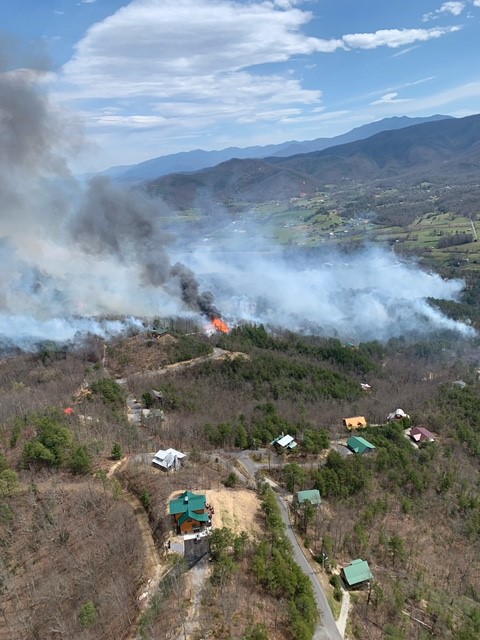 Sevier County Emergency Management Agency
Forest fire above Wears Valley in Sevier County nears full containment; Seymour fire under control
UPDATE APRIL 4: The Sevier County Emergency Management Agency said the Hatcher Mountain/Indigo Lane fire is largely extinguished. Fire crews continue to further subdue the Millstone Gap fire near the Sevier/Blount county line.
The National Weather Service warns of continued high fire danger citing breezy winds and low humidity. Widespread rainfall is forecasted to fall beginning tomorrow.
Officials said the Hatcher Mountain fire ultimately burned 2,500 acres, and damaged or destroyed 300 structures.
UPDATE APRIL 1: Fire crews focusing on the stubborn Hatcher Mountain fire had to pivot in part early Friday to also fight a new wildfire in Seymour near the Blount and Sevier county lines.
Sevier County officials said the Wears Valley-area fire was 45-percent contained this afternoon following a significant brew-up late Thursday. At least 100 structures/dwellings had been “affected” by the fire, which has consumed at least 3,739 acres. Numerous rental cabins and homes have been lost.
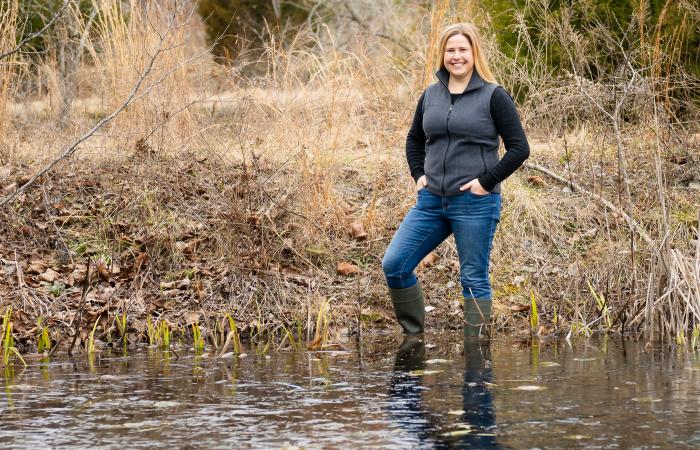 Marie Kurz is seen at a pond on the campus of Oak Ridge National Laboratory. Carlos Jones/ORNL
From California canyons to German creeks: Science is personal and practical for ORNL scientist Marie Kurz
Kristen Coyne is a writer for Oak Ridge National Laboratory.
OAK RIDGE — Spanning no less than three disciplines, Marie Kurz’s title — hydrogeochemist — already gives you a sense of the collaborative, interdisciplinary nature of her research at the Department of Energy’s Oak Ridge National Laboratory. Still, those six syllables only hint at the vast web of relationships encompassed in her work.
Kurz studies how rivers flow through landscapes; what kinds of nutrients, contaminants and other material sail through them; and how they transform along the way. As an experimentalist, her favorite part of the job is getting into the field. Depending on the season, Kurz can be found clad in tights, gloves reaching her shoulders, a neon vest and a ponytail-taming cap as she sloshes in olive hip waders through the particular stream under her scrutiny. The getup, she said, always makes her feel a bit like the Michelin Man.
- ornl
- kristen kurz
- watershed research
- ornl scientist
- oak ridge national laboratory
- east fork poplar creek oak ridge
- water pollution
- oak ridge scientist
- critical interface science
- water flow
- eddy
- swirl
- vortex
- stream ecology
- hydrology
- transient storage zone
- sediment
- biogeochemistry
- microbiology
- watershed modeling
- polyfluoroalkyl substance
- pfas
Bobcats vs. pythons in the swamps of Florida
 USGS
USGSNew York Times: Evolving native predation may help stem invasion of Burmese python
The proliferation of the exotic and invasive Burmese python in the swamps and wilds of Florida is demonstrably bad for native birds and mammals.
Researchers now have evidence the best solution might have been there all along.
A bobcat was captured on a trail camera by the U.S. Geological Survey eating python eggs and challenging one of the gigantic snakes. It was the first instance of natural, native predation on the snake’s eggs. Bobcats are already known to target reptile eggs, including those of sea turtles.
“While it is possible that this interaction was just an isolated incident, it is also possible that native species are beginning to respond to the presence of the python," the New York Times reported.
“‘Most cat species adapt their diet to what is available, so bobcats predating on python eggs is actually not that surprising’” said Mathias Tobler, a wildlife ecologist at the San Diego Zoo Wildlife Alliance.”
New digital maps outline precious pockets of remaining U.S. biodiversity and the threats they face
Written by Dave Russell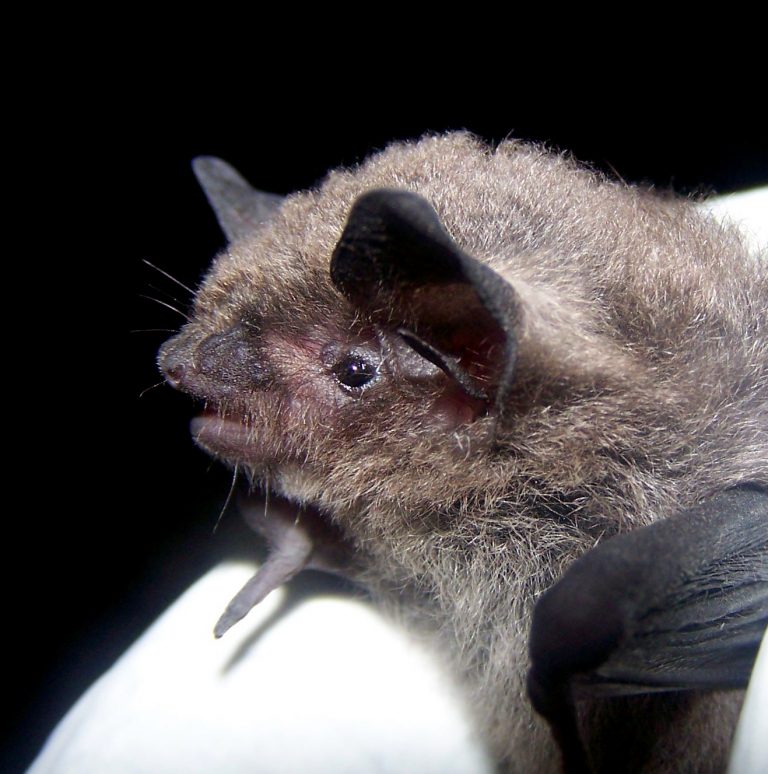 The endangered Indiana bat is among threatened and endangered species in Great Smoky Mountains National Park. U.S. Fish and Wildlife Service
Southern Appalachians show red as a warning on new detailed biodiversity maps
This story was originally published by the Sylva Herald.
SYLVA — Great Smoky Mountains National Park has long been known for its abundance of different species of flora and fauna.
Credit old mountains in a warm, sunny and wet region with varying types of climate, soil and stone for that large number.
“The park is almost certainly the most biodiverse national park in North America,” said Paul Super, national park science coordinator. “And certainly the most studied of any national park.”
A group of environmental organizations recently put together a series of maps illustrating the regions with the biggest threats to their biodiversity, and the area around Jackson County and the national park showed up in the red, showing risk. One such map, based on NatureServe data, is among the most detailed maps of endangered and threatened species ever produced.
 Carson-Newman University Professor Brian Sohn is hosting a climate-oriented webinar on March 30. Thomas Fraser/Hellbender Press
Local installment of worldwide virtual Climate Teach-In is set for 2:30 p.m. March 30
JEFFERSON CITY — Brian Sohn had “the closest thing to a panic attack” when his second daughter was born.
He had long been alarmed by climate change and its potentially disastrous effects, but her arrival brought home the need to address the environmental challenges of a rapidly changing planet.
So now the Carson-Newman University education professor is putting some final touches on a virtual climate-related “teach-in” he’ll host from 2:30 to 3:30 p.m. Wednesday, March 30.
Advance Knox — Ideas Week: Knox County invites public participation to guide land use and transportation decisions for years to come
Written by Wolf Naegeli Knox County offers opportunities for public participation in the overhaul of planning guidelines Knoxville-Knox County Planning
Framework for growth in Knox County
Advance Knox is a comprehensive planning process initiated by Knox County Mayor Glenn Jacobs “to guide growth, land use, transportation, economic prosperity, and quality of life.”
The process is intended to result in a new Knox County general plan and subsequently shape revisions of the sector plans. Together, that set of major plans establishes criteria for further plans by Knoxville-Knox County Planning, such as local area and annual plans, as well as timing and implementation specifics for the Knox County portions of the Regional Transportation Planning Organization’s Long Range Regional Mobility Plan.
At each 90-minute Ideas Week event, you’ll learn about the process through idea generation and map-based activities. It’s a chance to share what’s important to you.
— Sunday, March 27 – 1:30 p.m. at Gibbs Middle School
— Monday, March 28 – 5:30 p.m. at Hardin Valley Middle School or Carter High School
— Tuesday, March 29 – 5:30 p.m. at West High School or Northshore Elementary School
— Wednesday, March 30 – 5:30 p.m. at Powell High School or South Doyle Middle School
Knoxville-Knox County General Plan 2033, adopted in 2003, established the framework for the current sector plans and was amended with the Knoxville-Knox County Park, Recreation and Greenways Plan in 2010.
Fossil-fuel pipeline in your front yard, anyone? Senate passes bill blocking local power over pipeline placement
Written by Dulce Torres Guzman This pumping station in Dickson County was the site of a 1992 gas line rupture. John Partipilo/Tennessee Lookout
Bill eliminating local oversight of fossil-fuel infrastructure passes state Senate at behest of fuel companies, now on to House
This story was originally published by Tennessee Lookout.
UPDATE: The state House approved the bill March 29 with moderating amendments sought by local governments and environmental and social justice advocates.
NASHVILLE — The Tennessee Senate passed a controversial pipeline preemption bill on Thursday in spite of concerns about the effect oil and gas pipelines could have on personal property and drinking water.
Before passage, Sen. Ken Yager, R-Kingston, sponsor of SB2077, amended the bill to allow for wellhead protections and to align with its House counterpart. Critics still contended that with local governments lacking the ability to regulate fossil fuel infrastructure, communities could do little to protect themselves from unwanted pipelines.
- blocking pipeline oversight tennessee
- local control over pipeline placement in tennessee
- tennessee state senate pipeline
- local control fossil fuel
- tennessee lookout
- memphis aquifer
- pipeline controversy
- wellhead protection
- byhalia pipeline
- memphis city council
- shelby county commission
- public safety
- environmental protection
Parson Branch Road improvements under way in Smokies
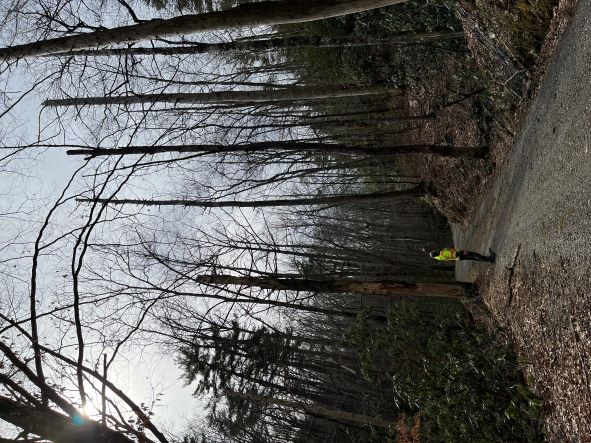 Dead hemlocks are seen along Parson Branch Road near Cades Cove. National Park Service
CADES COVE — Great Smoky Mountains National Park contractors began removing at least 800 dead hemlock trees along Parson Branch Road, an eight-mile primitive backcountry road that connects Cades Cove with U.S. 129 on the western edge of the park.
The road has been closed since 2016 because of the tree hazards and damage to the road surface. The hemlocks succumbed to the hemlock woolly adelgid, an exotic insect that has wreaked havoc on hemlock stands and their accompanying ecosystems.
The road passes several trailheads, and is used by emergency vehicles as needed. The park initially identified some 1,700 trees that posed a hazard to the adjacent roadway, but that number has naturally declined by about half over the past six years.
Friends of Great Smoky Mountains National Park provided $100,000 for the hazard-mitigation project. That was matched with $50,000 from the federal government.
Once the dead trees are removed, work will begin to rehabilitate the roadway and ensure its safety.
The roadway could reopen this summer, according to a news release from the National Park Service.
It’s Sirius: Light pollution blots out the night sky but pockets of true darkness remain
Written by Rick Vaughan The Southeast is seen at night from the International Space Station. NASA
Dark Sky parks, including some in East Tennessee, offer true views of heaven
“Look up at the sky. There is a light, a beauty up there, that no shadow can touch.” J. R. R. Tolkien
WARTBURG — Those who came before us read the night sky like we read maps today.
In ancient times, pointing to the stars, they imagined creatures, mythological heroes and common every-day objects. Because of their fixed positions, the constellations became a foolproof way to navigate across vast, featureless deserts and expansive seas. The stars marked the changing seasons and the passage of time. The star patterns were memorized and taught to each new generation.
- light pollution
- obed river
- pickett state park
- dark sky park
- dark sky
- astronomy in southeast
- what is light pollution
- sky meadow
- tennessee state park
- stargazing in tennessee
- appalachian dark sky
- where is best place to see stars near knoxville?
- rick vaughan
- see the milky way
- constellation
- southeast at night
- why can't i see stars in the city
- international dark sky park
- bortle scale
More...
 UT doctoral student Bryce Wade examines a Southern zigzag salamander he found at Ijams Nature Center in South Knoxville. Keenan Thomas/Hellbender Press
On the happy herping trail: Bryce Wade searches for salamanders
KNOXVILLE — Bryce Wade scours the nature trail, turning over rocks and logs. On this overcast day at Ijams Nature Center, he searches beneath the leaves on the ground for one creature: salamanders.
Underneath the rocks, logs and leaves, salamanders populate the cool, moist earth, avoiding the sun whenever they can. Wade is looking for a particular type: a winter species informally called the Southern zigzag salamander (Plethodon ventralis).
- ijams nature center
- salamander biodiversity
- southern zigzag salamander
- applachian salamander
- salamander hunting
- bryce wade
- fitzpatrick lab
- utk salamander research
- plethodon ventralis
- herping
- southeastern us
- biodiversity
- University of Tennessee
- oak ridge national laboratory
- oak ridge reservation
- oak ridge national environmental research park
Red tape and busy schedules limit use of outdoor classroom at Farragut High School
Written by Ivy Zhang The town of Farragut owns the outdoor classroom property on Campbell Station Road at Farragut High School. It’s difficult for students and teachers to use the outdoor classroom as much as they’d like. Ivy Zhang/Hellbender Press
An educational outing to a living laboratory by the high school is considered a field trip
Hellbender Press intern Ivy Zhang is a junior at Farragut High School. She plans a career in journalism and digital media.
KNOXVILLE — The best place to learn about the natural environment is not in a classroom. It’s outside.
Teachers and students at Farragut High School said the school’s outdoor classroom improves academic performance and there is a schoolwide desire to utilize it even more as an educational resource.
Students show more interest in learning when they are outside in a calming, natural environment, teachers said. And for those studying the biological sciences, outdoor classrooms serve as a living laboratory for the study of soils, trees, plants, animals, insects and other natural resources.
- hellbender press intern
- farragut high school
- farragut high school outdoor classroom
- knox county education
- farragut high school science
- environmental science
- knox county stormwater
- farragut
- write for hellbender press
- submit article to hellbender press
- hellbender press education
- hellbender press writer
- biology
- living laboratory
- outdoor learning
- teach outside
Hike and learn at Trails and Trilliums Festival in South Cumberland State Park

MONTEAGLE — Naturalists and nature lovers are invited to South Cumberland State Park April 8-10 for the Trails and Trilliums Festival sponsored by Friends of South Cumberland State Park. The Dubose Conference Center will be the base of operations for activities throughout the park.
Registration opens at noon April 8 with activities for those who arrive early, followed at 5 p.m. by Wine and Wildflowers, a kickoff event featuring author David Haskell. In 2012, “The Forest Unseen” was nominated for the Pulitzer Prize in nonfiction. Haskell is expected to speak about his latest book “Sounds Wild and Broken” released by Penguin Random House on March 1.
The rest of this weekend-long celebration of nature and education will feature activities throughout the park and the community. From Foster Falls to Savage Gulf and Sherwood Forest, participants will enjoy bird walks, wildflower walks, nature journaling and sketching, and a university herbarium and greenhouse tour. The Saturday evening star party is sure to be a hit, weather permitting.
Find a full schedule and registration information at Trails and Trilliums.
 The Ukrainian roosting areas of the endangered Saker falcon face a threat from military conflict precipitated by the Russian invasion. International Union for Conservation of Nature
10 ways war is bad for the natural world
This story was originally published by The Revelator. Here's a related story about endangered species in Ukraine threatened by the invading forces of Vladimir Putin.
As war and conflicts rage on in Ukraine, Yemen, South Sudan, Libya and other places around the globe, it’s important to look at the long-term effects of military strife, which can destroy the environment as easily as it destroys lives. (Thousands of humans have already perished in the invasion.)
“Russia’s military operations in a heavily industrialized, densely populated nation containing numerous refineries, chemical plants, and metallurgical facilities further compounds the threat of these hostilities for Ukraine’s people and their environment, both now and for years to come.”
Here are 10 of the most dangerous ways war affects the animals and plants around us — many of which also harm humans in the process.
- ukraine war
- russian invasion of ukraine
- endangered species in ukraine
- war effects on environment
- ukraine pollution
- war pollution ukraine
- environmental threat ukraine
- john platt writer
- the revelator
- barbary lion
- wake island rail
- environmental impact war
- okapi conservation project
- thin green line foundation
- long term effect