
News (340)
 Tennessee Aquarium
Tennessee Aquarium hatches endangered shark species
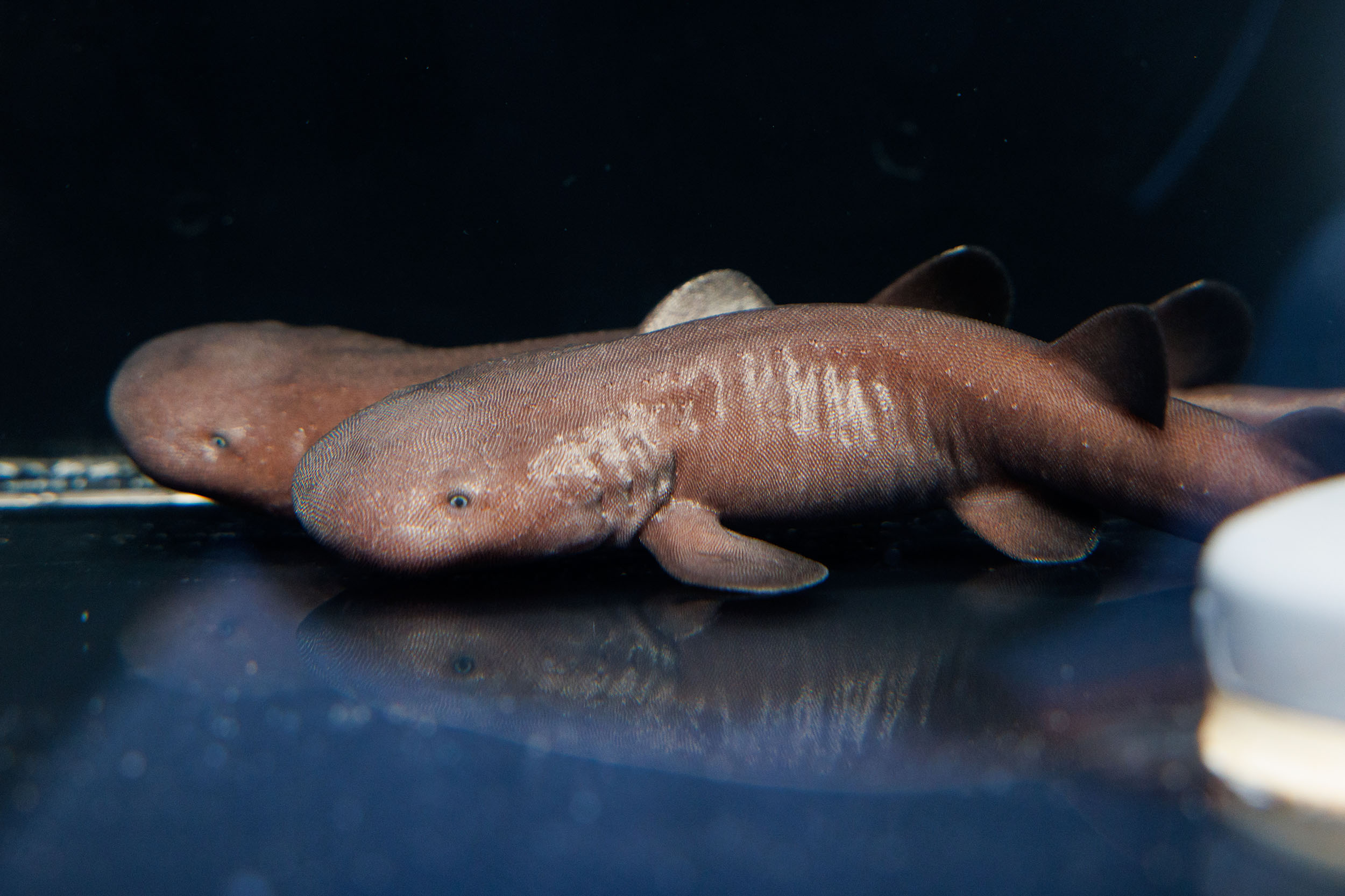
CHATTANOOGA — The Tennessee Aquarium reached a significant milestone just in time for Shark Week with the recent hatching of three critically endangered short-tail nurse shark pups.
The diminutive youngsters, which hatched July 7, are the product of three adult short-tail nurse sharks — one male and two females — which arrived at the aquarium along with eight juveniles and eight fertilized eggs from a facility in Canada last year.
MOTHER EARTH — Scarcity of food, lack of safety nets and paucity of solidarity lead to famine. 12-minute video raises awareness of how global crises combine with intricate national and international issues to precipitate local predicament.
 The Midwest U.S. is seen in this image taken at night from the International Space Station. It's a good representation of the challenges presented by light pollution in the Southern Appalachians and beyond. NASA
Light pollution is disrupting the seasonal rhythms of plants and trees, lengthening pollen season in US cities
This story was originally published by The Conversation. Yuyu Zhou is an associate professor of environmental science at Iowa State University.
City lights that blaze all night are profoundly disrupting urban plants’ phenology — shifting when their buds open in the spring and when their leaves change colors and drop in the fall. New research I coauthored shows how nighttime lights are lengthening the growing season in cities, which can affect everything from allergies to local economies.
(Hellbender Press has covered light pollution, such as this great article from Rick Vaughan).
In our study, my colleagues and I analyzed trees and shrubs at about 3,000 sites in U.S. cities to see how they responded under different lighting conditions over a five-year period. Plants use the natural day-night cycle as a signal of seasonal change along with temperature.
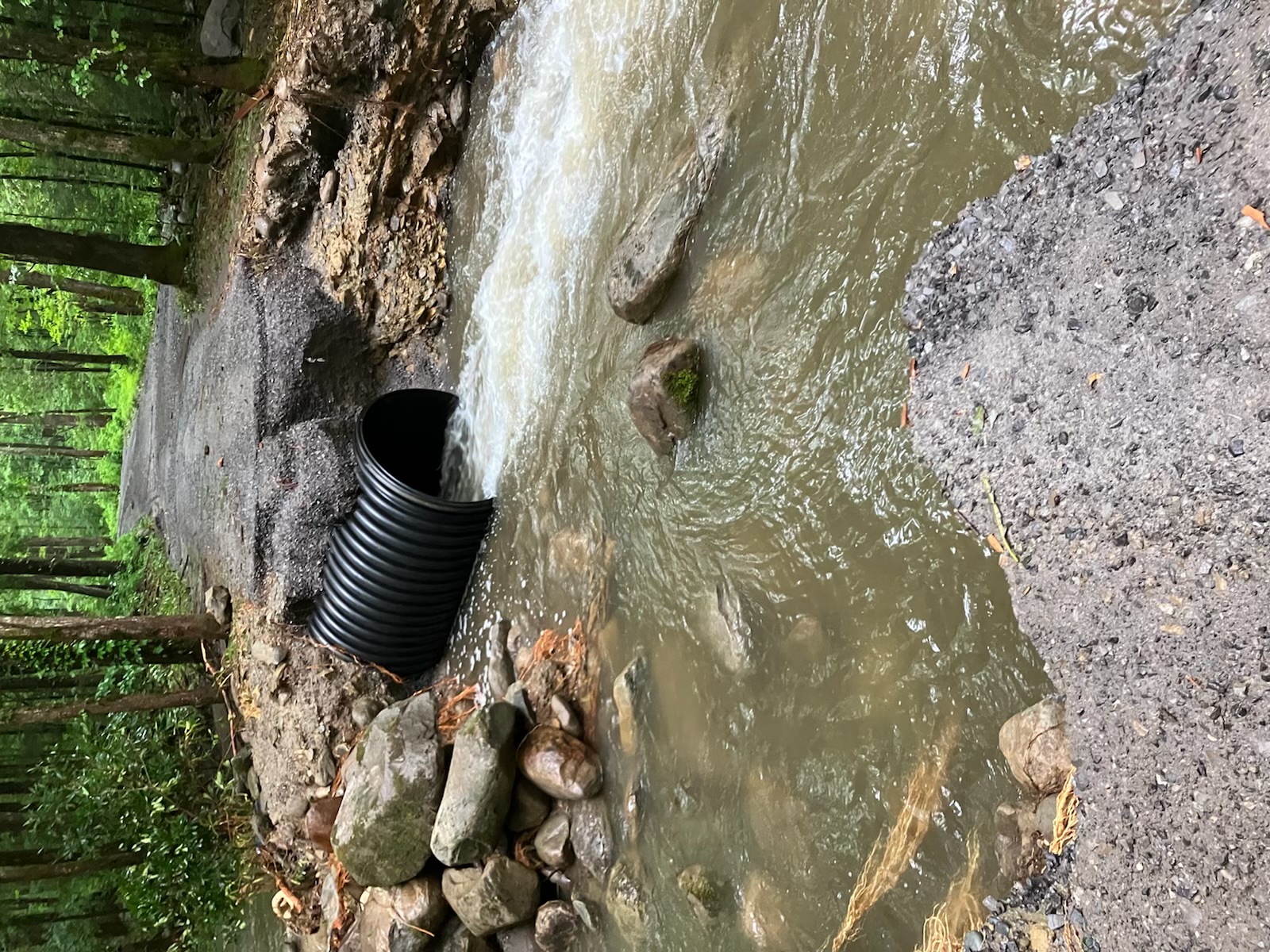 A washout is seen along Porters Creek Road in Great Smoky Mountains National Park following torrential rain on July 12. National Park Service
Flooding causes Smokies damage, prompts water advisory for Sevierville
SEVIERVILLE — Extremely heavy rain on July 12 in the Smoky Mountains caused a cascade of problems now just coming to light.
Sevierville and Sevier County issued a boil-water advisory early Thursday after debris flushed by Tuesday’s floodwaters clogged the city water utility’s main intake on the French Broad River, leading to pressure decreases that opened up lines to possible outside contamination.
In Great Smoky Mountains National Park, Greenbrier campground was closed indefinitely after the swollen Middle Prong of the Little Pigeon River wiped out roads, trails and bridges in the area.
U.S. Supreme Court’s recent clean-air ruling renews spotlight on fossil-energy producers like TVA
Written by Anita Wadhwani
Supreme Court air-pollution ruling calls into stark context all that must be done
This story was originally published by Tennessee Lookout.
KNOXVILLE — The U.S. Supreme Court’s ruling limiting the power of the Environmental Protection Agency to regulate carbon emissions that cause climate change has renewed the spotlight on the Tennessee Valley Authority, the nation’s largest public utility and Tennessee’s primary source of electricity.
The case involved EPA efforts to implement a key provision of the Clean Air Act in a challenge brought by 15 Republican-led states. That provision, which never went into effect, would have required existing power plants to shift from dirty sources of energy — such as coal — to cleaner sources, including solar and wind, as part of an urgent effort to reduce global warming.
Falcons in flight: Gatlinburg couple earns top conservation honors from Tennessee Wildlife Federation
Written by Deborah Sosower![Worsham Conservationist of the Year1]() Arrowmont supporters Margit and Earl Worsham named Conservationists of the Year by Tennessee Wildlife Federation
Arrowmont supporters Margit and Earl Worsham named Conservationists of the Year by Tennessee Wildlife Federation

This story was provided by Arrowmont School of Arts and Crafts.
GATLINBURG — Margit and Earl Worsham stood in front of family, friends, and fellow conservationists on stage in Nashville this spring and were presented with a unique award of mahogany shaped like a peregrine falcon in flight.
They were named the Tennessee Wildlife Federation’s 2022 Conservationists of the Year at the federation’s 57th Annual Conservation Awards in May.
It’s a prestigious honor presented to nominees considered to have the most significant contribution to the cause of natural resources conservation in Tennessee.
HuffPost: More than 50 House Republicans want to repeal a century-old excise tax that bankrolls wildlife conservation
In the latest “gun rights” lash-out from the GOP, legislation has been filed to abolish firearms taxes levied on gunmakers that fund wildlife conservation.
The Republican legislation is framed as a way to defend gun purchasers from odious taxation under the 2nd Amendment umbrella, but leading hunting and fishing interests said the proposal is misguided and misses the target by a wide mark.
The levy as currently written applies to gunmakers, not individual firearms purchasers.
The GOP target is the Pittman-Robertson Act, which “helped confront decades of overhunting and habitat loss by creating a financial link between hunting and conservation,” according to HuffPost.
“This year, the Interior Department will distribute a record $1.5 billion to state wildlife agencies through the Pittman-Robertson Act and its fisheries equivalent, the Dingell-Johnson Sport Fish Restoration Act. To date, the programs have divvied up a combined $25.5 billion for conservation and outdoor recreation projects,” according to reporting from HuffPo reporter Chris D’Angelo.
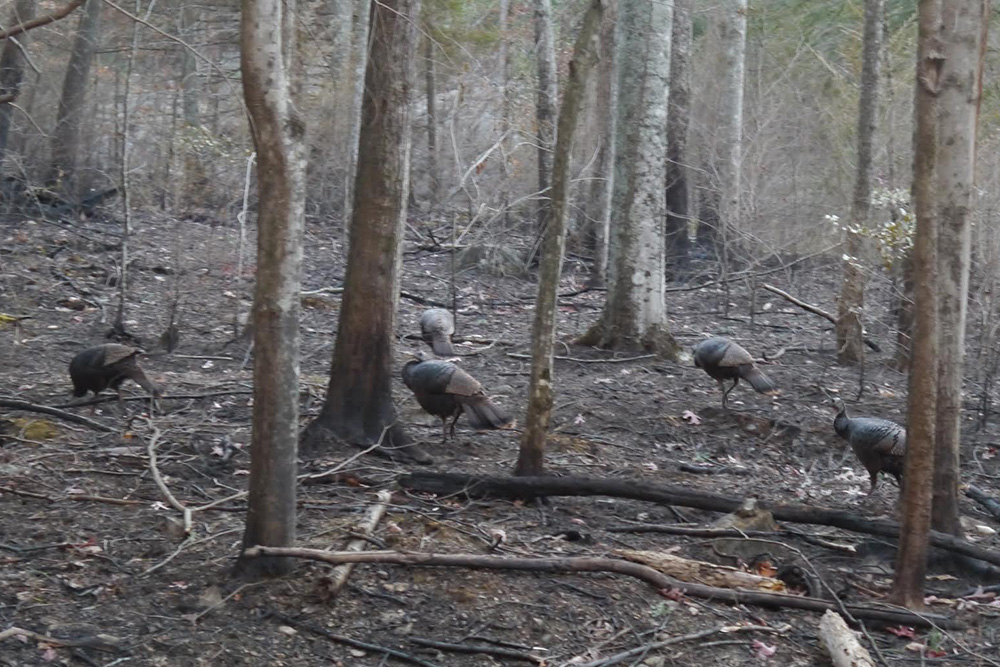 Wild turkeys forage in charred hardwood forest soon after the 2016 Gatlinburg fires, which moved from the Smokies to developed areas in Sevier County. An ORNL model predicts wildfire threats will increase in the Southern Appalachians because of climate change. Thomas Fraser/Hellbender Press via Knoxville Mercury
ORNL report: Local wildfire danger will likely loom larger because of climate change
OAK RIDGE — This cruel summer, the Southern Appalachian region is already baking in above-normal temperatures and basking in poor air quality.
Air temperatures in Knoxville flirted with 100 degrees on July 6, which were well above average and prompted the National Weather Service to issue a heat advisory for much of the metropolitan area.
It’s hard to definitively link a heat wave to global warming, but one oft-cited consequence of climate change is the growing intensity of wildfires, even in the traditionally moisture-rich Appalachians. The range of climate change effects is difficult to pin down, but one constant in the study of climate change is an expected increase in overall temperatures, which can power wildfires via both fuel increases and volatility.
- oak ridge national laboratory
- wildfire
- wildfire risk
- climate change wildfire
- jaifu mao
- thanksgiving fire of 2016
- sevier county wildfire
- wears valley wildfire
- brush clearing for wildfire
- smokies wildfire mitigation
- smokies fire
- computational earth model system
- peter thornton
- southern appalachian bioregion
- southern appalachian climate change
- southeast wildfire risk
- heat wave
- global warming
- earth system model
- wildfire carbon emission
- ornl
 Jim Hill Fellow for Conservation Breelyn Bigbee holds a viewing window with a logperch in Long Swamp Creek while conducting fieldwork in search of bridled darters near Jasper, Georgia. Tennessee Aquarium
Tennessee Aquarium fellowships bring minorities into the science space
CHATTANOOGA — Never let it be said that all summer jobs are created equal.
Squatting on his heels to dangle the flexible hose of an environmental DNA pump into a briskly flowing North Georgia stream, the last few weeks have been anything but ordinary for Spencer Trimpe. With the pump’s droning motor steadily collecting a sample of water to filter out genetic traces of the stream’s inhabitants, he doesn’t bother holding back a smile.
A lanky junior biology major from Thomas More University, Trimpe is one of two students selected as part of the Tennessee Aquarium’s George Benz Aquatic Ecology Fellowship. Instead of manning a cash register or waiting tables this summer, he’s assisting freshwater scientists from the Tennessee Aquarium Conservation Institute with a variety of research projects.

2021 economic numbers prove small parks have big impacts
ONEIDA — Both the Obed National Wild and Scenic River and Big South Fork National River and Recreation Area offer wilderness options free of the hassles associated with Great Smoky Mountains National Park, the most visited national park in the country.
The Cumberland Plateau-area destinations continue to grow in popularity as more tourists seek solace in nature, a trend that began during the Covid-19 pandemic.
Those tourists also spend millions of dollars in nearby rural communities, some of which face chronic economic challenges.
More...
Rare bipartisan legal effort under way for widespread wildlife protections
NYT: Recovering America’s Wildlife Act a big bipartisan push to preserve animal species
New York Times columnist Margaret Renkl noted recently that a precious opportunity has presented itself to strengthen wildlife-protection laws and add to environmental protections across the nation.
The Nashville-based journalist said the act, known as RAWA, “is poised to become the single most effective tool in combating biodiversity loss since the Endangered Species Act.” The resolution is carried in the House by Michigan Democrat Rep. Debbie Dingell.
“This bill provides funding for (1) the conservation or restoration of wildlife and plant species of greatest conservation need; (2) the wildlife conservation strategies of states, territories, or the District of Columbia; and (3) wildlife conservation education and recreation projects,” according to the U.S. Congress.
“The Department of the Interior must use a portion of the funding for a grant program. The grants must be used for innovative recovery efforts for species of greatest conservation need, species listed as endangered or threatened species, or the habitats of such species.
“In addition, the bill requires certain revenues generated from fees and penalties for violations of environmental requirements to be used as a source for the funding.”
The legislation, which has already passed the House of Representatives, would allocate $1.4 billion each year across the country to protect and restore endangered plant and animal populations, and protect species already tipping toward endangered status. It is up for consideration in the Senate, where it has already garnered the support of at least a dozen Republicans and a majority of Democrats, virtually ensuring its passage, according to Renkl.
“You don’t have to nurse a fondness for spotted owls or snail darters — creatures at the heart of two of the most contentious environmental debates in recent history — to understand that what is best for the ecosystems we share with nonhuman animals is what’s best for us, too,” Renkl wrote.
Georgia’s Ocmulgee River is a case study in the decline of Southern river fisheries, and their revival
Ethan Hatchett is a writer for the Georgia Department of Natural Resources.
MACON — The Ocmulgee River has changed. The cloudy water once ran clear. The sandy bottom was once rocky. Fish swam upriver to breed from places as distant as the Altamaha River, which the Ocmulgee and Oconee rivers join to form near Lumber City and the Atlantic Ocean.
European settlement changed the river. Centuries of agriculture and development stripped away much of the land’s vegetation that filtered the flow, causing the Ocmulgee to fill with sediment. The soil particles gradually moved through the waterway, covering gravel that fish spawned in, smothering fishes’ eggs, mucking up the water and even building up on the banks, saturating the ground with sediment.
It is impossible to know how many freshwater fish the Ocmulgee lost since the first Europeans arrived. Many species disappeared without being discovered. Yet on a clear afternoon in May, DNR aquatics biologist Paula Marcinek led a team on the upper Ocmulgee in search of robust redhorse, a “lost” fish found in 1991.
Read DNR’s blog post about efforts to restore the robust redhorse, plus news of a new grant that will expand the work and rare video of these fish spawning.
SACE released its annual utility decarbonization tracking report, and it’s not pretty
Written by Heather Pohnan and Maggie Shober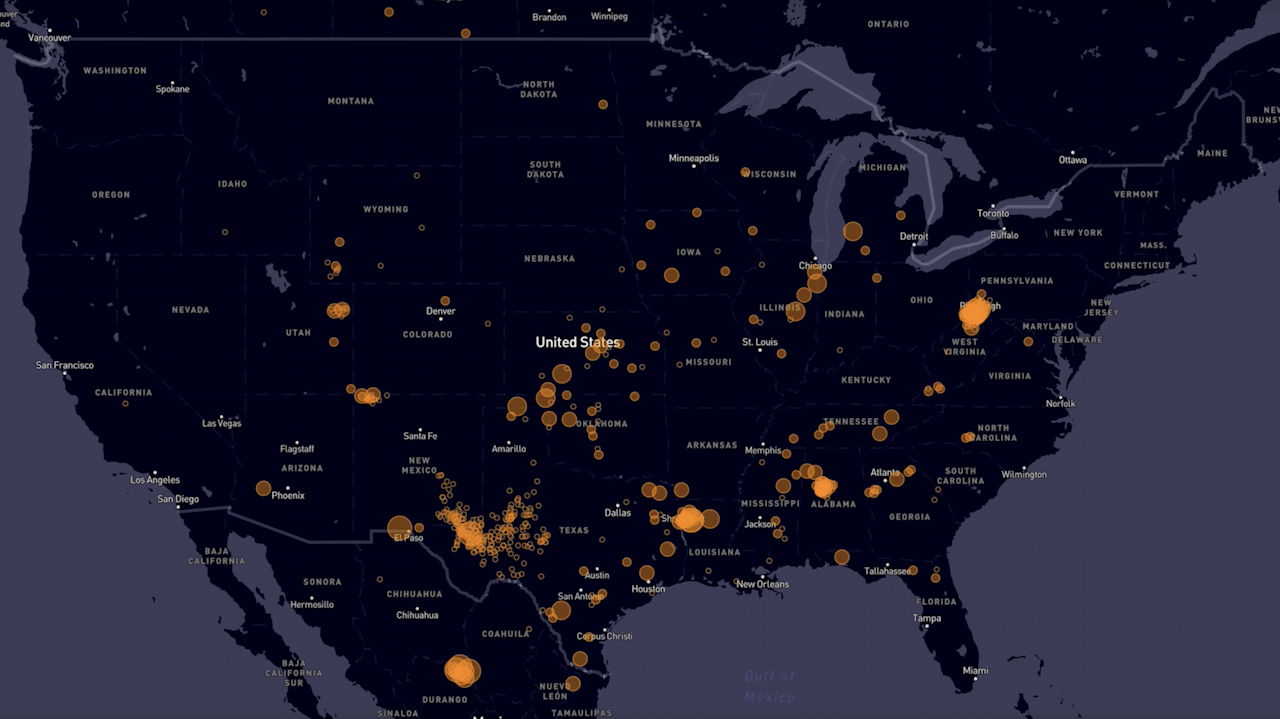 Bloomberg reports that methane leaks from the natural gas sector may be far worse than estimated by the EPA. While replacing coal-fired power plants with natural gas ones reduces air pollution it may not help at all with climate change because methane is 30 times more effective as a greenhouse gas than CO2. Image source: Kayrros SAS
Report: Many utilities are not reducing carbon emissions despite public assurances to the contrary
KNOXVILLE — Global greenhouse gas emissions must peak by 2025 and experience rapid and deep reductions to avoid a potentially catastrophic future, according to a new analysis by air-quality and climate advocates. Emissions must reach net zero by the early 2050s to limit warming to 1.5 degrees (C) in order to avoid the worst impacts of the climate crisis.
Many utilities and municipalities have acknowledged this dynamic, but the Southern Alliance for Clean Energy s fourth annual “Tracking Decarbonization in the Southeast" report highlights that current utility resource plans are not in line with this overarching target. Obstacles to getting utilities on track that are discussed in our report include: increasing reliance on fossil gas, underutilizing energy efficiency, and placing limitations on popular technologies such as rooftop solar. There’s still a lot of work to do before any Southeast utility is on track to decarbonize.
The South’s hidden climate threat
Written by Dan Chapman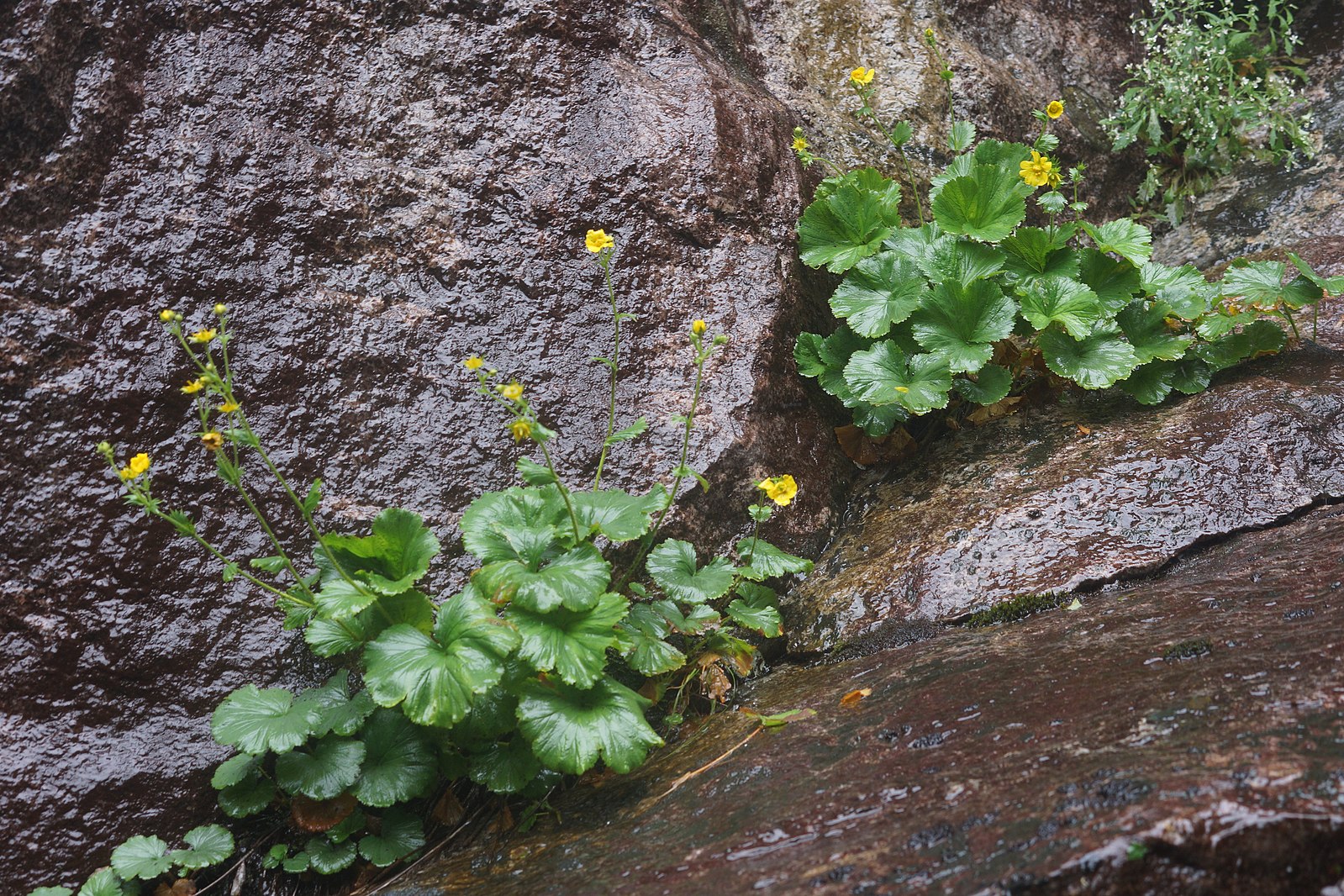 Spreading avens are seen in bloom in the Appalachians. The endangered long-stemmed perennials survive in higher mountain elevations but their lack of space to move higher in elevation in times of climate change and warming further threaten the plant. USFWS
It’s not just the coastlines that are recording climate change. Even the mountains of North Carolina are feeling the heat — including some endangered plants
“Atlanta reporter Dan Chapman retraced John Muir’s 1867 trek through the South, including the naturalist’s troubling legacy, to reveal environmental damage and loss that’s been largely overlooked.” This is an excerpt published by The Revelator from his book, A Road Running Southward: Following John Muir’s Journey Through an Endangered Land.
BOONE — It’s a wonder anything survives the ice, snow, and winds that pummel the ridge, let alone the delicate-seeming yellow flowers known as spreading avens.
The lovely, long-stemmed perennials are exceedingly rare, officially listed as endangered, and found only in the intemperate highlands of North Carolina and Tennessee. They sprout from shallow acidic soils underlying craggy rock faces and grassy heath balds. At times blasted with full sun, but mostly shrouded in mist, the avens are survivors, Ice Age throwbacks that refuse to die. Geum radiatum is only known to exist in fourteen places, including hard-to-find alpine redoubts reached via deer trail or brambly bushwhacking.