
News (340)
Updated: Knox County Commission greenlights Dry Hollow housing, with changes
Written by Thomas FraserOpposition still stands against Dry Hollow housing proposal on Knox commish agenda
KNOXVILLE — Compass reported that Knox County Commission voted 8-3 Monday night to approve a new housing development in South Knox County, “despite fierce opposition from surrounding residents.
“Local residents haven’t stopped a development, but they forced some changes,” Compass reported.
“But the conditions imposed by Commission limit the subdivision in the Dry Hollow area to 180 homes on the flattest, most developable part of the property — down from 255 that the Knoxville-Knox County Planning Commission had approved.”
Court finds TVA contractor potentially liable for Kingston coal-ash cleanup injuries and deaths
Written by Jamie Satterfield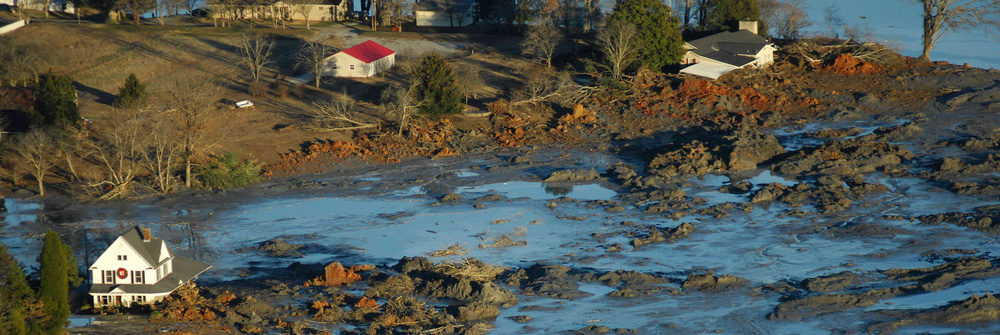 On Dec. 23, 2008, a massive dam at the Kingston coal-fired power plant in Harriman, Tenn., ruptured and spilled 1.1 billion gallons of coal ash into the Clinch and Emory rivers. Appalachian Voices teamed up with Southwings to take pictures from the air and launched two separate missions by water to test the river and fish for pollutants as a result of the spill. Appalachian Voices
Contractor that cleaned up infamous TVA ash spill not immune from responsibility for alleged unsafe worksite
This story was originally published by Tennessee Lookout.
CINCINNATI — A federal appellate court last week struck down a last-ditch appeal by a Tennessee Valley Authority contractor accused in the mass poisoning by radioactive coal ash waste of the utility’s Kingston disaster workforce.
The 6th Circuit U.S. Court of Appeals ruled Jacobs Engineering Inc. cannot ride the coattails of TVA governmental immunity because TVA itself would not have been immune from liability had sickened workers chosen to sue the utility.
Dry Hollow rezoning: Trade historic cultural landscape for a crammed subdivision? Expanded and updated again May 21.
Written by Wolf Naegeli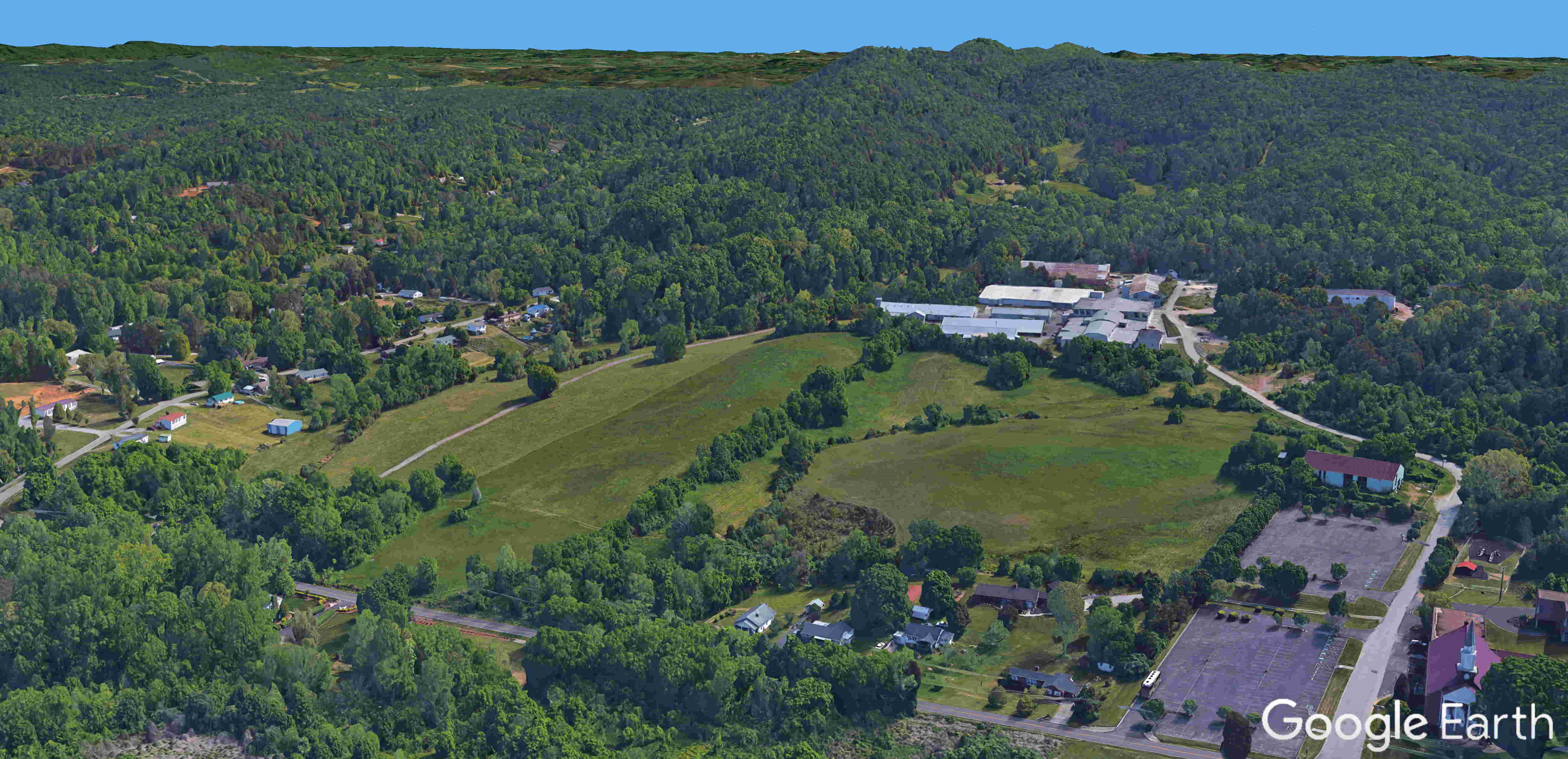 Dry Hollow before the bulldozers devastated it. This rural area is zoned agricultural except for the old commercial/light industrial cluster and the church area at right. The barn at the end of the church parking lot and the trees in the project area are already gone! The trees can grow back over time if Knox county commissioners make a wise decision. Synthetic virtual oblique aerial view generated by Atelier N / Hellbender Press
More and much improved picture galleries
May 20: included new “Six on Your Side” report from WATE TV Channel 6 News
Massive residential development planned without regard for beautiful farmland, historic context and rich wildlife habitat — what’s at stake?
SOUTH KNOX COUNTY — When you drive out of Knoxville on Chapman Highway toward Seymour and Sevierville, you see little more than ugly strip development. That bleakness is interrupted only when passing through narrow gaps in the ridges, which tend to focus your view even more on the heavy traffic. No notable pleasant vista until just before the county boundary at Shooks Gap! If you look to your left, across the slope of Berry Highland South Cemetery, you get a brief glimpse of Dry Hollow.
That is the only view I remember from my first drive on Chapman Highway after moving to East Tennessee in 1985. Then, we did not yet have so much urban sprawl that one hardly gets a feeling of having left Knoxville before crossing into Sevier County and momentarily passing through a corner of Blount County.
- dry hollow
- shooks gap
- thunder mountain properties llc
- loveday springs
- camel manufacturing
- benjamin a bower
- knoxville knox county planning commission
- south knox county
- sevierville pike
- stage coach relay
- knoxville sevierville stage coach
- knox county commission
- knoxville, sevierville & eastern road
- smoky mountain railroad
- the old slow and easy
- hines creek
- fastest stage coach in the nation
- knoxville to sevierville mail hack
- endangered bat
- bat cave
- bat habitat
Ancient river, new threats: Water quality officials declare 19 miles of French Broad River in NC impaired by pollutants
Written by Jason Sandford Recreational uses of the French Broad River in Asheville, including tubing, kayaking and canoeing, have grown dramatically in recent years. Jason Sandford/Ashevegas Hot Sheet
Booming construction and development, combined with more frequent heavy rains and an aging stormwater system, continue to threaten the age-old Appalachian river
This story was originally published by Jason Sandford of the Ashevegas Hot Sheet.
ASHEVILLE — North Carolina water quality officials declared a 19-mile section of the French Broad River in Buncombe County as officially “impaired” because of fecal coliform levels found during recent testing. It’s a sobering alarm bell (though there have been plenty of warning signs, as you’ll see below.) In Asheville, interest in the river as an economic force and tourist destination has never been higher. (The confluence of the French Broad and Holston rivers forms the Tennessee River above Knoxville.)
The designation will come as no surprise to even casual observers of the wide, northward-flowing river. Often, it runs a chocolate brown color, a clear sign of the sediment and other pollutants running through the waterway.
- french broad river
- ashevegas
- jason sandford
- asheville environment
- is french broad river clean
- tubing in asheville
- fecal coliform french broad
- is french broad part of tennessee river
- what direction does the french broad flow
- kayaking on french broad
- hot springs environment
- french broad sedimentation
- french broad impaired river
- is french broad river polluted?
- what forms the tennessee river
- french broad river asheville
- river health
- threats to french broad river
Opponents of Oak Ridge waste dump, citing comms breakdown, urge extension of public comment period
Written by Thomas Fraser Image from a 2018 memorandum authored by experts including former Department of Energy employees in Oak Ridge. EMWMF is the present landfill that has a history of failures and is reaching capacity. Ecologists say, after a decade DOE still is not adequately addressing waste acceptance criteria and feasible alternatives.
Public can comment in person Tuesday night in Oak Ridge on proposed DOE waste dump
OAK RIDGE — The Southern Environmental Law Center blistered the Department of Energy in a letter ahead of a May 17 hearing on construction of a toxic-waste landfill that opponents said poses contamination threats to portions of the Clinch River watershed and downstream TVA reservoirs.
The hearing is set for 6-8 p.m. Tuesday, May 17 at the Pollard Technology Conference Center, 210 Badger Ave. This email address is being protected from spambots. You need JavaScript enabled to view it. will be accepted through June 7.
The Department of Energy wants to bury contaminated debris from demolition of Manhattan Project-era complexes and associated legacy toxins from the Oak Ridge Reservation. The drawn-out debate about how best to safely store the materials now focuses on the transparency of the decision process and the health of the Bear Creek watershed and downstream pollution threats to the Clinch River.
- doe
- doe waste dump
- does oak ridge have nuclear waste
- oak ridge landfill
- oak ridge
- bear creek valley
- oak ridge reservation
- radioactive waste
- hazardous waste
- advocates for the oak ridge reservation
- southern environmental law center
- selc
- aforr
- clinch river
- tva reservoir
- soggy bottom
- environmental quality advisory board
- eqab
- public participation
- public meeting
- environmental management disposal facility
- emdf
Hellbender Press nets two top awards from Society of Professional Journalists
KNOXVILLE — Hellbender Press took home two awards from the 2021 Golden Press Card contest sponsored by the East Tennessee Society of Professional Journalists.
Hellbender Press was recognized with two first-place awards for East Tennessee digital journalism: The Hal DeSelm Papers and Requiem for the Lord God Bird.
The Hal DeSelm story chronicled his decades-long effort to document terrestrial biomes in all but one Tennessee county, and subsequent work by the University of Tennessee to craft his datasets into an accessible database.
The other award was for reporting on the extinction of the ivory-billed woodpecker relying heavily on the work of Ijams Nature Center naturalist Stephen Lyn Bales.
Judging was conducted by the SPJ chapter in Cincinnati.
“We are incredibly grateful to our editorial board, readers and others who helped with this great win,” said Hellbender Press editor Thomas Fraser. “Our stories are only as good as the sources.”
 Erich Henry and Julia Konkel of the Blount County Soil Conservation District pose by a recent project. Blount County Soil Conservation District
Erich Henry and Julia Konkel anchor East Tennessee soil
MARYVILLE — The Dust Bowl was a time of extreme drought in the Southern Plains in the 1930s. The dry topsoil whipped by winds created the infamous “bowl of dust.” It polluted the air and made it nearly impossible to grow crops or maintain livestock.
East Tennessee gets more rain than the Southern Plains but regional farmers to this day unknowingly use bad agricultural practices.
Blount County Soil Conservation District’s Director Erich Henry doesn’t want history to repeat itself.
Smokies rangers, swift-water teams retrieve body from Little River near Metcalf
TOWNSEND — Great Smoky Mountains National Park rangers responded to a report of a body in Little River about a mile west of Metcalf Bottoms at 1:30 p.m. May 9. Rangers and Gatlinburg EMS/Fire discovered the body of Charles Queen, age 72 of Bybee, Tennessee, partially submerged in the middle of the river.
A technical swift water rescue team recovered the body, which was released to the Sevier County Medical Examiner’s office. A vehicle registered to Queen was found in a pullout 600 feet upriver along a steep embankment.
No witnesses were immediately found; there are no signs of foul play, according to the park service, but officials plan an autopsy.
TDOT wants your input on electric-vehicle infrastructure
 Proposed electric-vehicle infrastructure corridors in Tennessee. TDOT
Inside of Knoxville: State seeks input on charging stations, EV corridors
(Update: The survey has now ended.) The Tennessee Department of Transportation’s traveling and electrifying road show made an appearance in Knoxville this week. The intent of the meeting, as others scheduled around the state, was to collect public feedback on proposed charging station networks and other components of EV infrastructure.
Tennessee will receive a significant chunk of change toward developing its own share of National Electric Vehicle Infrastructure, provided as part of the infrastructure bill passed by Congress last year. The state will receive $88 million over five years, and has begun drafting some options.
“The initial push nationally is for travel corridors to have charging stations at least every fifty miles,” according to Knoxville blogger Alan Sims. “They must have at least four chargers and they must be within one mile of the travel corridor. Most travel corridors are identified as Interstates, though Tennessee, for example, has also included U.S. Highway 64. Once those corridors are built out, any remaining funds may be directed elsewhere. The cost of each station is approximately $1 million, which is largely infrastructure cost.”
 The Chornobyl Nuclear Plant in Ukraine is seen in 1986 after a fire devastated the plant and led to radiation emissions that spread across the European continent. United Nations
36 years after the Chornobyl crisis, Ukraine presents a test for nuclear reactor survivability
This story was originally published in The Revelator.
CHORNOBYL, UKRAINE — It took less than a minute after an unexpected power surge for one of the nuclear reactors at Chornobyl (Chernobyl in the Russian spelling) to explode on April 26, 1986, ripping the roof off and spewing dangerous toxins into the air.
The event, and emergency cleanup that followed, left 30 workers dead, thousands exposed to cancer-causing nuclear material and later death, and a legacy of radiation. Now, 36 years later and with war raging, Ukraine is desperate to prevent another nuclear disaster.
Nuclear reactors generate more than half of the country’s power. Ukraine is the first country with such a large and established nuclear energy program to experience war, according to the International Atomic Energy Agency.
More...
UT journalism stalwart James Crook dies at 82

KNOXVILLE — Dr. James Crook, the former director of the University of Tennessee School of Journalism and Electronic Media, died April 30 in Knoxville. Dr. Crook led the School of Journalism for 28 years before retiring in 2002 and becoming professor emeritus. He also served as a president of the East Tennessee Pro Chapter of the Society of Professional Journalists.
Crook died at the age of 82, just two days short of his 83rd birthday.
He was considered the “father” of the Front Page Follies, an annual satiric send-up of Knoxville’s newsmakers that raised funds for the Front Page Foundation. Dr. Crook, a co-founder of the Follies, was an excellent vocalist and served as musical director for a number of years. His wife, Diane, an experienced theater person and teacher, teamed with her husband during the productions. The couple met while they were teaching journalism, speech and drama in Iowa in high school and community college and married in 1966.
During his teaching career, he established the national scholarly journal, Journalism & Mass Communication Educator. In 2003, the Association for Education in Journalism and Mass Communication awarded Crook the Eleanor Blum Distinguished Service to Research Award, which recognizes individuals who have devoted their careers to promoting research in mass communication, according to the UT School of Journalism and Electronic Media.
A Celebration of Life will be held Saturday, May 7, at 11 a.m. at Church Street United Methodist Church, 900 Henley St., in downtown Knoxville. In lieu of flowers, donations may be made to the Front Page Foundation to fund journalism scholarships
— East Tennessee Society of Professional Journalists
Sam Adams raises trees like healthy children at the University of Tennessee
Written by Keenan Thomas University of Tennessee arborist Sam Adams stands in front of a blooming dogwood on the campus of UTK. Keenan Thomas/Hellbender Press
First campus arborist continues climb up Utree Knoxville
KNOXVILLE — Students at the University of Tennessee walk by hundreds of trees every day without thinking about them.
Sam Adams was thinking about them even before he became UT’s first arborist.
Adams, 58, has cared for trees in the field of arboriculture for decades. He’s worked privately and publicly, including as arborist supervisor for Sarasota County, Florida. He graduated with a degree in environmental studies at Warren Wilson College in North Carolina, where he initially pursued a degree in English.
- ut arborist
- ut tree
- sam adams utk
- jim cortese
- trees knoxville
- University of Tennessee
- university of tennessee knoxville
- sam adams
- jack neely
- knoxville history project
- knoxville history
- cortese tree
- keenan thomas
- ut journalism school
- hellbender press ut
- knoxville persimmon
- trees in knoxville
- utk history
- civil war knoxville
- the hill ut
- tree care
- what does an arborist do?
- clearing trees at utk
 Tennessee Aquarium Director of Hospitality and Marketing Meredith Roberts and her daughter Lucy release a juvenile lake sturgeon during an Earth Day event on the Chattanooga riverfront. Tennessee Aquarium
Tennessee Aquarium releases endangered sturgeon on a fin and a prayer
CHATTANOOGA — Lake sturgeon are living fossils.
They are dinosaur fish. They have no scales. They are protected by a tough skin with boney plates, and are unchanged for millennia. They are part of a widespread related group of fish, with 23 species worldwide, and are an endangered species in Tennessee.
Tennessee Aquarium staff released some of these dinosaurs into the Tennessee River here on Earth Day, observed this year on April 22. Aquarium staff were joined by 30 students from Calvin Donaldson Elementary School and the public to release 65 juvenile lake sturgeon into the Tennessee River at Chattanooga’s Coolidge Park.